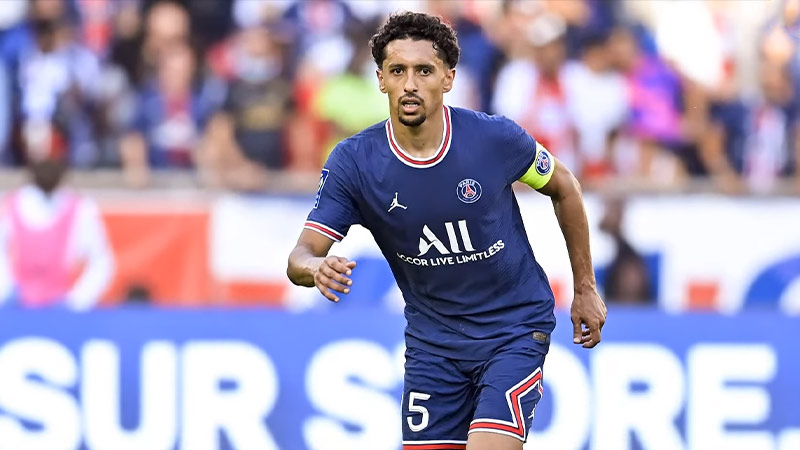
In the world of international football, few names carry as much weight and versatility as “Marquinhos.”
Whether you are a tactical analyst, a casual fan watching the Champions League, or a dedicated FIFA/EAFC gamer looking to optimize your Ultimate Team, understanding a player’s technical profile is crucial.
One of the most frequently asked questions regarding the Brazilian stars who share this name is: Is Marquinhos left-footed?
Despite the common confusion that often arises due to the technical proficiency and positioning of these players, the data provides a clear answer.
This article delves deep into the profiles of the most prominent Brazilian players, named Marquinhos, to settle the debate once and for all.
The PSG Captain: Marcos Aoás Corrêa’s Dominant Foot
When most fans think of “Marquinhos,” they immediately picture the stalwart defender and long-time captain of Paris Saint-Germain (PSG). Marcos Aoás Corrêa, born in 1994, has established himself as one of the premier center-backs in global football.
To answer the burning question: No, the famous PSG captain and Brazilian defender Marquinhos is right-footed.
Why the Confusion Exists
It is not uncommon for fans to wonder if he favors his left foot. This confusion typically stems from his exceptional tactical versatility.
In modern football, top-tier center-backs are often required to play on the left side of a defensive pairing (the LCB position) to facilitate ball progression.
Marquinhos has frequently occupied this space for both PSG and the Brazilian national team, showing such comfort in passing and tackling with his non-dominant foot that he appears almost ambidextrous.
However, his primary strength and “natural” side for distribution remains his right foot. His ability to launch long-range diagonal balls and maintain high passing accuracy is a testament to his technical training, rather than a natural left-footed orientation.
The Spartak Moscow Forward: José Marcos Costa Martins
As is common in Brazilian football culture, the name “Marquinhos” is shared by several high-level professionals. The second most searched profile is often the younger forward currently making waves in the Russian Premier League.
José Marcos Costa Martins, born in 1999 and currently playing for Spartak Moscow, is an attacking talent who often operates on the wings.
In football, many wingers are “inverted,” meaning a left-footed player plays on the right wing to cut inside and shoot. This led many to assume that this Marquinhos might be left-footed.
The Attacker’s Profile
Playing as a forward at Spartak Moscow, this Marquinhos utilizes his right foot for both clinical finishing and creative playmaking. While he is capable of using his left foot to provide crosses or maintain balance in dribbling, his dominant side is unequivocally his right.
The “Marquinhos” Name: A Legacy of Right-Footed Talent
It is a fascinating coincidence that the two most prominent Brazilian “Marquinhos” profiles currently active in top-flight European football both share the same dominant foot.
Whether you are looking at the defensive anchor in Paris or the offensive threat in Moscow, you are looking at right-footed players.
Key Technical Takeaways:
- Marcos Aoás Corrêa (PSG): Right-Footed Defender.
- José Marcos Costa Martins (Spartak Moscow): Right-Footed Forward.
Why Dominant Foot Data Matters
In the digital age, the “search intent” behind a player’s dominant foot is often driven by the gaming community. In titles like EA Sports FC (formerly FIFA), a player’s “Weak Foot” rating and their dominant side determine their effectiveness in certain positions.
For example, a right-footed center-back like the PSG captain is often preferred on the right side of the defense to ensure that their clearance angles and passing lanes are optimal.
For the Spartak Moscow forward, being right-footed means that when playing on the left wing, he acts as an inverted winger, a highly sought-after archetype for players who like to cut inside and take shots on goal.
Conclusion: Settling the Debate
To summarize the findings based on official records and player profiles: Marquinhos is not left-footed.
Both the legendary PSG defender, born in 1994, and the Spartak Moscow forward, born in 1999, are right-footed players. This clarity helps fans better understand the tactical decisions made by their respective coaches and allows gamers to make more informed decisions when building their squads.
The next time you see a “Marquinhos” pull off a stunning cross-field pass or a pinpoint tackle, remember that while they may be comfortable with both feet, their right foot is the foundation of their world-class skill set.
Would you like me to create a tailored report detailing the career achievements and trophy counts of these two players?