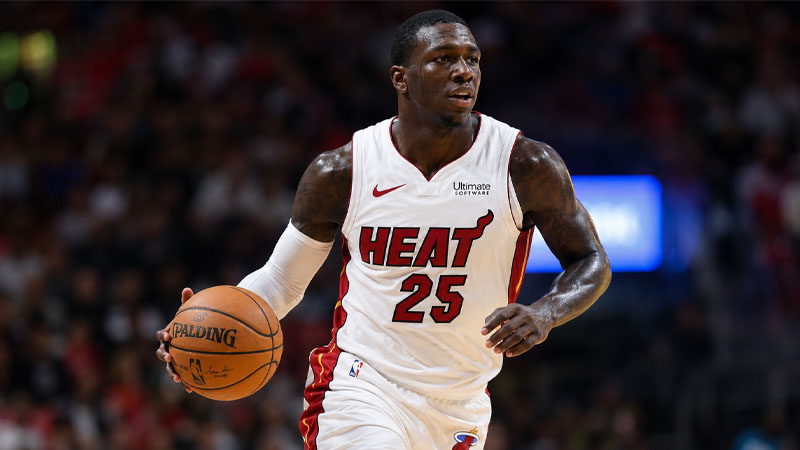
Kendrick Nunn is widely categorized as an average to below-average defender, balancing a high-effort motor against significant physical limitations.
While he is an elite offensive engine, his defensive role is defined by tactical survival rather than lockdown capabilities. His effectiveness stems from explosive lateral quickness and tenacious on-ball pressure, allowing him to disrupt ball handlers.
However, his 6-foot-2 frame and struggles with screen navigation often make him a target for opposing offenses. Ultimately, Nunn is not a defensive stopper, but a high-IQ player who can succeed within a structured team scheme alongside elite defensive anchors.
Statistical Breakdown of Nunn’s Defensive Performance
Evaluating a player’s defensive merit requires a deep dive into both traditional box scores and advanced analytics.
For a player like Kendrick Nunn, the numbers tell a story of a guard who performs adequately within a system but lacks the individual metrics of a defensive specialist.
His career has been marked by a transition from the high-paced NBA to the tactically rigorous EuroLeague, and his defensive statistics reflect the different demands of these environments.
While his steals and rebounding suggest active engagement, his defensive ratings often point to the inherent difficulties of guarding larger, elite perimeter players.
| Competition / League | Key Defensive Metric | Statistical Value | Tactical Context |
|---|---|---|---|
| NBA Career | Defensive Rating | 113.7 | Often paired with elite anchors |
| NBA Career | Steals Per Game | 0.7 | Focus on active perimeter positioning |
| EuroLeague | Defensive Efficiency | ~115.2 | Solid within team schemes |
| EuroLeague | Individual DBPM | -2.3 | Indicates net-negative individual impact |
| EuroLeague | Defensive Rebounds | 2.1 – 2.4 | Tracks long rebounds effectively |
| EuroLeague | Steals Per Game | 0.8 – 1.0 | High-effort jumping of passing lanes |
The Mechanics of Nunn’s On-Ball Tenacity
Despite the statistical gaps, scouting reports frequently highlight Nunn’s “tenacious” approach to guarding the ball. This effort-based defense is what allows him to stay on the floor during high-stakes games where his scoring is desperately needed.
When he is fully locked in, particularly during late-game execution, his defensive engagement skyrockets, demonstrating that his issues are often more physical than psychological.
By examining the specific mechanics of his on-ball defense, we can see how he manages to mitigate some of the disadvantages inherent in his smaller frame.
Lateral Velocity and Point-of-Attack Coverage
Nunn possesses highly explosive lateral quickness, which is his primary weapon when guarding the point of attack. This allows him to move horizontally fast enough to cut off driving lanes against even the most lightning-fast guards in professional basketball.
Because he can mirror the movement of the ball handler, he often forces opponents into lateral retreats or difficult contested mid-range jumpers rather than allowing clean lines to the basket.
This quickness is a core component of his “plus” defensive traits, enabling him to stay in front of his matchup and maintain pressure throughout a possession.
Physicality in Navigating Ball Screens
A common criticism of offensive-minded guards is that they “give up” when encountering a screen, but Nunn has shown a consistent willingness to fight through contact.
According to film reviews, he physically struggles to slide over the top of screens to prevent ball handlers from getting uncontested pull-up opportunities.
While he has historically struggled with screen navigation—dating back to his time with the Miami Heat and the Los Angeles Lakers—his effort levels remain high.
He takes severe pride in these lockdown sequences, especially when the game is on the line, proving he is willing to do the “dirty work” required of a guard in a modern pick-and-roll-heavy offense.
Identifying the Physical and Tactical Weaknesses
To answer whether Nunn is a “good” defender, one must also confront the clear limitations that prevent him from reaching an elite tier.
Scouting reports are consistent in their assessment that Nunn’s defensive impact is often capped by his stature and the massive energy demands placed on him by his offensive role.
These factors create vulnerabilities that savvy coaching staffs and elite players often look to exploit during a game’s critical stretches. Understanding these gaps is essential for any team looking to integrate him into a championship-level defensive rotation.
Height Limitations Against Elite Perimeter Length
Standing at 6-foot-2, Nunn is inherently undersized against modern elite perimeter players who often possess significant height and reach advantages.
In both the NBA and high-level European play, bigger guards and wings frequently target him, either by posting him up or simply shooting over his outstretched arms.
This physical reality makes it difficult for him to provide effective “contest” on shots, even when his positioning is perfect.
His limited 0.2 blocks per game average is a direct reflection of this 6-foot-2 ceiling, as he lacks the verticality to challenge shots at the rim or high-release jumpers.
Mental Fatigue and Off-Ball Tracking Issues
Another significant challenge in Nunn’s defensive profile is the “scoring load tax.” Because he carries an immense burden as an offensive focal point—averaging 18.2 points per game in the EuroLeague—his focus on the defensive end can occasionally waver.
Scouts have noted that he sometimes relaxes or gets caught “lost” tracking off-ball movement, allowing his man to find open space through cuts or relocated shots.
This lapse in off-ball awareness is a common trait among high-usage stars, but for a player of Nunn’s size, these mental errors are harder to recover from because he cannot rely on length to make up for lost ground.
Tactical Synergies and Team Defensive Schemes
While Nunn may have individual defensive flaws, his ability to function within a broader team strategy is a testament to his basketball IQ and adaptability.
He is not a “stop sign” that can shut down an entire side of the court, but he is also not a player who will single-handedly sink a team’s defensive rating if the right pieces are around him.
Modern coaches have found several ways to utilize his quickness and active hands while shielding his size-related vulnerabilities.
- Utilization of Defensive Anchors: Nunn historically performs at his best when paired with elite defensive anchors, such as Bam Adebayo during his NBA tenure, who can absorb screens and switch behind him to cover for potential mismatches.
- Aggressive Trapping and Switching: He fits seamlessly into aggressive trapping schemes designed by master coaches. His speed allows him to double-team ball handlers and recover to his man quickly, leveraging his motor rather than his size.
- Disruptive Perimeter Pressure: By using his anticipation to cheat off his man slightly, he can dart into passing lanes. This has allowed him to maintain a consistent average of 0.8 to 1.0 steal per game, sparking transition opportunities.
- Effective Defensive Rebounding: For a guard of his size, he is surprisingly effective at tracking long rebounds. Securing 2.1 to 2.4 defensive boards per game helps his team close out possessions without allowing the second-chance points that often kill defensive momentum.
Comparing Defensive Impact Across Major Leagues
Nunn’s defensive reputation has evolved as he transitioned from a reliable NBA starter to an absolute superstar and EuroLeague MVP. In the NBA, where the spacing is wider and the players are often more athletic, his physical limitations were more pronounced.
However, in the more tactical and compact environment of European basketball, his quickness and tenacity have allowed him to be part of highly capable defensive units.
This transition highlights how “good” defense can often be a matter of context and scheme rather than just individual talent.
The Transition from NBA to EuroLeague Intensity
During his 193-game NBA career with the Heat, Lakers, and Wizards, Nunn maintained a defensive rating of 113.7, which was often managed by “hiding” him next to elite defenders.
In the EuroLeague, while his individual defensive box plus-minus remained a net-negative -2.3, his team defensive efficiency has been a solid 115.2.
This suggests that while he remains an individual target, the European style of play allows his high motor and active perimeter hands to be more disruptive within a collective unit, especially during Panathinaikos’ championship runs.
The Defensive Anchor Requirement
A recurring theme in Nunn’s career is the necessity of a support system. Whether in the NBA or Europe, his most successful defensive stretches occur when he is not the primary line of defense against interior scoring.
Having a rim protector who can “absorb” the players who occasionally beat Nunn off the dribble allows him to play more aggressively at the point of attack.
This synergy is what prevents him from being a total liability and instead makes him a manageable part of a championship-level defense.
Comprehensive FAQ on Nunn’s Defensive Value
Is Nunn considered a defensive liability in high-stakes games?
Not necessarily. While he has clear physical disadvantages, he is often described as a “visual textbook example” of an offensive focal point who survives through effort.
If his team has a sound defensive scheme, his high motor and late-game pride prevent him from being the weak link that sinks the entire defense.
How does his EuroLeague defense compare to his NBA tenure?
In Europe, Nunn has leveraged his lateral quickness and active hands more effectively to average up to 1.0 steal per game.
The tactical nature of the EuroLeague allows him to fit into switching and trapping schemes more naturally than the isolation-heavy environment sometimes found in the NBA, where his size was more easily exploited.
What is his defensive ceiling for championship teams?
Nunn’s defensive ceiling is that of a “solid system player.” He will likely never be an All-Defensive team candidate, but his ability to track long rebounds (2.1-2.4 per game) and fight over screens ensures he contributes to closing out defensive possessions successfully.
Final Verdict: Balancing the Two-Way Scale
In the final analysis, Kendrick Nunn is an average defender who maximizes his limited physical tools through sheer persistence and tactical awareness. He is an elite offensive weapon whose defensive game is built on a foundation of “survival and tactical positioning”.
While he may struggle with height and off-ball focus, his ability to apply point-of-attack pressure and secure defensive rebounds makes him a net positive when his world-class scoring is factored into the equation.
For teams looking for a lockdown defender, Nunn is not the answer. However, for organizations seeking a superstar offensive engine who will fight every night to stay relevant on the other end of the floor, Nunn provides exactly what is needed to win at the highest levels.
His journey from a Horizon League standout to a EuroLeague MVP proves that while defense may not be his calling card, his competitive pride ensures he is never a player you can simply overlook.