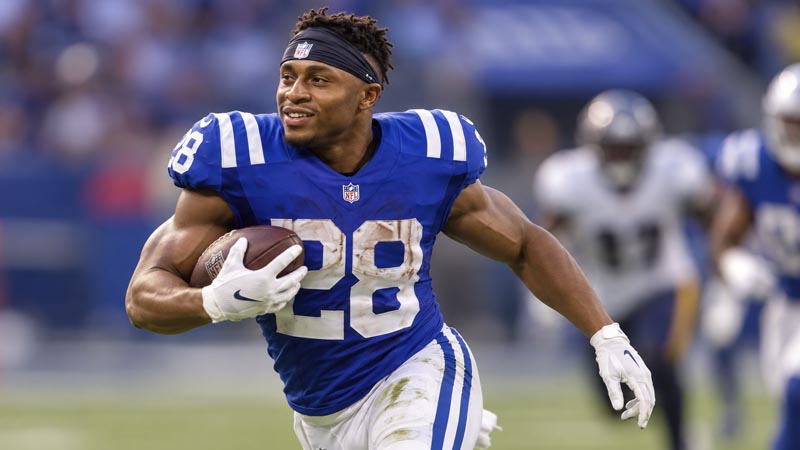
In the landscape of professional football, few individual campaigns have matched the sheer dominance exhibited by Jonathan Taylor during his recent breakout.
However, for the high-stakes decision-maker, past performance is not always a guarantee of future results.
By analyzing historical workload markers, touchdown sustainability, and the shifting infrastructure of the Indianapolis offense, a clear pattern emerges.
This analysis posits that while Taylor remains an elite talent, he is currently the primary candidate for significant statistical regression.
To navigate the upcoming draft cycle effectively, one must separate the player’s talent from the mathematical probability of his environment.
The Pinnacle: Reviewing a Career-Defining Campaign
To understand why a decline is probable, we must first acknowledge the height of the pedestal. Taylor’s recent performance was a masterclass in efficiency and volume.
Leading the league with 20 total touchdowns and a massive workload, he provided a floor and ceiling that few running backs in the modern era can replicate.
In the world of elite performance, reaching the top is often easier than staying there. The sheer volume of touches—approaching 370—places Taylor in a rare tier of usage that historically acts as a precursor to a “performance cliff”.
For managers, the question is not whether Taylor is “good,” but whether the circumstances that allowed for a 20-touchdown season are repeatable.
The Mathematical Certainty of Touchdown Regression
The most volatile statistic in football is the touchdown. Scoring is often a product of “red-zone environment” rather than individual skill alone. When an athlete clears 18 touchdowns in a single season, they enter a danger zone of unsustainable production.
The 95% Rule
Data provided by industry leaders like ESPN suggests a startling trend: 95% of players who record 18 or more touchdowns in a season experience a decrease in scoring the following year.
This is not a slight against the player; it is a law of averages. On average, these elite scorers see a reduction of approximately eight touchdowns in the subsequent campaign.
Why the Drop Occurs
- Red-Zone Volatility: Scoring depends heavily on the team’s ability to reach the 20-yard line consistently. Any dip in overall offensive efficiency directly impacts the running back’s opportunity to score.
- Personnel Changes: Changes in the supporting cast or offensive line can disrupt the “Red-Zone Environment” that previously allowed for high conversion rates.
- Defensive Adjustment: After a 20-touchdown season, opposing coordinators spend the entire offseason building schemes specifically designed to neutralize that singular threat in tight spaces.
For Taylor, losing eight touchdowns would represent a 48-point swing in standard fantasy scoring, a gap that is difficult to bridge through yardage alone.
The Physiology of the 370-Touch Season
The human body has a finite capacity for high-impact collisions. Taylor has now entered the “Over-300 Carry Club,” clearing that threshold in consecutive years.
When you combine carries with receptions, Taylor is nearing the 370-touch mark, a milestone that has historically signaled physical wear-and-tear for even the sturdiest athletes.
The Burden of Back-to-Back Volume
Taylor is part of an extremely small group of running backs to maintain this level of volume in back-to-back years. History shows that the “inevitable dip” in per-play efficiency is not a matter of “if,” but “when”.
From a physiological standpoint, the recovery time required after a 370-touch season often bleeds into the next training camp. This can lead to:
- A decrease in “burst” or top-end speed.
- A lower yards-per-carry (YPC) average as the player loses the ability to break the third and fourth tackles of a game.
- An increased risk of soft-tissue lingering issues.
Historical Case Studies: The Warning Signs
To project Taylor’s future, we must look at his predecessors. The history of high-volume running backs is littered with cautionary tales.
According to historical tracking of players with similar workloads, the success rate for repeating a top-tier finish is alarmingly low.
The Probability Breakdown
- The Top-12 Trap: Of the players who historically hit these heavy workload markers, only six managed to finish as a top-12 fantasy running back the following year.
- The Elite Ceiling: Even more concerning is that only two players in history have finished inside the top eight after such a high-usage season.
These numbers suggest that the market is currently pricing Taylor at his absolute ceiling, while history suggests his most likely outcome is a finish outside the top five.
The Macro View: Indianapolis’ Offensive Infrastructure
A running back is only as successful as the five men in front of him and the quarterback keeping the defense honest. The “Red-Zone Environment” in Indianapolis is currently in a state of flux.
The data indicates that “shifting offensive circumstances” are already pointing toward a decline in raw efficiency. When an offense becomes less predictable or faces personnel turnover, the “conversion rate” for a lead back typically suffers.
Audience Profiling: Who Should Be Concerned?
To maximize the utility of this analysis, we must look at how this impacts different types of stakeholders.
- The “Win-Now” Manager: If you are in a “win-now” window, Taylor represents a high-risk, high-reward asset. The data suggests you may be buying at the peak of the market.
- The Value-Driven Strategist: For those who prioritize value in their decision-making, the historical precedent of the 95% rule cannot be ignored.
- The Dynasty Participant: Long-term value may be preserved, but the immediate 12-month outlook suggests a significant dip in trade value is coming.
Strategic Recommendations: Navigating the Regression
If you choose to roster Taylor, you must do so with the understanding that you are likely not getting the 20-touchdown version of the player.
- Hedge Your Bets: If Taylor is your primary asset, prioritize “high-floor” wide receivers in the subsequent rounds to offset the potential 40-50 point drop in his season total.
- Monitor the Environment: Pay close attention to the offensive line’s health during the preseason. If the “supporting cast” shows signs of struggle, the regression case strengthens.
- Consider a “Tier-Down” Trade: If you can trade Taylor for a slightly lower-ranked back plus a high-end draft pick, the math suggests this is the optimal time to “sell high.”
Final Verdict: The Case for Caution
The evidence against a repeat performance for Jonathan Taylor is overwhelming. Between the 95% touchdown regression rule, the over-300-carry physical burden, and the shifting offensive environment in Indianapolis, all signs point to a decline.
In the world of high-performance analytics, the goal is to anticipate the curve before it happens. While Taylor’s talent is undeniable, the math tells a different story. For the upcoming season, the most prudent strategy is to treat Taylor as a top-tier asset with a significant “warning label” attached.