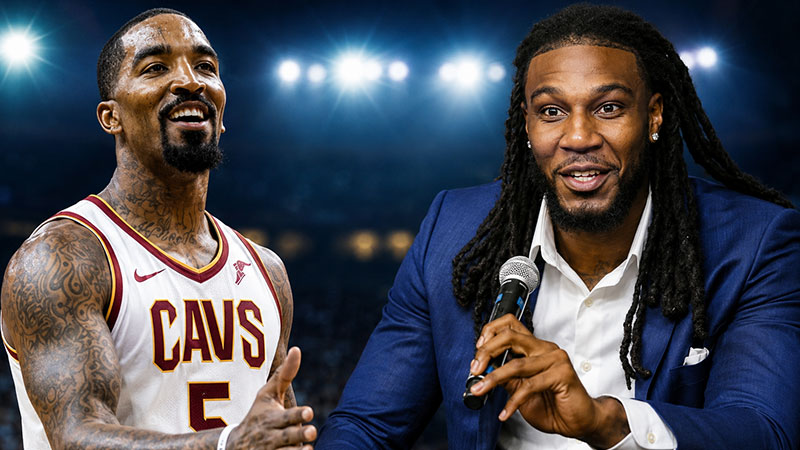
J.R. Smith is typically viewed as the superior individual talent due to his elite shot-making, higher scoring ceiling, and Sixth Man of the Year honors.
However, determining if Jae Crowder is “better” depends on team needs. Smith provided dynamic, self-sufficient offense and floor-spacing, while Crowder offered defensive versatility and a low-usage “3-and-D” profile.
Statistically, Smith leads in points and shooting efficiency, whereas Crowder excels in rebounding and defensive consistency. Ultimately, Smith had the higher peak, but Crowder’s ability to anchor elite defensive units makes him a more seamless fit for diverse rosters.
Statistical Comparison: J.R. Smith vs. Jae Crowder
When analyzing the raw output of these two NBA veterans, the data highlights a clear divergence in their on-court responsibilities. J.R. Smith was recruited for his ability to put the ball in the hoop, whereas Jae Crowder was valued for his physical presence and rebounding.
| Statistic | J.R. Smith | Jae Crowder |
|---|---|---|
| Points Per Game | 12.4 | 9.3 |
| Rebounds Per Game | 3.1 | 4.2 |
| Assists Per Game | 2.1 | 1.6 |
| Field Goal % | 41.9% | 41.8% |
| 3-Point % | 37.3% | 34.7% |
| Free Throw % | 73.3% | 77.7% |
| Turnovers Per Game | 1.3 | 0.8 |
The figures above demonstrate that while their overall field goal percentages are nearly identical, Smith was the significantly more lethal threat from beyond the arc and the charity stripe.
Conversely, Crowder’s lower turnover rate suggests a more disciplined, low-risk style of play that appeals to coaches looking for reliability over volatility.
The Case For J.R. Smith As The Superior Talent
To understand why many analysts rank Smith higher, one must look at his ability to influence the game through pure offensive gravity. Smith was not just a floor-spacer; he was a creator who could generate high-quality looks when the shot clock was winding down.
Peak Performance and Individual Accolades
J.R. Smith reached a level of individual recognition that has eluded Jae Crowder throughout his career. In 2013, while playing for the New York Knicks, Smith was named the NBA Sixth Man of the Year.
During that campaign, he averaged a staggering 18.1 points per game entirely coming off the bench. This demonstrates a level of offensive self-sufficiency that Crowder, who largely relies on others to create his looks, simply does not possess.
Smith’s ability to lead a second unit and provide “instant offense” made him a luxury for every team he played for during his prime.
Offensive Gravity and Shot-Creation Capabilities
Unlike many role players who are relegated to the corners, Smith was an elite, self-sufficient scorer who could create his own shot off the dribble.
His career average of 12.4 points per game is notably higher than Crowder’s 9.3, and his total of 1,930 made three-pointers places him among the elite shooters in the history of the league.
In high-stakes environments, such as the 2016 NBA Finals, Smith’s ability to hit difficult, contested shots provided the Cleveland Cavaliers with the necessary spacing to allow stars like LeBron James and Kyrie Irving to operate in the paint.
Why Jae Crowder Is The Ultimate System Player
While Smith may have the higher “highlight reel” potential, Jae Crowder has carved out a legacy as one of the most successful “glue guys” in the modern era.
His value is often found in the “dirty work” that does not always show up in a standard box score but is essential for winning basketball.
Defensive Versatility Across Multiple Positions
The primary argument for Crowder being “better” rests on his defensive impact. Crowder built his career on being a physical, tough wing defender capable of guarding positions 2 through 4.
His basketball IQ and ability to switch seamlessly onto smaller guards or larger forwards made him a highly sought-after playoff utility piece.
This versatility is a major reason why Crowder has been a starter for multiple different contenders, including the Miami Heat and the Phoenix Suns. While Smith was a capable defender when motivated, Crowder made defense his primary identity.
Low-Usage Efficiency and Playoff Reliability
Crowder excels as a low-usage, system-oriented player who does not require the ball to be effective. This is a critical trait for championship-caliber teams that already have high-usage superstars.
Crowder averages fewer turnovers than Smith (0.8 vs 1.3) and provides superior rebounding from the wing position, pulling down 4.2 boards per game compared to Smith’s 3.1.
In a playoff setting, Crowder’s rebounding becomes even more pronounced, as he increases his output to 5.0 rebounds per game.
His ability to “plug and play” into various offensive and defensive schemes makes him an invaluable asset for coaches who prioritize structural integrity over individual scoring bursts.
Regular Season Career Totals: A Tale of Two Timelines
Examining the cumulative impact of both players provides perspective on their longevity and sustained production. J.R. Smith enjoyed a longer career, spanning 16 seasons, which allowed him to accumulate massive leads in several volume-based categories.
| Cumulative Statistic | J.R. Smith (16 Seasons) | Jae Crowder (13 Seasons) |
|---|---|---|
| Games Played | 977 | 812 |
| Total Minutes | 26,301 | 20,111 |
| Total Points | 12,148 | 7,542 |
| Total Rebounds | 3,073 | 3,415 |
| Total Assists | 2,077 | 1,280 |
| Total Steals | 962 | 808 |
| Total Blocks | 198 | 224 |
| Total 3-Pointers Made | 1,930 | 1,273 |
The total points gap of over 4,600 points highlights the massive difference in their offensive roles. However, it is noteworthy that despite playing fewer seasons and roughly 6,000 fewer minutes, Crowder has already surpassed Smith in total career rebounds.
This reinforces the narrative that Crowder is the more productive player in the trenches, while Smith is the superior perimeter weapon.
Postseason Impact: Rings vs. Finals Appearances
In the NBA, greatness is often measured by how a player performs when the lights are brightest. Both Smith and Crowder have been perennial fixtures in the postseason, frequently contributing deep into the month of June.
J.R. Smith’s Role in the 2016 Championship
J.R. Smith has two NBA championships to his name, most notably serving as the starting shooting guard for the 2016 Cleveland Cavaliers.
During that historic run, Smith was an essential floor-spacer, often taking and making the “big shots” that shifted momentum in the Cavaliers’ favor.
His ability to hit transition threes and defend high-level wings was instrumental in Cleveland overcoming a 3-1 deficit. Smith currently sits among the top postseason three-point shooters in NBA history, a testament to his playoff consistency as a marksman.
Crowder’s Path Through the NBA Finals
While Crowder has not yet secured a ring, his playoff experience is incredibly deep and varied.
He has reached the NBA Finals with two different franchises—the 2020 Miami Heat and the 2021 Phoenix Suns—and has made the postseason with a long list of contenders including the Celtics, Cavaliers, Jazz, and Bucks.
Crowder has played 115 playoff games, and in those matchups, he has proven to be a more effective rebounder than Smith, averaging 5.0 RPG in the postseason.
His presence on so many different winning teams suggests that front offices view him as a “winning player” who elevates a team’s floor.
Shooting Percentages and Efficiency Metrics
A common misconception is that all shooters are created equal. However, a deeper look at the efficiency metrics reveals that J.R. Smith was the more precise specialist, particularly regarding his effective field goal percentage and free throw accuracy.
- Three-Point Accuracy: Smith’s career 37.3% from deep is significantly higher than Crowder’s 34.7%, making him the more reliable threat to break open a zone defense.
- Free Throw Reliability: Smith shot 73.3% from the line, but Crowder actually holds the advantage here at 77.7%, showing he is the better option to have on the floor during late-game intentional fouling situations.
- Postseason Shooting: In the playoffs, Smith’s three-point percentage remains strong at 36.7%, whereas Crowder’s drops slightly to 33.6%.
These percentages suggest that while Crowder is a capable shooter, he lacks the elite accuracy that made Smith a defensive nightmare for opposing coaches.
Smith’s ability to maintain his efficiency in the high-pressure environment of the playoffs further solidifies his standing as a premier secondary scoring option.
Frequently Asked Questions About Their NBA Legacies
Who had the higher peak, J.R. Smith or Jae Crowder?
J.R. Smith had the higher individual peak. His 2012-2013 season, where he won Sixth Man of the Year and averaged over 18 points per game, represents a level of offensive production that Crowder has not matched in his career.
Which player is better for a championship team?
The answer depends on the roster. J.R. Smith is better if the team needs an explosive scorer and elite floor-spacing.
Jae Crowder is the better choice for a team that already has established stars and needs a versatile defender who can guard multiple positions without needing the ball.
Does Jae Crowder have more playoff experience than J.R. Smith?
While J.R. Smith has played in more total playoff games (140 vs 115), Jae Crowder has reached the postseason with a wider variety of contenders, including the Heat, Suns, Celtics, and Jazz.
Crowder’s ability to find a home on winning teams across both conferences is a testament to his value as a role player.
Who is the better three-point shooter?
Statistically, J.R. Smith is the better shooter. He has a higher career three-point percentage (37.3% vs 34.7%) and has made significantly more total three-pointers (1,930 vs 1,273).
Final Verdict: Who Should You Choose for Your Team?
Deciding whether Jae Crowder is better than J.R. Smith requires a nuanced understanding of basketball archetypes.
If you are building a team that needs a spark of brilliance—a player who can explode for 30 points on any given night and shift the momentum of a game through pure shot-making—then J.R. Smith is the undisputed choice.
His talent ceiling is simply higher than Crowder’s, and his history as a champion and Sixth Man of the Year proves he can deliver at the highest levels.
On the other hand, if your roster is already loaded with offensive talent and you require a hard-nosed, disciplined defender who can anchor a switching scheme and hit timely corner threes, Jae Crowder is the ideal fit. He is the ultimate professional who understands his role and executes it with high IQ and minimal mistakes.
While Smith may have the rings and the accolades, Crowder’s consistency and rebounding often make him the more reliable “everyday” player for modern defensive systems.
Both athletes have left an indelible mark on the league as premier contributors to winning cultures. Their careers serve as a blueprint for how different skill sets—one offensive-heavy and one defensive-focused—can both lead to immense success in the NBA.