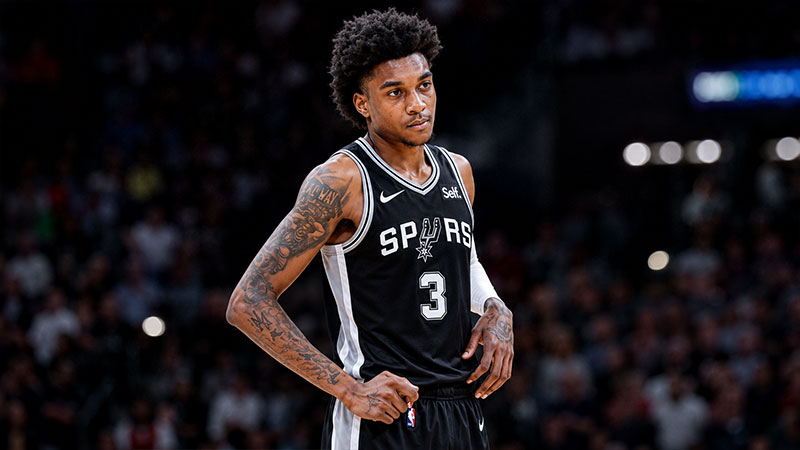
Jaden McDaniels has transcended the traditional “role player” label to become an essential cornerstone for the Minnesota Timberwolves’ championship aspirations.
Often referred to by nicknames like “Seatbelt” and “Big Mac,” the 6’9″ forward has evolved from a raw defensive prospect into one of the most feared perimeter stoppers in the NBA.
While his defensive accolades, including an All-Defensive Second Team selection in 2024, are well-documented, his offensive maturation during the 2025-26 season has shifted the narrative.
To understand if McDaniels is “good,” one must look beyond simple box scores and analyze his unique two-way value.
The Defensive Architecture of a Perimeter Lockdown Specialist
The primary reason Jaden McDaniels is considered elite is his defensive versatility, which allows the Timberwolves to implement complex, switch-heavy schemes.
Standing at 6’9″ with a massive 7-foot wingspan, he possesses a rare combination of length and lateral quickness that makes him a nightmare for modern NBA superstars.
He is routinely tasked with guarding the league’s most prolific scorers, including Luka Dončić, Kevin Durant, and Devin Booker, often frustrating them with his ability to disrupt shots even after being beaten off the dribble.
Statistical Defensive Impact and Advanced Metrics
The eye test confirms his dominance, but the advanced data solidifies it. Advanced tracking metrics, such as Estimated Plus-Minus, have graded McDaniels in the 96th percentile of all league defenders.
His impact is best felt at the point of attack, where he functions as a premier “wing stopper”. Unlike many specialists who struggle to stay on the floor during high-stakes offensive possessions, McDaniels’ defensive floor is so high that he remains indispensable during late-game situations.
Versatility and Positionless Defense
McDaniels’ physical profile allows him to switch seamlessly between quick point guards and larger power forwards. This adaptability is crucial in a league that prioritizes “positionless” basketball.
He averages nearly one block and one steal per game over his career, but these traditional stats underrepresent the number of possessions he disrupts simply by being in the passing lane or forcing a difficult kick-out pass.
The 2025-26 Offensive Breakthrough
While defense has always been his calling card, the 2025-26 season marked a significant shift in his offensive utility. No longer just a “3&D” specialist, McDaniels has become a reliable scoring threat who punishes teams for over-committing to stars like Anthony Edwards.
In the 2025-26 regular season, he posted career-high numbers across nearly every major offensive category.
Jaden McDaniels 2025-26 Regular Season Performance Summary
| Metric | 2025-26 Season Average | Career Average |
|---|---|---|
| Points Per Game | 14.8 | 11.1 |
| Field Goal Percentage | 51.5% | 48.9% |
| Three-Point Percentage | 41.2% | 35.9% |
| Free Throw Percentage | 83.5% | 77.4% |
| Assists Per Game | 2.7 | 1.7 |
| True Shooting % (TS%) | .611 | .581 |
(Data compiled from regular season metrics)
Efficiency and Beyond the Arc Shooting
The most impressive aspect of his growth is his efficiency from deep. Shooting 41.2% from three-point range on 3.4 attempts per game has turned him into a deadly floor-spacer.
During the early parts of the 2025-26 season, he even led the league in three-point shooting percentage at a staggering 53.8%, demonstrating that when he finds his rhythm, he is one of the most efficient shooters in the world.
Evolution as a “Release Valve” Scorer
On a team featuring high-usage players, McDaniels excels as a “release valve”. He is elite at attacking closeouts and hitting catch-and-shoot jumpers.
While he is not yet a primary shot creator who can consistently generate his own looks off the dribble, his ability to finish around the rim—evidenced by his 74% field goal percentage from 0-3 feet—makes him a versatile threat.
Maturity, Mentality, and the “Toughness” Factor
A significant part of McDaniels’ journey has been his mental development. Earlier in his career, he was known for “frustration fouls” and emotional outbursts, most notably an incident where he punched a wall and sidelined himself with a hand injury.
However, he has since apologized for that “selfish” moment and used it as a catalyst for growth.
The Heart of the Timberwolves’ Culture
Timberwolves coach Chris Finch has praised McDaniels for his “legitimate tough” persona, noting that he talks throughout the series and backs it up with his play. This internal grit is highly valued by his teammates.
Anthony Edwards, arguably the face of the franchise, has repeatedly called McDaniels his “favorite player in the NBA,” emphasizing how much the team depends on him every single night for both offensive and defensive stability.
Aggressive On-Court Presence
McDaniels plays with an “unbothered” and sometimes “angry” demeanor that serves as an intimidation factor. Whether it is catching an alley-oop or getting into a “kerfuffle” with opponents like Nikola Jokić to protect his team’s interests, his intensity is a vital part of the Timberwolves’ identity.
This mental toughness allows him to stay focused even when facing provocation from opposing superstars.
Identifying Gaps: Areas for Continued Improvement
To provide a professional and balanced assessment, it is necessary to acknowledge the limitations that still exist in McDaniels’ game. While he is a top-tier asset, there are specific areas where he must continue to refine his skills to reach an All-Star ceiling.
Managing Foul Trouble
One of the most persistent issues for McDaniels is his high foul rate. During the 2025-26 season, he averaged 3.3 personal fouls per game, frequently finding himself in foul trouble during crucial moments.
His high-intensity, physical style of defense often leads to quick whistles, which can limit his playing time and force the coaching staff to adjust their defensive rotations prematurely.
Expanding Shot Creation and Volume
Currently, McDaniels thrives in a low-usage role, but for him to take the “Pascal Siakam-type leap” that many analysts predict, he needs to improve his independent shot creation.
He rarely initiates the offense and remains primarily a play-finisher rather than a playmaker. Increasing his volume while maintaining his 51.5% field goal efficiency will be the next step in his evolution.
Player Comparisons: Where Does He Rank?
When evaluating McDaniels’ value, basketball fans and analysts often compare him to elite 3&D wings who eventually became championship anchors. Common comparisons include Suns-era Mikal Bridges and Tayshaun Prince.
These players represent the “gold standard” for defensive wings who provide enough offensive gravity to keep defenses honest.
- Tayshaun Prince: Like Prince, McDaniels uses his length to smother wings and is a “winning player” who does the dirty work.
- Mikal Bridges: The Bridges comparison highlights his potential as a high-efficiency shooter who never misses rotations on defense.
- Pascal Siakam: Some believe his ultimate ceiling is that of an All-Star like Siakam, provided he gets more primary offensive responsibilities and continues to develop his handle.
Comprehensive FAQ: Understanding the “Seatbelt”
Is Jaden McDaniels considered an elite defender?
Yes. He is widely recognized as one of the premier perimeter stoppers in the NBA, evidenced by his 2023-24 All-Defensive Second Team honors and his 96th percentile ranking in defensive impact metrics.
What are Jaden McDaniels’ career-high stats?
McDaniels has recorded single-game career highs of 30 points, 13 rebounds, 7 assists, 5 steals, and 5 blocks. His scoring jumped significantly in the 2025-26 season to 14.8 points per game.
What is his current contract situation?
McDaniels signed a significant contract with Minnesota that was initially viewed as generous but is now seen as a bargain given his elite two-way production. He made over $23 million in 2025.
Why is his nickname “Seatbelt”?
The nickname “Seatbelt” refers to his ability to “strap in” opposing players and shut them down defensively, effectively “buckling” the opponent’s best scoring options.
Does he have championship experience?
While he has not yet won a ring, he has been a starter in 43 playoff games, averaging 13.6 points and nearly 5 rebounds while playing heavy minutes (32.0 MPG) in high-pressure postseason environments.
The Verdict: A Championship-Caliber Cornerstone
In conclusion, Jaden McDaniels is much more than just a “good” basketball player; he is a prototype for the modern NBA wing.
By combining elite, switchable defense with a rapidly improving offensive game—highlighted by his 41.2% shooting from deep in 2025-26—he has made himself indispensable to the Minnesota Timberwolves.
While his high foul rate and limited independent shot creation remain areas for growth, his maturity and willingness to take on the toughest defensive assignments every night set him apart.
For any team with title aspirations, a player like McDaniels is the ultimate “glue guy” who can also punish opponents as a primary scoring option on any given night.
His trajectory suggests that he is not just a role player, but a rising star whose two-way impact will anchor Minnesota’s defense for years to come.
Whether you call him “Slim,” “Big Mac,” or “Seatbelt,” one thing is clear: Jaden McDaniels has arrived as an elite force in the NBA.