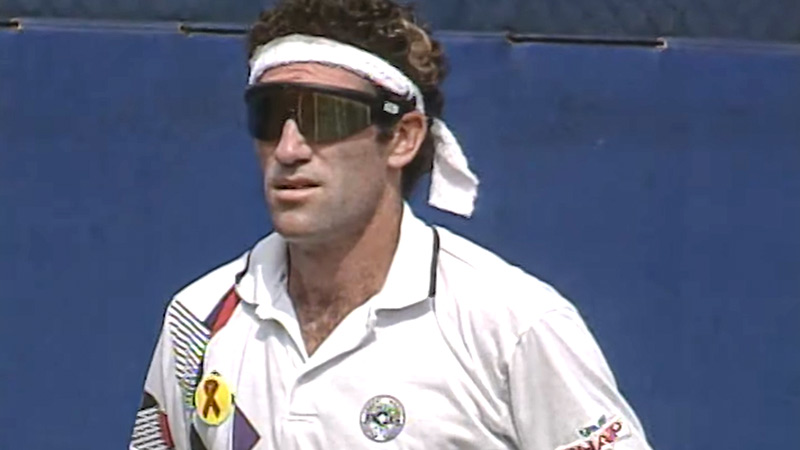
Brad Gilbert is exceptionally good, cementing his legacy as one of the most brilliant tactical minds in tennis history. While he lacked the raw power of his contemporaries, he utilized a unique “Winning Ugly” philosophy to peak at World No. 4 and claim 20 ATP titles.
As a coach, his impact is even more profound, guiding legends like Andre Agassi and Andy Roddick to World No. 1 rankings and a combined eight Grand Slam titles.
Whether through his strategic books or elite broadcasting, Gilbert’s ability to deconstruct opponent weaknesses makes him a gold standard for tactical excellence.
Was Brad Gilbert a Good Tennis Player?
To understand if Brad Gilbert was good, one must look past aesthetic elegance and focus on the cold reality of results. He was a master of maximizing his physical tools through psychological pressure and strategic positioning.
The Giant Slayer and Mental Warfare
During his 14-year professional career from 1982 to 1995, Gilbert earned the reputation of a “giant slayer”. He did not possess a booming serve or a highlight-reel forehand, but he understood the rhythm of a match better than almost anyone on the tour.
His 1989 season is a prime example of this mastery; he won five titles and defeated four future International Tennis Hall of Fame inductees—Pete Sampras, Michael Chang, Boris Becker, and Stefan Edberg—on his way to winning the Cincinnati Masters.
His ability to frustrate superior ball-strikers was legendary, most famously leading John McEnroe to take a six-month break from the sport after a particularly frustrating loss to Gilbert in 1986.
Statistical Breakdown of a 14-Year Career
Gilbert’s longevity and consistency are reflected in a career singles record of 519–288, a 64.3% win rate that places him among the elite of his era.
He was particularly effective in the best-of-three-set format, where his tactical adjustments could quickly overwhelm an opponent before they could find their rhythm.
| Statistic Category | Singles Achievement |
|---|---|
| Career Win-Loss | 519–288 (64.3%) |
| ATP Singles Titles | 20 |
| Career-High Ranking | World No. 4 (1990) |
| Olympic Success | Bronze Medal (1988) |
| Prize Money | $5,507,973 |
Beyond his 20 ATP titles, Gilbert reached 42 career finals, proving that his “Winning Ugly” style was a sustainable and winning strategy across different surfaces and tournament tiers.
He reached the quarterfinals of both the US Open and Wimbledon, showing he could compete with the best in the world over five sets.
The Strategic Mastery of Winning Ugly
The phrase “Winning Ugly” has become synonymous with Gilbert, defining a philosophy that prioritizes efficiency and mental toughness over traditional textbook technique. This approach changed how many professionals viewed match-day preparation.
Psychological Advantage on the Court
Gilbert’s core philosophy is built on the premise that you do not need to play your best tennis to win; you simply need to play better than the person across the net. He focused on identifying opponent vulnerabilities and exploiting them relentlessly.
This involved playing high-percentage shots, varying the pace and height of the ball to break an opponent’s rhythm, and remaining mentally unflappable during high-pressure moments.
By turning matches into a grueling mental and tactical battle, he often forced more talented players into making unforced errors and losing their composure.
Why Tactics Often Outperform Mechanics
The success of the “Winning Ugly” method lies in its adaptability. Gilbert believed that while mechanics can fail under pressure, a sound strategy remains a constant.
This realization allowed him to compete against “baseline heavyweights” despite being physically disadvantaged.
By focusing on court positioning and smart shot selection rather than trying to match the power of players like Boris Becker, Gilbert was able to secure 27 wins against Top 10 opponents throughout his career.
This tactical depth became the foundation for his second act as one of the most successful coaches in the history of the modern game.
Why Brad Gilbert is Considered an Elite Coach
If there were any doubts about Gilbert’s tactical genius during his playing days, his coaching career silenced them. He has a unique ability to instill supreme confidence in his pupils while implementing hyper-focused, opponent-specific strategies.
The Agassi Renaissance
Gilbert’s greatest coaching achievement was the total revitalization of Andre Agassi’s career. When Gilbert took over in 1994, Agassi was in a severe slump, with his ranking eventually dropping as low as No. 141.
Gilbert completely overhauled Agassi’s approach, moving him away from a purely aggressive style to a more calculated, strategic game.
Under Gilbert’s eight-year tutelage, Agassi won six Grand Slam titles and reclaimed the World No. 1 spot. Agassi later referred to Gilbert as the “greatest coach of all time,” noting that Gilbert made him truly believe he could defeat anyone on any given day.
Mentoring the Next Generation of Champions
Gilbert’s “Midas touch” extended well beyond Agassi. He has consistently demonstrated the ability to produce immediate results for top-tier talent.
- Andy Roddick: Gilbert guided the young American to his 2003 US Open title and the World No. 1 ranking.
- Andy Murray: He managed Murray’s crucial transition into the top tier of the sport, helping the young pro surge from No. 36 into the Top 10.
- Kei Nishikori: Under Gilbert’s guidance, Nishikori broke into the upper echelons of the ATP tour.
- Coco Gauff: In a highly publicized partnership, Gilbert helped Gauff secure her first Major title at the 2023 US Open and reach a career-high ranking of World No. 2.
The Specific Limitations of Tactical Coaching
Despite his immense success, Gilbert’s coaching style is not a universal fix for every player’s struggles. His expertise is specialized, which occasionally leads to the natural conclusion of his partnerships when a player’s needs change.
Technical Flaws vs. Tactical Strategy
The primary distinction in Gilbert’s coaching is his focus on match-day warfare rather than rebuilding physical stroke mechanics. He is not a technical coach who will spend months reworking a player’s serve or backhand from a biomechanical perspective.
Instead, he teaches players how to win with the weapons they currently possess. This strategy works exceptionally well for established players who are underperforming mentally or tactically, but it can be less effective when a player’s core physical game begins to break down.
The 2024 Breakup with Coco Gauff
The end of the partnership between Gilbert and Coco Gauff in late 2024 serves as a case study for these limitations. While their collaboration initially yielded the 2023 US Open title, Gauff’s form deteriorated during the 2024 summer season.
Her game was plagued by severe serving struggles and high double-fault counts—technical issues that fell outside Gilbert’s tactical specialty.
Because Gauff required a mechanical overhaul of her serve and unforced error correction, her team ultimately chose to seek fresh technical guidance rather than continuing with Gilbert’s strategy-first approach.
Brad Gilbert in the Media and Podcast Era
After decades on the court, Gilbert transitioned into a prominent media personality, becoming one of the most recognizable voices in the sport. His ability to break down complex matches for a global audience solidified his status as an industry authority.
The ESPN Broadcasting Legacy
Gilbert spent several decades as a staple of ESPN’s tennis coverage, where he was known for his eccentric slang and fast-paced analytical breakdowns.
He became famous for giving players custom nicknames and providing “deep-dive” tactical insights during live broadcasts.
While his hyperactive style occasionally divided some viewers, his peers and serious fans respected his unparalleled ability to predict tactical shifts before they happened on screen.
His long-standing contract with the network concluded following his return to full-time coaching with Gauff.
Digital Content and The Big T Podcast
In the current landscape, Gilbert has embraced new media to share his expertise. He has transitioned to hosting “The Big T Podcast” alongside former professional players CoCo Vandeweghe and Danielle Collins.
On this platform, he continues to provide the same level of strategic analysis that made him a legendary coach.
Additionally, he remains a dominant presence on social media, offering live match commentary and tournament previews to a dedicated following of tennis enthusiasts.
While he is currently focused on media and consulting, he has expressed an open interest in returning to the ATP tour as a coach if a compelling new project arises.
Essential Facts About Brad Gilbert’s Career
Did Brad Gilbert ever win a Grand Slam title?
As a player, Gilbert never won a Grand Slam singles title. His best major results were reaching the quarterfinals at the 1987 US Open and 1990 Wimbledon. However, as a coach, he has been part of eight Grand Slam title victories.
What was Brad Gilbert’s highest ranking?
Gilbert reached a career-high of World No. 4 on January 1, 1990. This ranking was achieved during a highly competitive era of men’s tennis, further proving his elite status among his peers.
How many titles did he win in total?
He won 20 ATP singles titles and 3 doubles titles during his career. His 20 singles titles place him in an exclusive group of players who maintained high-level success over more than a decade.
Why is his book “Winning Ugly” so famous?
The book is considered a seminal text in sports psychology and tactics. It provided a roadmap for players of all levels to overcome physical disadvantages by using their minds to break down an opponent’s game.
Is he still coaching today?
Following his split with Coco Gauff in late 2024, Gilbert is not currently coaching a top-tier pro full-time. He is currently focusing on his podcast and independent consulting but remains open to the right coaching opportunity on the ATP tour.
The Architecture of a Lasting Legacy
Ultimately, Brad Gilbert is much more than a “good” tennis figure; he is a transformative one. He proved that the mental side of the game is just as important as the physical, and his eight Grand Slam titles as a coach stand as a testament to his unique genius.
Whether he is behind a microphone or on a coaching bench, his impact on the strategic fabric of professional tennis is permanent. For any player looking to maximize their potential through intelligence and grit, Gilbert remains the ultimate blueprint for success.