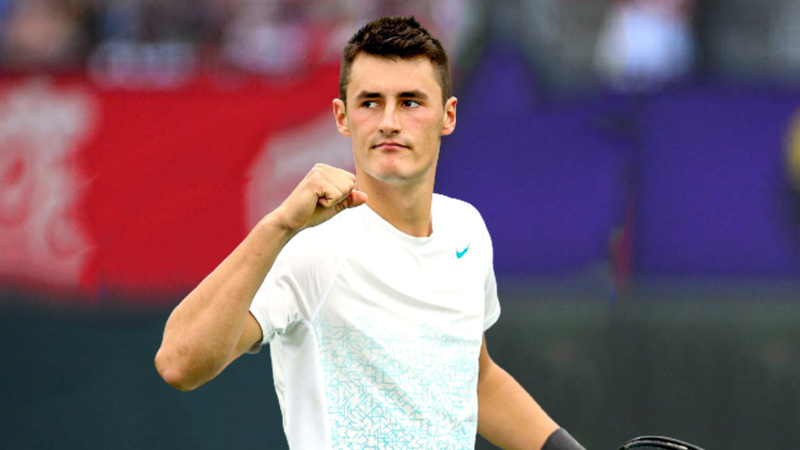
Bernard Tomic is undeniably a “good” tennis player by professional standards, having reached a career-high ranking of World No. 17 and securing four ATP singles titles.
While his peak performance was defined by elite finesse and a Wimbledon quarterfinal run, his legacy is complicated by public burnout and a plummet in rankings.
Today, he maintains a professional standing of World No. 204, proving his continued capability on the global circuit.
Evaluating Tomic requires balancing his natural tactical brilliance with his documented struggles, yet his statistical resume places him far above the average athlete in the sport’s history.
Is Bernard Tomic actually a good tennis player?
Determining the quality of a professional athlete requires looking past media headlines and focusing on long-term data and competitive milestones.
In the context of global tennis, Bernard Tomic has achieved heights that only a fraction of one percent of players ever reach.
His career is a tale of two halves: a prodigy who dominated the junior ranks and an experienced veteran now fighting to reclaim his spot among the elite.
By analyzing his historical peak and his current resilience, we see a player whose “goodness” is defined by natural skill and a high tactical IQ.
The Significance of a Career-High World No. 17
Reaching the top 20 in the world is a feat that requires consistent wins against the most elite athletes on the planet. On January 11, 2016, Tomic achieved a career-high singles ranking of World No. 17.
This ranking was not a fluke but the result of deep runs in major tournaments and a high volume of wins on the ATP Tour.
During this period, Tomic was considered a legitimate threat to the top seeds at Grand Slams, particularly on fast surfaces like grass and hardcourt.
His ability to sustain this level of play for several years proves that his ceiling is significantly higher than most of his peers.
Breaking Down the Total Professional Win Record
When viewing his entire career across all tiers of professional tennis, Tomic holds a positive win-loss record. He has recorded 442 total professional wins against 362 losses, resulting in a career win rate of approximately 55%.
Even when narrowing the scope to the elite ATP Tour level, he holds a respectable 187-184 record.
These numbers indicate that even during periods of inconsistency or lack of motivation, Tomic has remained a competitive force.
His historical pedigree is further bolstered by his 12 total career titles, which include 4 ATP Tour titles, 3 ATP Challengers, and 5 ITF Futures.
The Technical Brilliance of Tomic’s Unorthodox Game
Bernard Tomic does not play the modern baseline power game that defines many of his contemporaries on the tour. Instead, he relies on a style that many coaches describe as “unorthodox finesse,” utilizing touch and timing rather than raw strength.
This approach makes him a difficult opponent for players who thrive on rhythm and predictable power. His game is built on a foundation of elite anticipation and a unique ability to manipulate the ball in ways that disrupt an opponent’s natural flow.
Disrupting Opponents with Flat Groundstrokes
Tomic’s groundstrokes are characterized by their extreme flatness and low clearance over the net. Unlike modern heavy topspin shots that bounce high and allow opponents to strike the ball at shoulder height, Tomic’s shots skid low across the court.
This technique is especially effective on grass courts, where the surface already favors low-bouncing balls.
By hitting flat, he forces his opponents to bend their knees and dig the ball out of the court, which often leads to shorter replies or unforced errors. This strategic advantage is a primary reason he reached the Wimbledon Quarterfinals in 2011 at just 18 years old.
The Strategic Utility of the Backhand Slice
One of the most praised aspects of Tomic’s technical arsenal is his masterful backhand slice. He uses this shot not just as a defensive tool to buy time, but as an offensive weapon to change the pace of a rally.
By varying the depth and spin of the slice, he prevents his opponents from stepping into the court to attack. This “unconventional mix” of slow, flat groundstrokes and delicate drop shots creates a tactical nightmare for power hitters who prefer a consistent pace.
His exceptional touch at the net further complements this style, making him a complete, albeit unusual, technical player.
Navigating the Infamous “Tomic the Tank Engine” Era
The primary criticism of Tomic’s career revolves around his mental approach and perceived lack of professional effort during certain matches.
The media nickname “Tomic the Tank Engine” was born from several instances where he appeared to stop trying when a match became difficult or frustrating.
This reputation has often overshadowed his physical talents, leading many to question if he was ever truly “good” or simply gifted and unmotivated.
Understanding this era requires looking at the psychological toll of the professional tour and the burnout that Tomic eventually admitted to experiencing.
The Psychology of the Fastest ATP Match Loss
Tomic holds an unfortunate record for the fastest match loss in the history of the ATP Tour. In 2014, he lost to Jarkko Nieminen at the Miami Open in just 28 minutes and 20 seconds.
While the scoreline of 6-0, 6-1 suggested a total lack of effort, it is important to note that he had recently undergone double hip surgery earlier that year.
However, this match became a focal point for critics who viewed it as a symbol of his career-long struggle with conditioning and motivation. The record remains a permanent part of his professional history and a testament to the volatility of his career trajectory.
Managing Public Perception and Personal Motivation
Public backlash toward Tomic intensified after he made several candid, albeit controversial, remarks about his wealth and lack of desire to play. He famously told critics that they could only “dream” of his success while he “counted his millions” following losses.
Later in his career, he admitted that the isolation of the professional tour caused him to grow to hate the sport around the age of 23.
This admission of burnout provides context for his drop in rankings; it was not a loss of skill that derailed him, but a loss of hunger for the daily grind of the elite circuit.
A Deep Dive into Tomic’s Career Statistics and Earnings
The following data provides a comprehensive overview of Bernard Tomic’s professional standing and financial success across his career.
| Metric | Professional Milestone |
|---|---|
| Career-High Ranking | World No. 17 (January 2016) |
| Total Professional Wins | 442 |
| Total Professional Losses | 362 |
| ATP Singles Titles | 4 (Sydney, Bogota x2, Chengdu) |
| Grand Slam Best Result | Wimbledon Quarterfinalist (2011) |
| Junior Grand Slam Titles | 2 (Australian Open, US Open) |
| Total Career Prize Money | $6,769,903 USD |
| Current Ranking (2026) | World No. 204 |
| 2026 Win/Loss Record | 13 Wins / 16 Losses |
The Resilience of the Late-Career Challenger Circuit Grind
In a significant shift from his early-career reputation, Tomic has spent the last few years demonstrating a renewed work ethic.
After his ranking plummeted outside the top 800 in 2022 due to a lack of activity and form, he chose to return to the lowest tiers of the sport to rebuild his career.
This “calculated reclamation” has seen him swallow his pride and compete in ITF Futures and ATP Challenger events, often in remote locations far from the glamour of the main tour.
This phase of his career provides a different answer to the question of whether he is “good”: he is now a resilient veteran.
Swallowing Pride for the ITF Futures Ascent
Many former top-20 players would choose retirement over playing in the ITF Futures circuit, where prize money is low and facilities are basic. Tomic’s decision to grind through these events shows a newfound passion for the sport that was missing during his peak years.
He has played an “immense volume” of matches to claw his way back into the top 200, proving that he still possesses the skill to dominate at the lower tiers.
This journey from World No. 800+ back to World No. 204 is a testament to his enduring talent and a refutation of the idea that he does not care about his career.
Assessing the Physical Demands of a 33-Year-Old Athlete
At 33 years old, Tomic is competing against younger, hungrier players who grew up watching his early successes. His 2026 record of 13 wins and 16 losses highlights the difficulty of this stage of his career.
While he is struggling for consistent form at the Challenger level, his ability to remain competitive at this age, despite previous hip surgeries and conditioning issues, is noteworthy.
He has openly stated that his final goal is to break back into the top 100 before he retires, a mission that requires more discipline than he ever displayed in his twenties.
Does Bernard Tomic Still Have the Potential for Top 100 Success?
Whether Tomic can return to the top 100 remains one of the most intriguing questions in Australian tennis.
His current ranking of 204 puts him within striking distance, but the gap between the top 250 and the top 100 is significant in terms of consistency and physical intensity.
However, his unique playing style remains an advantage; because he does not rely on physical power, he may be able to sustain his career longer than more athletic players who suffer from wear and tear.
If he can find a string of results on his preferred grass courts, a return to the main tour is mathematically possible.
Evaluating the 2026 Win-Loss Dynamics
His current form in 2026 shows a player who is “grinding” but not yet dominating. With 13 wins and 16 losses, he is currently winning approximately 45% of his matches this season.
To break back into the top 100, he will likely need to improve this rate significantly and reach the final stages of several ATP Challenger events.
The data suggests that while the “elite” consistency of his World No. 17 days may be gone, his “good” baseline of professional skill allows him to remain a fixture in the top 250.
Future Projections and Retirement Goals
Tomic’s legacy will ultimately be defined by how he finishes this final chapter of his career. If he successfully reaches the top 100 again, it will be hailed as one of the greatest redemption stories in the sport.
Even if he falls short, his transition from a “burnt-out” star to a hardworking journeyman has already changed the narrative surrounding his character.
He has earned over $6.7 million in career prize money, a figure that places him in an elite bracket of earners in tennis history. His journey serves as a reminder that professional “goodness” is not just about trophies, but about the resilience to keep competing.
Frequently Asked Questions
What was Bernard Tomic’s highest ranking?
Bernard Tomic reached a career-high ranking of World No. 17 on January 11, 2016. This peak ranking followed several years of strong performances on the ATP Tour, including reaching the fourth round of the Australian Open and winning multiple titles in Bogota.
How many ATP titles has Bernard Tomic won?
He has won 4 ATP singles titles. These victories came at the 2013 Sydney International, the 2014 and 2015 Claro Open Colombia, and the 2018 Chengdu Open. All four of these titles were achieved on hardcourt surfaces.
Why was he called “Tomic the Tank Engine”?
The nickname was given to him by the media due to his history of “tanking,” which is the practice of intentionally giving up or not providing full effort during a match.
This often occurred when he was frustrated, bored, or facing physical limitations, most notably during his 28-minute loss in 2014.
Is Bernard Tomic still playing tennis in 2026?
Yes, as of 2026, the 33-year-old Bernard Tomic is active on the professional circuit. He is currently ranked World No. 204 and primarily competes in ATP Challenger and ITF Futures events as part of a late-career comeback attempt.
What is Bernard Tomic’s career prize money?
Throughout his career, Bernard Tomic has earned a total of $6,769,903 USD in prize money from both singles and doubles competitions. A large portion of this wealth was accumulated during his prime years between 2011 and 2018.
Conclusion: Redefining Professional Success at 33
The career of Bernard Tomic is a study in the complexity of natural talent. While he may never again reach the heights of World No. 17 or a Wimbledon quarterfinal, his current status as a top 250 player at age 33 is an achievement that should not be overlooked.
He has successfully transitioned from a controversial prodigy to a resilient competitor, proving that he still belongs on the professional court.
Ultimately, his statistical records and 442 professional wins confirm that Bernard Tomic is a “good” tennis player whose career has been a remarkable, if turbulent, journey through the elite levels of the sport.