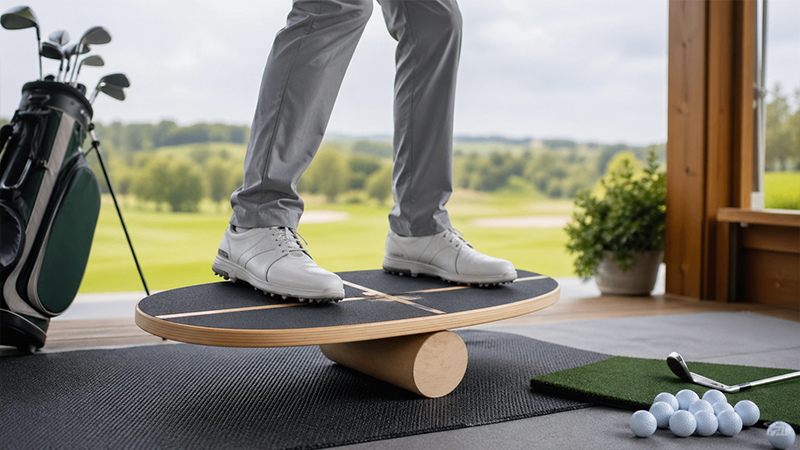
The hallmark of a world-class golf swing is not just speed, but exceptional balance. If you watch any professional on the PGA Tour, you will notice a common thread: they remain incredibly stable and athletic throughout the entire motion, never swaying off the ball or losing their footing after impact.
This stability is the foundation upon which all power and consistency are built. However, for many amateur golfers, “feeling” a proper weight shift is one of the most difficult aspects of the game to master.
While commercial weight shift and pressure boards are highly effective, they often come with a price tag exceeding $100.
For the cost-conscious golfer or the DIY enthusiast, you can build an equally effective training aid in under an hour for less than the price of a box of premium golf balls.
This guide provides a comprehensive blueprint for constructing and utilizing your own golf balance board to transform your swing from the ground up.
The Science of Stability: Why Balance Dictates Your Score
A powerful golf swing is a complex sequence of movements that requires a solid foundation. When you move into your backswing, your weight should load into your trail leg without your body sliding laterally away from the target—a mistake commonly known as a “sway”.
During the downswing, that weight must shift gracefully yet powerfully onto your lead side to support rotation and transfer energy into the ball.
Any unwanted lateral movement, whether a sway away from the ball or a “slide” toward the target, leaks power and destroys consistency.
The challenge is that these subtle shifts are hard to perceive. You may believe you are rotating properly, but video evidence often reveals significant lateral movement.
A balance board solves this by creating an unstable surface that exaggerates poor movement patterns.
If you sway instead of rotate, the board will tip prematurely, or you will lose your balance entirely, forcing your core to engage and training your brain to find its true center of gravity.
Choosing Your DIY Build Style
Before heading to the workshop, you must decide which type of balance challenge your swing requires. There are two primary styles of DIY boards, each serving a unique purpose in your training regimen.
1. The Simple Rocker Board
The rocker board is the most accessible DIY project and is perfect for golfers struggling specifically with linear weight transfer. It consists of a flat board resting on a rounded fulcrum, functioning much like a seesaw.
- Best For: Isolating the feel of shifting weight from the back foot to the front foot.
- Primary Benefit: It provides immediate auditory and tactile feedback (a “clunk”) when the weight shifts from one side to the other.
2. The Classic Wobble Board
The wobble board is a more dynamic and challenging variation. Instead of a linear rocker, the board rests on a single point in the center, such as a ball.
- Best For: Developing 360-degree equilibrium, ankle strength, and advanced core awareness.
- Primary Benefit: It forces the golfer to maintain stability in all directions, which is essential for controlled, centered rotation.
Level 1: The Professional Rocker Board Build
This build is designed to be sturdy, safe, and highly effective for daily practice.
Required Materials
- Base: A piece of sturdy plywood (at least 3/4 inch thick), ideally 15 inches by 24 inches.
- The Fulcrum: A 4-inch diameter PVC pipe (14 inches long) or a high-density foam roller. Reddit users have also successfully experimented with 1/2” to 3/4” wooden dowels or metal bars for a lower-profile rock.
- Adhesive: Heavy-duty liquid nails or wood glue.
- Hardware: Wood screws and a drill for extra security.
- Surface: Non-slip grip tape or a rubber mat to prevent slipping.
Step-by-Step Construction
- Prepare the Base: Cut your plywood to the 15″ x 24″ specifications and sand all edges and corners to prevent splinters or injuries.
- Fabricate the Rocker: If using PVC, you can cut the pipe in half lengthwise to create two half-pipes, though this requires precision tools like a band saw. A “no-cut” alternative is using a firm foam roller.
- Align the Fulcrum: For golf-specific training (trail-to-lead shift), center the fulcrum on the underside of the board so it is parallel to the shorter sides.
- Secure the Components: Apply adhesive to the fulcrum and press it onto the plywood. For maximum durability, drill pilot holes through the top of the board and secure the fulcrum with wood screws.
- Safety Finish: Once the glue is dry, apply non-slip grip tape or a rubber mat to the top surface. This is a critical step, as bare wood can be slippery when wearing golf shoes or sneakers.
Level 2: The Advanced Wobble Board Build
For those seeking to master 360-degree stability, the wobble board is a minimalist yet challenging project.
Required Materials
- Base: A square or circular piece of 3/4-inch plywood (15-18 inches in diameter).
- The Pivot: A hard, solid ball. A lacrosse ball is widely considered the gold standard for this build, though a softball can also work.
- Alternative Pivot: For a less intense wobble, you can use a 4×4 wood post cut-off, sanded into a slight dome.
Step-by-Step Construction
- Shape the Board: Many home improvement stores sell pre-cut plywood circles, which are ideal for this build. Ensure the edges are sanded smooth.
- The Modular Setup: This design does not necessarily require permanent attachment. Simply place your lacrosse ball on a firm surface and center the board on top of it. This allows you to swap out different ball sizes to increase or decrease the difficulty level.
- Traction: As with the rocker board, add grip tape to ensure your feet remain locked during the swing motion.
The Training Protocol: 4 Drills to Revolutionize Your Swing
Simply building the board is not enough; you must use it with intention. Safety Warning: Always start slowly and use a wall or chair for support when first mounting the board.
Drill 1: The Centered Setup
The goal is to find your “athletic center.” Step onto the board with your normal stance width. Practice standing perfectly still in your golf posture, feeling your ankles and core muscles micro-adjust to keep the board’s edges from touching the floor. Hold this for 30 seconds to train your brain to recognize a balanced starting position.
Drill 2: The Liquid Weight Shift (Rocker Board)
Perform a slow-motion takeaway and feel your weight load into your trail foot, causing the board to gently rock toward the back.
As you transition to the “downswing,” smoothly shift your weight to your lead foot to rock the board forward. The key is a liquid, uninterrupted flow. If the board “clunks” violently, your transition is too jerky or out of sync.
Drill 3: The “Torso Turn” (Wobble Board)
Hold a golf club across your chest and shoulders. Rotate your torso into a full backswing while keeping the board as still as possible. This drill is essential for eliminating the “sway” and forcing your body to rotate around a stable spine.
Drill 4: The 50% Speed Half-Swing
Once comfortable, introduce a short iron (9-iron or wedge). Make half-swings at 50% speed. On the rocker board, focus on syncing the “rock” with your impact.
On the wobble board, focus on remaining perfectly centered throughout the finish. If you fall off the board after impact, your sequence is flawed.
Low-Tech “Hack” Alternatives
If you aren’t ready for a full build, the golfing community has developed several “emergency” hacks to simulate these effects:
- The PW Drill: Place a pitching wedge under your trail foot during practice; the goal is to have the club lie flat on the downswing as your weight shifts off the trail side.
- The Narrow Fulcrum: Use a simple narrow piece of plywood placed under a larger sheet of plywood for a quick-and-dirty rocker.
- The Step Drill: If technical boards feel overwhelming, Dr. Kwon’s step drill is a highly recommended alternative for naturally finding your rhythm and weight shift without equipment.
Expert FAQ: Maximizing Your DIY Investment
Q: What is the best thickness for the plywood?
A: You should use at least 3/4-inch plywood. Anything thinner may flex or crack under the dynamic pressure of a golf swing.
Q: I feel like I’m falling over. Is the board too difficult?
A: Not necessarily. The board is designed to exaggerate your flaws. If you feel unstable, it is a sign that your core is not engaged or your weight is shifting too far laterally (swaying) rather than rotating.
Q: Can I use this on carpet?
A: It is best to use the board on a flat, solid surface. Plush carpet can dampen the feedback of the board and make it harder to feel the precise moment of the weight shift.
Q: How often should I train with the balance board?
A: Just 5–10 minutes a day of “finding your center” can significantly improve your on-course stability. It is an excellent indoor drill for the off-season.
Final Thoughts for the Modern Golfer
Building a DIY golf balance board is a high-ROI project that delivers professional-grade feedback for a fraction of the cost. By mastering your stability at home, you develop the physical “feel” required for a repeatable, powerful swing.
However, physical training is only half the battle. Once you have developed a more balanced swing, the next step is applying that consistency to better on-course decision-making.
Tools like Caddie AI can complement your improved physical game by providing expert-level strategy, club recommendations, and shot-shaping advice based on your specific situation.