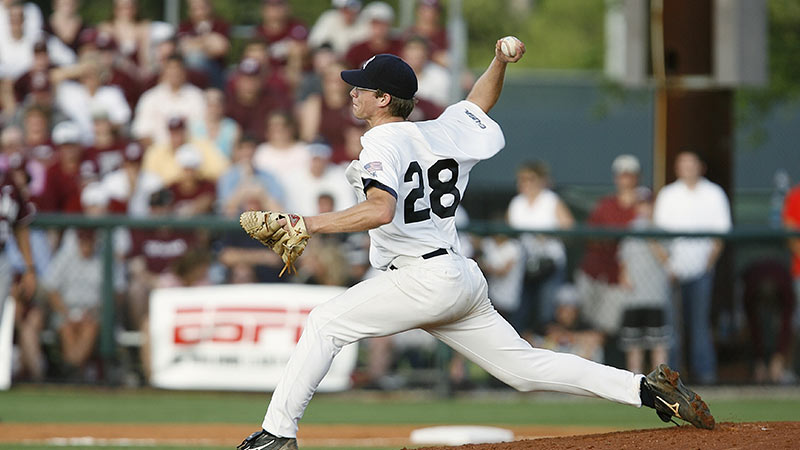
The difference between an elite ballplayer and an average one often comes down to the smallest details that occur before the arm even begins its forward motion.
While much of the attention in player development focuses on leg drive and arm slots, the invisible foundation of every successful throw is the grip.
Getting a proper hold on the ball every time you throw is the definitive first step to becoming a strong and accurate fielder.
In the high-stakes environment of professional play, consistency is the primary currency.
Whether you are a shortstop firing a ball across the diamond or an outfielder hitting a cutoff man, the four-seam grip is the gold standard for achieving maximum velocity, distance, and straight-line carry.
The Gold Standard: Understanding the Four-Seam Grip
To throw a baseball with maximum precision and “carry”—the ability of the ball to maintain its height and speed over distance—you must utilize the four-seam grip.
This specific orientation is designed to maximize backspin, which allows the ball to fight through wind resistance rather than being pushed by it.
The ideal hold is achieved by taking the index and middle fingers of your throwing hand and placing them perpendicular to the “horseshoe” or C-shaped part of the baseball’s seams.
This positioning is critical because it places the maximum amount of seam surface area in contact with your fingertips.
When you release the ball with this grip, your fingers are in the best possible position to pull down on those seams.
This action creates a clean, backward rotation known as backspin. Because the seams are rotating in a way that creates a consistent “true” flight, the ball will stay straight and on target.
The Anatomy of the Perfect Grip

Achieving the perfect four-seam grip requires attention to three specific areas: finger placement, thumb position, and the tension of the hand.
1. Finger Placement and Spacing
Place your index and middle fingers across the wide part of the seams. It is important to maintain a small, comfortable gap between these two fingers rather than pressing them together.
For optimal balance and to ensure the line of force is centered, you should aim to have your middle finger centered on the ball.
2. The 6 O’Clock Thumb Position
The thumb acts as the stabilizer for the entire throw. You should place your thumb directly underneath the center of the ball, which is often referred to as the “6 o’clock position”. When your thumb is properly aligned, it should point directly toward your target.
A common error among developing players is allowing the thumb to slide too far onto the side of the ball. This misalignment causes an unwanted “cutting” action, where the ball unintentionally drifts or “shoots” to one side during flight.
3. Pressure and the “Egg” Rule
One of the most nuanced aspects of throwing is the amount of pressure applied to the ball. Professional instruction suggests leaving a small pocket of space between your palm and the baseball.
You want to hold the ball firmly enough so that it does not drop, but loosely enough to minimize friction upon release.
A helpful analogy often used by coaches is to hold the ball as if you were holding a fragile bird or a delicate egg. This “loose” grip allows the ball to roll off the fingertips cleanly, maximizing the rotation that leads to a straight, powerful throw.
Modifications for Small Hands
It is important to acknowledge that not every player has the hand size of a Major League infielder. For younger athletes or those with smaller hands, a traditional two-finger grip may feel unstable.
In these cases, a three-finger grip is a perfectly acceptable modification. By placing three fingers across the seams while keeping them relatively close together, a player can gain the necessary control without sacrificing the benefits of the four-seam orientation.
As the player’s hands grow, they can eventually transition to the standard two-finger grip used at higher levels of play.
The Science of Flight: Why the Grip Matters
To understand why the four-seam grip is superior, one must look at the physics of wind resistance. If you were to grip the ball parallel with the horseshoe, the seams would catch the wind resistance as they spin backward. This uneven resistance causes the ball to “shoot” or drift to the left or right—and it will happen every single time.
The four-seam grip solves this by ensuring that the seams are rotating symmetrically. This symmetry creates a “true” spin that allows the ball to stay on a straight line.
For an infielder, this means the ball won’t “tail” away from the first baseman. For an outfielder, it means the ball will have the “carry” needed to reach the target without dying out mid-flight.
The “Quarter Turn” Technique: Fielding to Throwing
In the heat of a game, you rarely have the luxury of looking at the ball to find your grip. After you field a grounder or catch a fly ball, the ball will be in your hand in a different orientation every time. The elite skill is developing a “feel” for the ball so you can transition to a four-seam grip instantly.
The good news for players is that this transition is easier than it might seem. No matter how you initially grab the ball, you are never more than a quarter turn in any direction away from an ideal four-seam grip.
Integrating the Grip with Footwork
Finding the grip should happen during the transition from the glove to the throwing hand. A professional technique involves keeping the hand in the glove while holding the ball at the middle of the chest. While you are shuffling your feet in the direction of your target, you use that brief moment to find the seams.
By synchronizing your grip adjustment with your footwork, you ensure that by the time your arm is ready to fire, the ball is perfectly oriented.
This prevents the “high throw” that often happens when a player loses their drive because they are fiddling with the ball too long.
Professional Training Drills for Grip Consistency
Developing a pro-level feel for the baseball requires repetitive, low-intensity practice. You do not need a diamond or a teammate to improve this skill.
The Couch Drill
This is a simple drill that any player can do while sitting at home. Toss the ball up to yourself, catch it, and immediately find the proper four-seam grip as quickly as possible without looking at your hand.
Practice this until the “quarter turn” becomes second nature and your fingers instinctively find the seams.
The Active Catch Routine
During your daily warm-up, turn “playing catch” into a focused training session. Instead of just throwing, focus specifically on the “pull down” phase of the release.
Ensure the ball rolls off the tips of your first two fingers to generate that clean backspin. By being intentional during your warm-up, you build the muscle memory required for high-pressure game situations.
Expert Perspective: Insights from the Pros
The importance of the four-seam grip is echoed by those who have played at the highest levels. Doug Bernier, a Major League veteran with organizations like the Rockies and Yankees, emphasizes that getting a good grip every time is the fundamental first step to being an accurate and strong thrower.
Bernier’s experience across every infield position has shown that the most consistent throwers are those who have mastered the “feel” of the ball.
Whether you are charging a ball and fielding one-handed or making a routine play, the goal remains the same: find the seams, shuffle toward the target, and let the backspin do the work.
Conclusion: The Path to Defensive Excellence
Mastering the four-seam grip is not about strength; it is about precision and habit. By focusing on the perpendicular finger placement, the 6 o’clock thumb, and the “quarter turn” transition, you provide yourself with the best possible chance to make an accurate throw every time you take the field.
Consistency in your grip leads to consistency in your performance. Start with the Couch Drill tonight, and watch how much more “true” your throws become during your next game. Play hard, and remember that every great play starts with how you hold the ball.