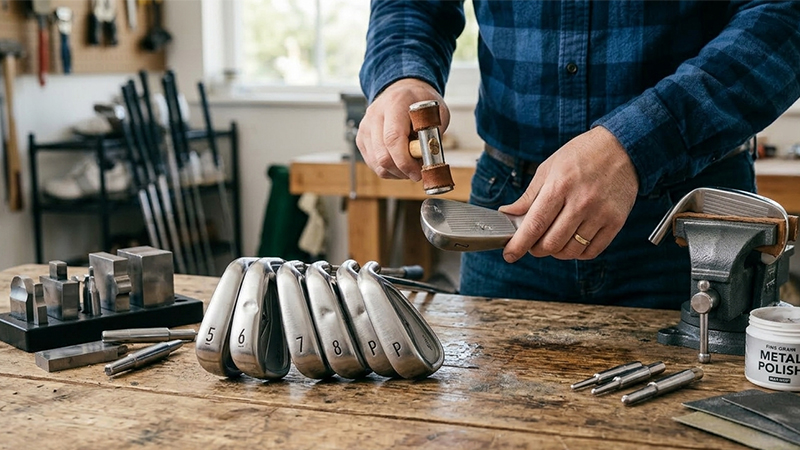
For the discerning golfer, a set of forged irons is more than just equipment; it is an investment in precision, feel, and performance.
Unlike cast irons, which are poured into molds, forged clubs are hammered into shape from a solid block of soft carbon steel.
This process creates a tight grain structure that provides the “buttery” feel sought after by low-handicap players.
However, that very softness makes them susceptible to the aesthetic and functional tolls of the game: nicks, scratches, and the dreaded “bag chatter.”
In this comprehensive guide, we will explore the professional standards for restoring these instruments. We will move beyond simple cleaning and delve into the mechanical processes required to return your irons to a showroom finish while maintaining their structural integrity.
The Anatomy of Damage: When to Repair and When to Replace
Before reaching for the workshop tools, a professional assessment is mandatory. The material properties of forged steel mean that while it is malleable enough to be repaired, it is also sensitive to weight distribution changes.
1. Assessing Structural Integrity
The primary concern during any restoration is the center of gravity (CG). Sources indicate that removing significant dents is exceptionally difficult, as deep impact damage often requires factory-level intervention. If a dent is deep enough to have displaced a significant amount of metal near the sole or the face’s “sweet spot,” the club’s performance profile may be permanently altered. In these instances, club replacement is often the safer, more performance-oriented choice to ensure consistent gapping and ball flight.
2. Identifying DIY-Friendly Imperfections
Minor imperfections, however, are perfectly suited for internal restoration. These include:
- Bag Chatter: Small dings caused by clubs knocking against each other in the bag.
- Surface Scratches: Linear marks from sand, stones, or hard turf.
- Minor Nicks: Small burrs on the leading edge or sole that do not penetrate the structural core of the head.
The Restoration Arsenal: Tools and Materials
To achieve a Fortune 500-level finish—one that rivals the original manufacturer’s luster—you must utilize the correct mechanical tools. Substituting high-grade shop equipment with “home hacks” often results in an uneven finish or, worse, ruined chrome.
1. Mechanical Equipment
- Bench Grinder: This serves as the powerhouse of your restoration station. It provides the consistent RPMs necessary for even metal removal.
- Deburring Wheel: A fine-textured deburring wheel is the professional’s choice for eliminating the “peaks” of small dings and scratches without gouging the base metal.
2. Abrasives and Polishing Media
- Sandpaper Grits: You must have a progression of sandpaper. Professional restoration requires moving systematically from coarse to fine grits. This “stepping” process ensures that each subsequent grit removes the scratch marks left by the previous one.
- Polishing Wheels: Use denim or loose cotton wheels for the final stages. Denim provides enough “bite” for initial polishing, while loose cotton allows for a high-gloss, mirror-like finish.
3. Specialty Compounds
The secret to a professional shine lies in the chemical composition of your polishing compounds:
- Black Emery: Used for initial heavy-duty polishing to remove coarse scratches.
- Green Compound: The final stage compound used to achieve a brilliant, high-luster finish.
The Step-by-Step Restoration Process
Restoring a forged iron is a subtractive process. You are carefully removing minute layers of metal to “level” the surface. Precision is paramount.
Step 1: Deburring the “High Spots”
Begin by using the bench grinder with a fine-textured deburring wheel. The goal here is not to grind the club down, but to gently “knock off” the raised edges of nicks and scratches. Hold the clubhead with a firm, two-handed grip, and use light, sweeping motions. Never hold the club in one spot for too long, as this can create flat spots or overheat the metal.
Step 2: Sequential Sanding
Once the burrs are removed, you must smooth the surrounding area. According to the sources, you should move from coarse to fine sandpaper.
- Start with a grit (e.g., 220 or 400) that can level the area where the ding was.
- Progress to finer grits (600, 800, then 1000+) to refine the surface.
- Pro Tip: Sanding in a consistent direction helps you see when the previous grit’s scratches have been fully removed.
Step 3: Initial Polishing (The Leveling Phase)
Switch to your bench grinder’s polishing wheel (denim is preferred for this stage). Apply black emery compound to the wheel. This compound is abrasive enough to blend the sanded areas with the rest of the clubhead. Focus on the sole and the back of the iron, avoiding the face’s grooves to ensure you don’t round off the sharp edges necessary for spin.
Step 4: Final Polishing (The Mirror Phase)
After the black emery has created a uniform, matte-satin finish, move to a loose cotton wheel and apply the green polishing compound. This stage is about aesthetics. The green compound will bring out the deep, silver luster characteristic of high-end forged steel. Use light pressure and let the speed of the wheel do the work.
Advanced Solutions: Repairing Deep Gouges
Occasionally, you will encounter a “rock ding”—a deep gouge that is too deep to sand away without compromising the club’s weight and balance.
In these cases, the sources suggest a specialized copper plating solution. This material acts as a filler for the damage.
- Application: The solution is used to fill the void of the gouge.
- Smoothing: Once the filler has set or bonded, it is smoothed down using the sanding and polishing steps mentioned above to match the original profile of the iron.
Note: This is an advanced technique. If the gouge is on the hitting surface (the face), consider that any filler material may have different friction properties than the surrounding steel, potentially affecting ball spin.
Maintaining the Standard: Post-Restoration Care
Once your irons have been restored to their former glory, maintaining that standard is essential for long-term value.
- Protecting the Surface: Forged steel is prone to oxidation if the protective chrome layer is thin. Regular cleaning with mild soap and immediate drying is non-negotiable.
- Preventing Bag Chatter: While controversial among traditionalists, high-quality iron covers or organized bag dividers are the only ways to truly prevent the recurring nicks that necessitate these repairs.
- Regular Inspections: Catching a small scratch early and treating it with a quick polish prevents it from becoming a deep-seated rust point or a more significant ding.
Enhanced FAQ: Professional Insights
Q: Can I use these methods on cast irons?
While these methods work on the surface of cast irons, cast steel is significantly harder than forged carbon steel. You may find that the deburring and sanding processes take much longer, and the final luster may not be as “deep” as it is on a forged head.
Q: Will polishing my irons change their weight?
Yes, but minimally. Professional restoration using fine compounds and deburring wheels removes only a fraction of a gram of material. However, aggressive grinding on a bench grinder can significantly alter the center of gravity and swing weight. This is why light, surgical movements are required.
Q: How often should I restore my irons?
Ideally, you should only perform a full mechanical restoration once every few seasons. Over-polishing can eventually wear down the “shoulders” of the club and thin the face. For day-to-day maintenance, stick to hand-polishing with a cloth and mild compound.
Conclusion: The Value of Precision
Restoring forged irons is an art form that sits at the intersection of metallurgy and craftsmanship. By utilizing bench grinders with deburring wheels and a disciplined sequence of polishing compounds, you can maintain a set of clubs that performs as well as it looks.
Remember: the goal of restoration is to honor the original engineering of the club. When in doubt—especially concerning deep structural dents that might shift the center of gravity—consult a professional factory repair center. For everything else, the tools and techniques outlined here will ensure your irons remain the pride of your golf bag.