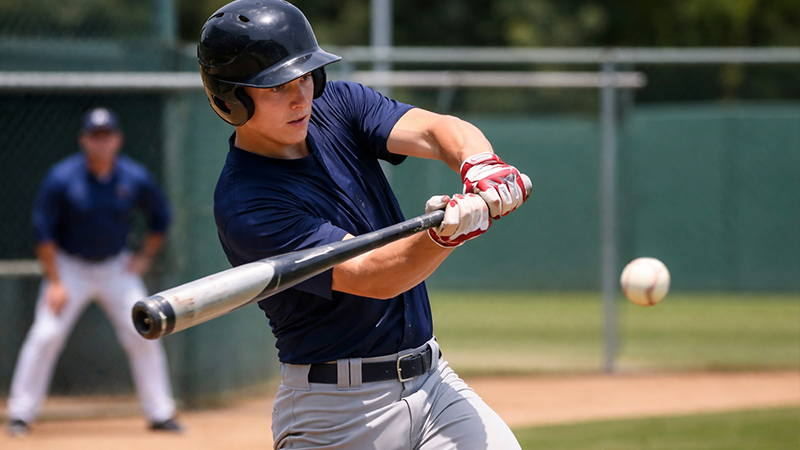
In the modern era of high-velocity pitching and the strategic “climbing the ladder” approach, hitters who cannot stabilize their hand position at stride landing are being exploited.
If your hitters are consistently swinging and missing, fouling back, or popping up pitches elevated in the zone, you are likely witnessing the “dropping hands” flaw. This mechanical inefficiency turns a hitter’s power into a liability.
At the Hitting Performance Lab, we don’t just advocate for “keeping the hands up” through verbal cues; we utilize Reactive Neuromuscular Training (RNT) and data-driven biomechanical benchmarks to create permanent, “sticky” changes in a hitter’s movement patterns.
The Biomechanical Diagnosis
The “2-Frame” Protocol for Modern Hitters
To fix a flaw, one must first define it with surgical precision. Many coaches misdiagnose a natural “live hand” load as a “drop.” According to Joey Myers, a former Division I player and corrective fitness expert, the diagnosis is revealed through slow-motion video analysis.
The primary benchmark is the back armpit line. At the exact moment of stride landing, the hitter’s hands must be positioned relative to this line.
- The Identification Rule: If the hands drop towards the waist 2 to 4 frames away from the back armpit line during the forward move, a correction is required.
- The Margin of Error: If the hands drop less than two frames, it is generally considered a minor movement that does not require intervention, as it may be part of a hitter’s unique “rhythm”.
Defining the “Bumper” Principle
In coaching, we often fall into the trap of demanding robotic perfection. However, human movement is better understood through the Bowling Alley Analogy.
Think of hitting principles as the “bumpers” in the gutters. The specific path the ball (or the hands) takes down the lane does not matter, provided the movement stays confined within the bumpers.
For hand height, the “bumpers” are positioned around the back armpit: slightly above, in-line, or slightly below are all acceptable Launch Positions.
The “Iron Mike” Power Posture
The Mike Tyson “Line”
To understand why hand height at landing is non-negotiable for power, we look to combat sports. Before delivering a knockout punch (excluding uppercuts), legendary boxer Mike Tyson would create a specific “line” with his hands to lock in his posture.
This “Iron Mike” reference illustrates a critical hitting truth: the hands, arms, and fingers channel energy from the core to the barrel.
By maintaining the hands near the armpit—the “top of the strike zone”—the hitter establishes a posture that allows for an effortless, sequenced delivery of force.
As noted in the HPL community discussions, “going up” during the swing sequence is a sign of being out of sequence; the swing should ideally move from the top down for maximum efficiency.
Advanced Entity Analysis: The Two-Bone Forearm Theory
A deeper investigation into hand complexity reveals that we should not view the forearm as a single entity.
The radius and ulna bones can be leveraged independently to control the “two swings” or “two loads” within a high-level move.
- The Flexion Connection: By understanding palmar flexion and the “fighting hands” posture (pushing against each other), a hitter can lock the lead arm into a position where it “whips out” because it has “no place else to go”.
- The Posture Lock: Boxers often touch their hands to their faces to lock their posture. Similarly, a hitter’s hand height at landing locks the upper-body “switch,” ensuring the “Catapult Loading System” can fire effectively.
The RNT Solution – Feeding the Mistake
What is Reactive Neuromuscular Training (RNT)?
Traditional coaching relies on conscious effort: “Keep your hands up!” This rarely works in a game-speed environment. RNT, or Reactive Neuromuscular Training, is a “sticky coaching” method that forces the hitter’s subconscious to solve the problem.
By “feeding the mistake”—pulling the hitter further into their flaw—the body’s nervous system is forced to react and self-correct. This moves the correction from the “robotic” conscious mind to the “sticky” subconscious movement patterns.
Step-by-Step: The RNT Band Drill
To implement this at home or at the field, you will need specific equipment: Tribe Resistance Bands (with door anchors) or Jaeger Sports J-Bands.
- The Setup: Anchor the resistance band to a fence or door at a height that allows the band to pull the hitter’s hands downward toward the waist.
- The Tension: The hitter takes their stance, holding the band handles (or the band itself) along with the bat.
- The Forward Move: As the hitter moves toward stride landing, the band tension will try to “drop” their hands.
- The Subconscious Fight: To maintain the “Armpit Benchmark,” the hitter must fight against the tension.
- The Result: The brain recognizes the downward pull as an “error” and automatically recruits the necessary musculature to keep the hands elevated in the “power line”.
Crucial Coaching Cue: Always focus on the process, not the performance. During RNT drills, the quality of the movement pattern is more important than the result of the ball on the tee or in the cage.
Section IV: Navigating the “V-Shape” Pitfall
While “dropping hands” is a primary concern for high pitches, there is a dangerous counter-flaw: starting too high.
The Danger of the V-Shaped Swing
Launching from excessively high hands can lead to a “V-shaped” swing path. This occurs when a hitter starts high, drops steeply to the ball, and tries to finish just as high. This path is rarely “on plane” with the pitch.
The “Nipple” Launch Point
Pro-level hitters often have “live” or “independent” hands that bounce or move during the load—this is a sign of a free-flowing, non-robotic movement.
However, as they move forward into the launch position, most elite hitters will bring their hands to a height roughly around the nipples or the middle of the chest to align with the plane of the ball.
To avoid the V-swing, emphasize a low finish. Finishing at the midpoint of the upper arm often fixes the swing plane automatically, ensuring the hitter stays through the zone longer.
Enhanced FAQ for Coaches & Parents
Q: My hitter’s hands are moving during the load. Is this always a “drop”?
A: No. Some movement is “live and independent,” which prevents a robotic, shoulder-controlled swing. Only intervene if the hands are consistently 2-4 frames below the back armpit at the moment of stride landing.
Q: How long does it take for the RNT Band Drill to work?
A: Because RNT targets the neuromuscular system, changes can happen very quickly—often within a single session. However, consistency is key to making the change “sticky” for game-time performance.
Q: Can this drill be used for both baseball and softball?
A: Absolutely. The physics of the “Catapult Loading System” and human movement principles apply across both sports. High-level velocity “up in the zone” is a challenge in both baseball and fastpitch softball that requires stable hand positioning.
Q: What if the hitter starts hitting pop-ups after this drill?
A: This may indicate they are over-correcting or launching from too high a position. Ensure they are aiming for the “Armpit/Nipple” launch area and focusing on a finish that is through the ball, rather than “flipping” the bat up.