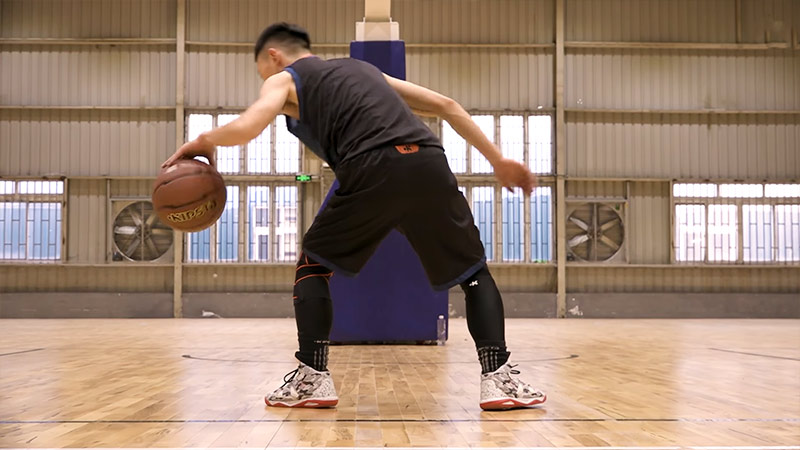
The behind-the-back crossover is often viewed as a highlight-reel staple, yet its true value lies in its functional efficiency as a tool for ball protection and rapid change of direction.
For players looking to elevate their game to an elite level, mastering this move is not merely about aesthetics; it is about developing a reliable method to navigate defensive pressure while maintaining a high offensive tempo.
This guide provides a comprehensive technical breakdown, troubleshooting strategies for common mechanical failures, and a progressive training protocol designed to transform this move from a practice drill into a game-ready asset.
The Strategic Value of the Behind-the-Back Move
At the highest levels of competition, space is a luxury. Defenders are coached to exploit any vulnerability in a player’s handle, particularly during a standard front crossover where the ball is momentarily exposed.
The behind-the-back crossover mitigates this risk by using the player’s own body as a physical shield between the defender and the ball.
However, many athletes find themselves frustrated when the ball repeatedly strikes their legs or lower back during execution.
These errors are rarely the result of a lack of talent; rather, they stem from foundational misalignments in posture and hand-eye coordination. By refining the underlying mechanics, any player can develop a crossover that is as secure as it is deceptive.
1: Establishing the Foundation—Stance and Posture
The success of a behind-the-back move begins before the ball even leaves your hand. Without the correct physical platform, the ball lacks the necessary clearance to travel from one side of the body to the other.
The “Sitting” Stance
To perform the move properly, you must adopt a low, wide athletic stance with your knees bent and your hips positioned back. A common cue used by elite trainers is to drop your hips as if you are preparing to sit in a chair.
This lower center of gravity is critical because it creates the physical window required for the ball to bounce cleanly under the buttocks without making contact with your feet.
Creating the “Arch”
One of the primary reasons players lose the ball is a lack of “wrap-around” space. To solve this, you should bend your shoulders back slightly while pushing your hips forward.
This adjustment creates a physical arch, providing more clearance behind your frame for a cleaner, more fluid dribble. When your hands and shoulders are closer to the ground, it becomes significantly easier to navigate the ball behind your legs.
2: Precision Mechanics—The Push and The Catch
Once the stance is established, the focus shifts to the technical execution of the dribble itself. This involves two distinct phases: the forceful “push” and the low “catch.”
The Correct Hand Placement
A frequent error that leads to a “carrying” or “palming” violation is placing the hand underneath the ball. To stay within the rules and maintain control, you must keep your hand on the outer side of the ball throughout the initiation of the move.
The Tight Wrap
When executing the move while moving, the ball should not travel in a wide, circular arc. A wide “windup” is slow and highly vulnerable to being poked away by an active defender.
Instead, the move must be quick, tight, and kept close to the body. The goal is a straight and rapid “wrap” that minimizes the time the ball is behind your back and out of your direct line of sight.
The Low Catch
The off-hand plays an equally important role in the success of the crossover. It should be kept low and positioned close to the opposite leg.
This positioning allows you to catch the ball immediately after it clears your frame, enabling a seamless transition into a drive toward the basket or a jump shot.
3: Troubleshooting Common Mechanical Errors
Even experienced players encounter hurdles when refining this move. Understanding the “why” behind a lost handle is the first step toward a permanent fix.
Problem: The ball keeps hitting my heels or calves.
- The Cause: This is almost always a result of standing too upright. When your legs are straight, the ball has no path to travel behind you without hitting your lower limbs.
- The Fix: Increase the bend in your knees. By lowering your entire frame, you change the angle of the bounce, allowing the ball to travel under the curve of your hamstrings rather than directly into the back of your legs.
Problem: I feel like I have to “wind up” to get enough power.
- The Cause: This usually indicates that the player is relying on their arm for power rather than a quick wrist snap.
- The Fix: Focus on the “push” toward your opposite back pocket. Use a sharp, downward flick of the wrist to generate speed, rather than a broad swinging motion of the arm.
Phase 4: A Progressive Training Framework
Mastery is achieved through high-volume, intentional repetition. The following drills are organized from basic muscle memory to advanced game-speed application.
Level 1: Stationary Muscle Memory
Before adding footwork, you must become comfortable with the sensation of the ball moving behind your frame.
- Wall Taps: Stand in your low athletic stance facing a wall. Repeatedly bounce the ball hand-to-hand behind your back. This builds the necessary rhythm and “feel” for the ball without the pressure of movement.
- The “Butt Slap” Cue: This is a highly effective mental and physical cue. As you release the ball, try to have your hand briefly slap the opposite buttock. This ensures your hand is traveling the full distance across your back, putting the ball in the perfect position for a quick catch.
- Standing Side-to-Side: Emulate elite ball handlers like Steph Curry by bouncing the ball behind your back from side to side repetitively while stationary. Start with short taps between your hands and gradually increase the distance as your control improves.
Level 2: Controlled Movement
Once the stationary mechanics are fluid, it is time to integrate movement.
- Circle Dribbling: Walk in a continuous circle while dribbling. Every few steps, execute a behind-the-back crossover. This forces you to manage the ball’s momentum while your body is in motion, helping you get comfortable with the move in both directions.
- The Expansion Drill: Start with your hands close together behind your back and tap the ball back and forth. Gradually expand how far your hands are apart and how high they are from the ground. This teaches you to adjust your handle based on different game scenarios.
Level 3: Dynamic Application
The final stage of training involves simulating the unpredictability of a real game.
- Lateral Movement Drills: Instead of moving forward, practice the behind-the-back crossover while moving side-to-side. This is particularly useful for perimeter players looking to create space for a shot.
- High-Knee Implementation: Once you can perform the move while walking, begin lifting your knees or increasing your pace to a jog. This adds a level of difficulty that requires superior timing and coordination.
Advanced Strategic FAQ
How can I make my behind-the-back move more deceptive?
Deception in basketball often comes from “selling” one direction before heading in another. Use your eyes and your lead shoulder to fake a drive to the strong side before snapping the ball behind your back. The more you can convince the defender you are going one way, the more effective the crossover will be.
Is it better to use a behind-the-back or a between-the-legs crossover?
Both have their place. A between-the-legs move is excellent for changing pace and keeping the ball protected while moving forward.
However, the behind-the-back crossover is often superior when you need to change direction completely or when a defender is playing “tight” on your hip, as it provides the maximum amount of body shielding.
How do I stop the ball from flying away when I try to go fast?
This usually happens because the player is “slapping” the ball rather than “pushing” it. Ensure your fingertips are the last thing to touch the ball, providing a final bit of guidance and spin that helps the ball land exactly where your off-hand is waiting.
Conclusion: The Path to Mastery
Mastering the behind-the-back crossover is a journey of refinement. It requires a commitment to the basics—stance, hand placement, and posture—long before you can expect to use it effectively under the lights of a competitive game. L
ike many aspects of high-level basketball, success is a product of consistent practice and endless repetition.
By starting with simple, stationary drills and gradually increasing the complexity and diversity of your training, you will develop the muscle memory necessary to execute this move instinctively.
Focus on creating space through your stance, keeping the motion tight to your body, and using cues like the “butt slap” to ensure precision.
With time, what once felt like an awkward, prone-to-error maneuver will become one of the most reliable and dangerous tools in your offensive repertoire.