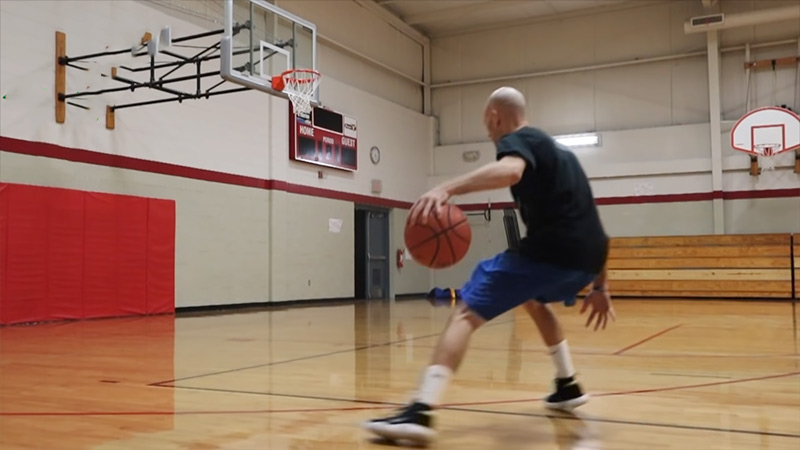
In the modern landscape of competitive basketball, the ability to navigate through high-pressure defensive schemes is the hallmark of an elite playmaker.
While the standard crossover remains a staple of the game, the behind-the-back dribble serves as a more advanced, secure method for changing direction while maintaining a physical barrier between the ball and the defender.
To master this move is to master the art of the “invisible” change of direction. It is a fundamental tool that utilizes your own body as a shield, allowing for seamless transitions in transition or half-court sets without exposing the ball to active hands.
This guide provides a comprehensive breakdown of the mechanics, tactical applications, and training regimens required to execute this move at a professional level.
The Fundamental Foundation: Why Body Mechanics Matter
Before a single dribble is taken, the success of the move is determined by your physical stance.
In basketball, the “low man” almost always wins the leverage battle. High-level ball handling is not merely about hand speed; it is an integrated movement involving the core, hips, and lower extremities.
Establishing a Low Center of Gravity
The first step in any effective change of direction is lowering your center of gravity. You must drop your hips and bend your knees deeply. This athletic stance provides two distinct advantages:
- Balance: A lower base makes you significantly harder to knock off your line by a physical defender.
- Explosive Potential: By pre-loading your muscles in a squat-like position, you create the tension necessary to explode past a defender once the move is completed.
Without this foundational low stance, the behind-the-back dribble becomes “loopy” and slow, making it easy for a defender to time their steal or recover their position.
The Mechanical Breakdown: A Step-by-Step Execution
Executing the perfect behind-the-back move requires a sequence of synchronized actions. It is a kinetic chain that starts from the floor and ends with a precise flick of the wrist.
1. The Pound Dribble: Generating Momentum
Many players make the mistake of trying to “guide” the ball behind their back from a resting state.
To create the velocity needed for the ball to clear your frame quickly, you must start with a “pound dribble.” This involves taking a hard, forceful dribble with your dominant hand directly next to your hip.
The momentum generated from this forceful contact with the floor is the engine of the move. It ensures the ball returns to your hand with enough energy to be directed behind your torso with minimal effort.
2. The Wrap and the Snap
As the ball rises from the pound dribble, the hand must migrate from the top of the ball to the side/back of the ball. Using your fingertips—rather than your palm—allows for greater control and “feel.”
You must use a snapping wrist motion to guide the ball behind your back. This “snap” is what gives the move its quickness. Simultaneously, your non-dominant hand must be prepared.
It should be waiting behind your body to either catch the ball or immediately push it forward into the new line of travel.
3. The Weight Shift: The Secret to the Blow-By
The most common point of failure for intermediate players is the feet. A behind-the-back dribble is useless if you remain in the same spot. To truly evade a defender, you must shift your weight in the direction of the new path.
As the ball moves behind you, you must explode off your back foot. For instance, if you are transitioning the ball from your right hand to your left hand, you must push off your right foot to propel yourself toward the left. This weight shift turns a ball-handling drill into a scoring threat.
Tactical Application: When and Why to Go Behind the Back
Strategic intelligence is what separates a flashy player from an effective one. The behind-the-back dribble is not a move for every occasion; it is a specialized tool for specific defensive looks.
Shielding Against Tight Pressure
When a defender is playing “up in your jersey,” a traditional crossover in front of your body is a high-risk maneuver. The defender’s hands are in the “passing lane” of your crossover.
By moving the ball behind your back, you use your entire torso and hips as a physical shield. The defender cannot reach the ball without reaching across their body, which usually results in a personal foul.
Maintaining Speed in Transition
On a fast break, stopping to perform a between-the-legs move can kill your momentum. The behind-the-back dribble allows you to change lanes while maintaining a linear sprint.
Because the ball follows the contour of your stride, you can shift from the middle of the floor to the wing without breaking your gait.
Advanced Drills for Elite Mastery
To reach a standard of excellence, these mechanics must be moved from conscious thought to subconscious muscle memory. The following training progression is designed to build that bridge.
Level 1: Stationary “V” Wraps
- Objective: To master the “snap” and the catch.
- Execution: Stand in a wide, low stance. Without moving your feet, perform continuous behind-the-back dribbles in a “V” shape. Focus on the force of the pound and the quickness of the exchange. Aim for 50 repetitions without a mistake.
Level 2: The Walking Wrap
- Objective: To synchronize the move with your stride.
- Execution: Walk slowly down the court. On every second step, perform a behind-the-back dribble. This teaches you how to time the “wrap” so the ball doesn’t hit your hamstrings or calves—a common error when learning the move.
Level 3: The Cone Zig-Zag
- Objective: To practice the explosion and weight shift.
- Execution: Set up cones in a zig-zag pattern. Approach each cone at game speed. Just before reaching the cone, drop your hips, perform the pound dribble, and explode behind your back to the next cone. This simulates the “blow-by” required to beat a real defender.
Common Pitfalls and How to Correct Them
Even professional athletes can struggle with this move if their fundamentals slip. Recognizing these errors is the first step toward correction.
- The “Hunchback” Error: Many players bend at the waist rather than the knees. This kills your balance and makes it impossible to see the floor. Always remember to drop your hips and keep your chest up.
- The Lazy Pound: If the pound dribble is too soft, the ball will not have the momentum to clear your back, leading to a turnover. The dribble must be forceful.
- Looking at the Ball: If you have to look at the ball to complete the move, you cannot see the open teammate or the help defender. Practice in the dark or with your eyes on a fixed point on the wall to develop “kinesthetic awareness.”
Enhanced FAQ: Addressing Technical Nuances
Q: Is the behind-the-back move legal in all levels of play?
A: Yes. As long as your hand remains on top of the ball and you do not “carry” or “palm” it during the wrap, it is a legal basketball move. The key is the snapping motion of the wrist.
Q: How do I prevent the ball from hitting my legs?
A: This usually happens because your hips are too high or the ball is being released too late. By dropping your hips lower, you create a larger “window” behind your glutes for the ball to travel through.
Q: Which is better: a crossover or a behind-the-back?
A: Neither is “better,” but they serve different purposes. Use a crossover for quickness when you have space. Use a behind-the-back when the defender is close and you need to protect the ball with your body.
Q: Can I use this move to step back for a jumper?
A: Absolutely. A “behind-the-back step-back” is an elite scoring move. It involves the same pound and wrap, but instead of exploding forward, you use that back-foot pressure to push yourself backward into a shooting pocket.
The Psychological Component: Confidence and Composure
The final layer of mastery is the mental game. To use this move in a high-stakes environment, you must have the confidence to fail during practice.
You will lose the ball, it will hit your heels, and it will go out of bounds during your training sessions. This is a necessary part of the “remapping” process in your brain.
Once the mechanics are fluid, the move becomes a “security blanket.” You no longer fear tight pressure because you know you have a shielded way to escape.
This composure allows you to keep your head up, read the defense, and make the right play for your team.
Conclusion: Elevating Your Game
Mastering the behind-the-back dribble is a transformative milestone for any basketball player. It signifies a transition from a basic ball handler to a sophisticated playmaker who understands leverage, protection, and explosive movement.
By consistently focusing on a low center of gravity, a forceful pound dribble, and a decisive weight shift, you turn a simple change of direction into a professional-grade weapon.
The court is a game of angles and shields; the behind-the-back move ensures you own both.