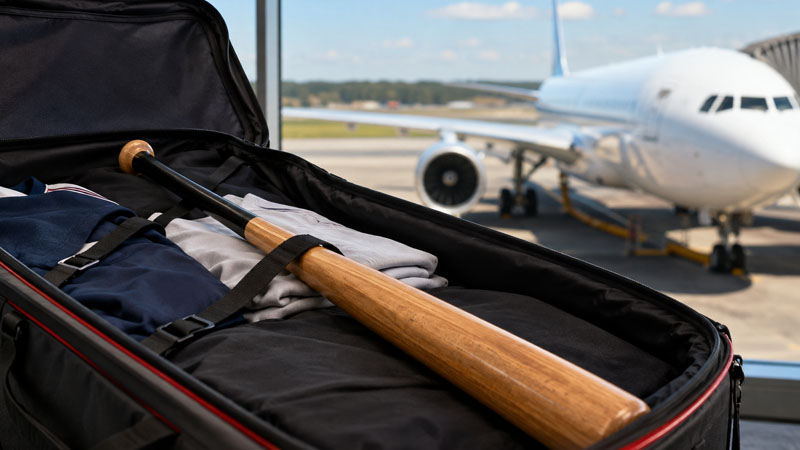
Transportation security regulations strictly prohibit baseball, softball, and T-ball bats inside airplane passenger cabins.
Aviation security authorities classify all bats—regardless of material, length, or age group—as blunt instruments capable of being used as weapons.
Attempting to bring a bat through an airport security checkpoint will result in immediate confiscation or being sent back to the check-in desk.
To travel with your equipment without delay or damage, you must check your bat at the airline counter before clearing security.
TSA & International Aviation Regulations
Aviation security frameworks worldwide hold uniform standards regarding sports equipment that functions as a potential bludgeon.
| Governing Authority | Region | Cabin Allowance | Checked Luggage Allowance | Special Notes |
| TSA | United States | Prohibited | Allowed | Applies to wood, alloy, composite, and mini souvenir bats |
| CATSA | Canada | Prohibited | Allowed | Strictly enforced across all commercial airports |
| EASA / EU | Europe | Prohibited | Allowed | Categorized under blunt impact items |
| CASA | Australia | Prohibited | Allowed | Must be stowed securely inside primary checked bag |
Material Exceptions
There are no exemptions for bat composition or size:
- Composite & Alloy Bats: High-end adult baseball and softball bats must be checked.
- Wooden Bats: Maple, ash, and birch bats require checked status and extra impact protection against cold altitude storage.
- Youth & Teeball Bats: Even lightweight junior bats are restricted from carry-on bags.
- Collectible & Mini Souvenir Bats: Display bats, autographed memorabilia, and novelty mini-bats are treated under the same restrictions as full-sized equipment.
Step-by-Step Packing Guide for Maximum Equipment Protection
Checked baggage undergoes rapid conveyor sorting and pressurized cargo handling. Protecting high-value composite and wood bats requires structured packing techniques to prevent denting, cracking, or handle snapping.
Carry-On vs. Checked Gear Breakdown
When traveling for tournaments or team trips, strategically separate your gear between checked luggage and carry-on bags to minimize the risk of lost equipment disrupting play.
| Equipment Item | Transport Method | Justification |
| Baseball / Softball Bats | Checked Only | Security compliance rules prohibit cabin transit. |
| Fielding Glove | Carry-On Highly Recommended | Custom gloves are broken-in and irreplaceable on short notice. |
| Batting Gloves & Sleeves | Carry-On | Lightweight items that take minimal cabin space. |
| Uniforms & Cleats | Carry-On | Ensures ability to play even if checked bags are delayed. |
| Helmets & Catcher’s Gear | Checked or Carry-On | Fits in larger carry-on rollers or central checked duffels. |
Major Airline Baggage Policies & Oversized Fees
Standard baseball bats measure 27 to 34 inches, easily fitting within standard 62-linear-inch checked luggage dimensions. However, long multi-bat team bags may trigger oversized or overweight evaluation.
Airline Rules Comparison
- Delta Air Lines: Allows standard bat bags as regular checked luggage. Bags exceeding 62 linear inches or 50 lbs incur standard excess fees.
- United Airlines: Accepts baseball equipment bags as standard checked luggage. If the bag contains only sports gear, standard checked bag rates apply up to 50 lbs.
- American Airlines: Equipment bags containing bats are treated as standard checked items, provided they remain within weight limits (50 lbs for main cabin).
- Southwest Airlines: Players can count a bat bag as one of their two free checked bags, provided it stays under 50 lbs and 62 linear inches.
Frequently Asked Questions
Can I bring a mini souvenir baseball bat in my carry-on bag?
No. Security agents classify mini bats, novelty wooden clubs, and collectible display bats as potential blunt weapons. All size variations must be placed in checked baggage.
What should I do if I accidentally bring a bat to the security checkpoint?
If time permits before your flight, exit the security line, return to the airline ticket counter, and pay to check the bag containing the bat. Alternatively, some major airports feature post-office kiosks where you can mail the item to your destination, though this is costly. Unattended or surrendered bats at checkpoints are permanently confiscated.
How do temperature changes in cargo holds affect high-end bats?
Modern composite and alloy bats tolerate cargo hold pressurized environments well. However, extreme cold can make wood bats temporarily brittle. Allow your wood bats to reach ambient room temperature for a few hours before using them in high-velocity batting practice.
Do I need a hard-shell case to fly with expensive bats?
While a hard case offers maximum protection, a padded rolling bat bag reinforced with internal clothing or bubble wrap is sufficient for most commercial flights.
Conclusion
Flying with a baseball bat does not have to be stressful when you plan ahead. Always stow your bats inside checked luggage with generous padding to prevent impact damage during airport handling.
Keep your most critical, irreplaceable items—like your broken-in glove and uniform—in your carry-on bag so you are game-ready even if your main luggage is delayed.
Finally, review your specific airline’s baggage fees and weight limits before departing. By following security guidelines and packing strategically, you protect your investment and ensure a seamless journey to your next game or tournament.