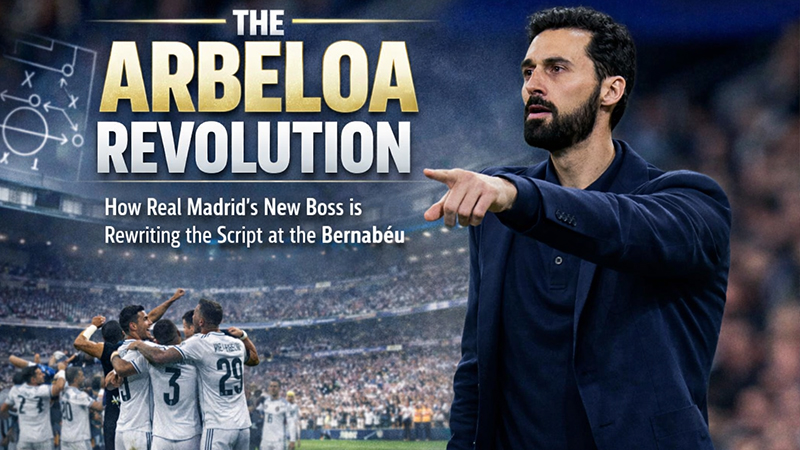
When Alvaro Arbeloa walked through the doors of the Valdebebas training ground as Real Madrid’s new head coach in January, the atmosphere was one of profound uncertainty.
Stepping into one of the most pressurized roles in world football mid-season is a daunting task for even the most seasoned veterans, let alone a manager tasked with navigating a packed fixture schedule that allowed virtually no time for a traditional “honeymoon period” or tactical bedding-in.
Spanish media outlets were quick to highlight the immense challenges ahead, specifically questioning whether the former Liverpool and Real Madrid defender possessed the gravitas to manage a dressing room teeming with global superstars and massive personalities.
Yet, two months into his tenure, the narrative has shifted from skepticism to admiration. Arbeloa hasn’t just steadied the ship; he has revitalized a squad that appeared to be drifting under previous leadership, guiding them through a gauntlet of elite opposition and narrowing the gap in the title race.
By focusing on human connection over tactical rigidity, Arbeloa is proving that sometimes the best way to manage stars is simply to understand them.
Building Bridges in the Midst of Chaos
The timing of Arbeloa’s appointment meant that his first few weeks were spent in the dugout rather than on the training pitch.
“I arrived at a time when I practically had no time to work with the players,” Arbeloa recently reflected, noting the difficulty of understanding player dynamics on the fly.
His primary objective was to observe how the team functioned under pressure and to identify where individual players felt most comfortable.
Unlike many modern coaches who arrive with a fixed “system” to which players must adapt, Arbeloa’s approach has been centered on personal and professional evolution.
He has spent the last two months meticulously learning the nuances of his squad—seeing how they mix with each other and where he can make the small adjustments that lead to maximum performance.
This philosophy was put to the ultimate test in March, a month that saw Real Madrid face a “murderer’s row” of managerial icons.
Arbeloa emerged victorious against Jose Mourinho’s Benfica, Pep Guardiola’s Manchester City, and Diego Simeone’s Atletico Madrid, a feat that has silenced many of his initial critics.
The Unlocking of Vinicius Jr.
Perhaps the most visible success of the Arbeloa era has been the explosive resurgence of Vinicius Jr. Under the previous management of Xabi Alonso, the Brazilian forward appeared stifled and increasingly frustrated.
Reports from October’s Clásico suggested a breaking point, with Vinicius allegedly muttering “I’m going to leave this team” after being substituted. His output reflected this discontent, as he managed only six goals in 27 appearances under Alonso.
Arbeloa recognized that Vinicius is a player who thrives on freedom and emotional backing. Rather than restricting him with complex tactical instructions, the new boss encouraged him to play with the joy that defined his early career.
“We want to see the Vini who enjoys playing, who laughs, who dances… that’s the Vini I want to see,” Arbeloa declared during his introductory press conference.
The results have been nothing short of spectacular. Vinicius has started 16 of Arbeloa’s 17 games in charge, and his productivity has soared to 11 goals in that short span.
Beyond the statistics, the player’s psychological state has undergone a complete 180-degree turn.
After putting his future on hold last summer, Vinicius recently committed his long-term future to the club, stating his desire to stay at the Bernabéu for “a long time”.
Arbeloa’s public defense of the winger, labeling him “the most dangerous player in the world,” has clearly fostered a sense of security that was previously missing.
Restoring the “Engine Room”: The Fede Valverde Shift
While Vinicius has provided the flair, Fede Valverde has provided the renewed power in the heart of the team.
During Alonso’s tenure, Valverde was often the victim of his own versatility, frequently deployed as a makeshift right-back due to injuries to Dani Carvajal and Trent Alexander-Arnold.
While Valverde performed these duties professionally, his frustration was palpable, famously stating, “I wasn’t born to be a right-back“.
Arbeloa’s arrival signaled a return to basics for the Uruguayan. By restoring Valverde to his natural midfield role, Arbeloa has unleashed a scoring threat that was previously dormant.
Under the current regime, Valverde has started every single game, contributing seven goals and five assists in just 17 appearances—already surpassing his total goal output from his 31 games under Alonso.
His recent form has been world-class, highlighted by a stunning hat-trick against Manchester City and the winning goal in the recent 3–2 derby victory over Atletico Madrid.
The Youth Revolution: A Dream Realized
Arbeloa’s transition to the first-team job was aided significantly by his recent history as the head coach of Real Madrid’s reserve team, Castilla.
This background has allowed him to integrate young talent with a level of seamlessness rarely seen at a club of Madrid’s stature.
This was most evident in a recent fixture against Elche, where Arbeloa handed minutes to six academy graduates, including Gonzalo Garcia, Daniel Yanez, and Diego Aguado.
The standout among these “Arbeloa proteges” has been Thiago Pitarch. At just 18 years old, Pitarch has already made history by becoming the youngest player to start twice in the Champions League knockout stages, remarkably beating the record previously held by Vinicius Jr. by 10 days.
For Arbeloa, seeing these players succeed on the grand stage of the Santiago Bernabéu is more than just a tactical victory; it is deeply personal.
Having coached many of them since they were 13 or 14 years old, he described the experience of giving them their first-team debuts as a “dream come true,” even stating he could “die happy” after witnessing their success.
This bridge between the academy and the first team provides Real Madrid with a sustainable path forward that leverages Arbeloa’s unique intimate knowledge of the club’s youth pipeline.
The Road Ahead: Evolution and Silverware
Despite the individual success stories and the impressive run of results in March, Arbeloa is the first to admit that his team is still a work in progress.
Real Madrid currently sits four points behind Barcelona in the La Liga standings, making the upcoming Clásico in May a potentially season-defining encounter.
Furthermore, the continental pressure remains high with a looming Champions League quarter-final tie against Bayern Munich.
The manager remains focused on the “constant evolution” of the squad. As key players like Eder Militao and Jude Bellingham return from long-term injury layoffs, Arbeloa faces the new challenge of integrating them into a winning system without disrupting the current chemistry.
“I still have a lot to learn because we’re gradually recovering players I haven’t worked with yet,” he admitted following the Atletico win.
With a grueling schedule that presents a “test every three days,” there is no room for complacency. However, if the first two months of the Arbeloa era are any indication, the “Spartan” has found a way to blend the high-octane talent of Madrid’s superstars with the hungry ambition of its youth.
By prioritizing relationships and confidence, Alvaro Arbeloa hasn’t just managed Real Madrid; he has reconnected the club with its own identity.
Whether this will result in a trophy-laden season remains to be seen, but for the fans at the Bernabéu, the sight of a “dancing” Vinicius and a thriving Valverde suggests that the future is in very capable hands.