You’ve finally done it. The watch has been presented, the office desk is cleared, and for the first time in decades, your Monday morning belongs to the fairway rather than the boardroom.
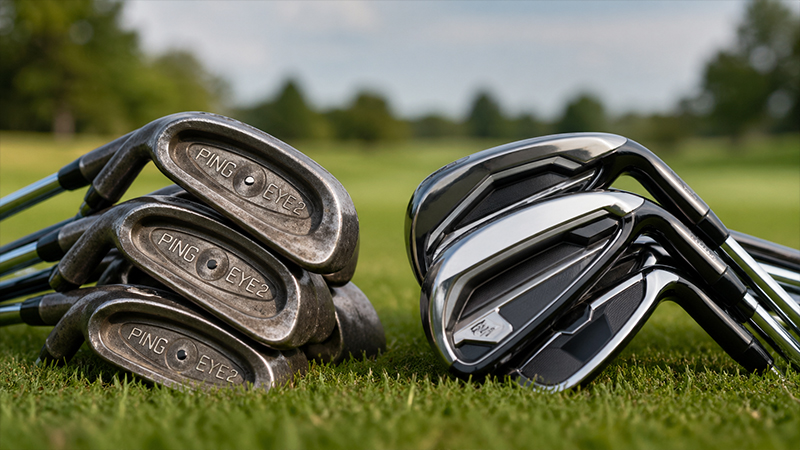
You head to the garage, pull aside a few moving boxes, and there they are—your Ping Eye 2 irons. They are iconic, indestructible, and carried you through your best rounds in the late 80s and 90s.
But as you stand on the first tee, watching a playing partner launch a towering 7-iron that seems to defy the laws of physics, a nagging question arises: Are these 30-year-old clubs a timeless classic or a technical handicap?
As a retiree returning to the game, you are facing the “Ping Eye 2 Dilemma.” Should you honor the nostalgia of your legacy gear, or is it time to leverage 21st-century engineering to make your retirement rounds more enjoyable?
Drawing on expert community insights and modern mechanical data, this guide explores whether your “old friends” are still up to par.
The Legend of the Ping Eye 2: More Than Just Metal
Before we discuss upgrading, we must respect the pedigree. Produced primarily between 1982 and 1990, the Ping Eye 2 is widely considered one of the most successful iron designs in the history of the sport.
Their longevity is not a fluke; they were pioneers in “perimeter weighting,” a design philosophy that moved mass to the edges of the clubhead to increase stability.
For many golfers, these clubs are “timeless”. They offer a “pure, better-than-sex feeling” on a perfectly struck ball that many modern, hollow-bodied irons struggle to replicate.
However, there is a common misconception about their age—if you’re dusting them off today, they aren’t just 25 years old; they are likely closer to 40.
While the stainless steel heads may look pristine, the technology inside them belongs to a different era of the game.
The Tech Gap: What “Game Improvement” Actually Means
The most significant advancement in the last four decades isn’t how far a club hits the ball on a perfect strike—it’s how little you are punished for a bad one.
The Forgiveness Factor
In the world of legacy clubs like the Eye 2, a well-struck ball feels amazing, but a poorly struck ball feels “like garbage”. More importantly, a “garbage” strike with an old iron results in a massive loss of distance and a significant offline deviation.
Modern “Game Improvement” irons (such as the Mizuno JPX Hot Metal or TaylorMade SIM2) are engineered with a much higher Moment of Inertia (MOI). This means:
- Off-Center Stability: If you hit the ball off the toe or the heel, the clubhead resists twisting.
- Correctional Launch: Poorly struck balls with modern tech still tend to go “mostly straight and in the air”.
- Ball Speed Retention: Even on a “thin” or “fat” strike, modern faces are designed to flex, ensuring you still reach the front of the green rather than falling 20 yards short.
The Mystery of “Loft Jacking”
One of the first things you’ll notice if you demo new clubs is that you’re hitting your 7-iron 15 to 20 yards further. While manufacturers point to “space-age materials,” much of this is due to Loft Jacking.
Over the last 40 years, lofts have become progressively “stronger.” A modern 9-iron often has the same loft as a vintage Ping Eye 2 8-iron.
Essentially, when you hit a modern 7-iron, you are often hitting the equivalent of an old 5 or 6-iron. However, modern tech adds a twist: even with these stronger lofts, the clubs are designed with a lower center of gravity, resulting in a noticeably higher ball flight and a “hotter” launch.
You get more carry and a steeper descent angle, which helps the ball stop faster on the green—a win-win for the senior golfer.
Ergonomics and the Aging Athlete: Why Your Joints Care
Retirement golf is about longevity. You want to be able to play 18 holes on Tuesday and still feel good enough to play again on Thursday. This is where your 1980s steel shafts may be working against you.
Impact and Vibration
As we age, our bodies—particularly our elbows and wrists—become less resilient to the harsh vibrations of a “mis-hit” golf ball. Legacy steel shafts are heavy and transmit every bit of that “garbage” feel directly into your joints.
Upgrading to graphite shafts is no longer just for “slow swingers.” Modern high-performance graphite is designed to:
- Dampen Vibration: Protecting your elbows from the impact of firm turf.
- Increase Swing Speed: Being lighter, they allow you to generate more clubhead speed with less physical effort.
- Reduce Fatigue: Allowing you to “hit a couple of buckets of balls without wearing yourself out”.
The Evolution of the “Big Stick”
While irons have evolved steadily, woods and drivers have experienced a revolution. If your fairway woods are as old as your Eye 2s, you are likely playing with wooden or early-generation small-headed steel clubs.
Modern drivers are 460cc giants with adjustable lofts and weights—features that “blow the mind” of golfers returning from a long hiatus. Replacing the “woods” in your bag is often considered a higher priority than replacing the irons.
The Financial Reality: Refurbish vs. Replace
You might be tempted to simply re-grip and “tune up” your old Pings. However, the economics often favor a fresh start.
- Refurbishment Costs: When you factor in the cost of professional re-gripping, potential re-shafting to graphite, and sharpening grooves, the total can approach the price of a high-quality used set of modern clubs.
- The “Trade-In” Goldmine: Your Ping Eye 2s have a cult following. A standard set can fetch $150–$200, and if you are lucky enough to own the Copper (Beryllium) version, they can sell for double that. That’s a significant “down payment” on a modern set.
- Value Hunting: You don’t need to spend $2,000 on the latest showroom models. Sites like Callaway Pre-owned offer “the best pricing hands down” for tech that is only 2–3 years old—which will still feel like a light-year jump from the 80s.
Your Retirement Success Plan: The “4-Month Rule”
If you’ve just retired, the impulse is to buy “new toys” immediately to celebrate. While you certainly deserve the “sticks,” the wisest move is a tactical transition.
1: The Re-Entry (Months 1–3)
Don’t buy on day one. Your swing today is not the swing you will have after three months of regular play. Dust off the Eye 2s and play with them for a season. Use this time to “fix the swing first” and find your rhythm.
2: The Assessment
Go to a local pro shop and “test out some newer irons” just to feel the difference. You may find that while you like the new irons, you still prefer your Eye 2 wedges—which many golfers continue to “game” because their shape and turf interaction are still world-class.
3: The Professional Fitting
Once your “golf muscles” are back, get a professional fitting. A fitter will match your current swing speed to the correct shaft flex and lie angle. This ensures you aren’t just buying “better” clubs, but clubs that are optimized for the golfer you are today.
Enhanced FAQ: Navigating the Legacy Transition
Q: Are my Ping Eye 2s “illegal” because of the grooves?
A: For the vast majority of amateur play, no. While there was a famous controversy regarding the grooves, they remain legal for general play and most club tournaments. If they “sent the ball into the air 20 years ago, they still will today”.
Q: If I keep my old clubs, should I sharpen the grooves?
A: It can help with spin, especially on wedges. However, if the grooves are “totally worn out,” the club is effectively dead, and no amount of sharpening will restore the original flight characteristics.
Q: I’m on a fixed income now; is the $1,000+ investment really worth it?
A: It depends on your goals. If you play once a month for the social aspect, the Pings are fine. If you plan to play 2–3 times a week, the reduced physical fatigue and increased forgiveness of modern clubs will significantly improve your quality of life on and off the course.
Q: Is “Loft Jacking” just a marketing scam?
A: Not entirely. While the numbers on the bottom of the club are misleading, the technology allows those stronger-lofted clubs to launch higher and land softer than an old club of the same loft. It is a genuine performance upgrade, even if the “extra distance” is partially a result of the loft change.
Conclusion: You’ve Earned the Upgrade
There is no denying that the Ping Eye 2 is a “timeless” masterpiece of engineering. If you are “dialed into them like they are an extension of your body,” there is a strong argument for keeping them.
However, golf is a game of misses. Modern technology is designed to make your “garbage” shots playable, your “good” shots effortless, and your body less achy the next morning.
You’ve spent decades working hard; your retirement golf should be about enjoyment, not struggling against antiquated equipment.