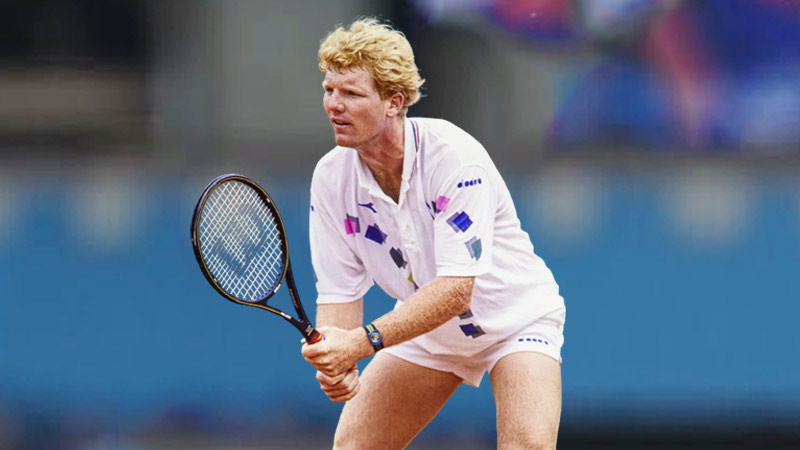
Jim Courier won four Grand Slam singles majors during his illustrious professional career. His championship run was defined by incredible consistency and physical baseline play, primarily between 1991 and 1993.
During this period, he secured two French Open titles and two Australian Open titles, establishing himself as a dominant force on both clay and hard courts.
Beyond his four victories, Courier reached an additional three major finals, bringing his total to seven championship appearances.
His rapid ascent led him to become the youngest man to reach the finals of all four Grand Slams, a legendary record that remained unbroken for thirty-two years.
How Many Grand Slam Titles Did Jim Courier Win?
The hallmark of Jim Courier’s career was a concentrated period of absolute dominance on the global stage, where he secured four major championships in just three years.
These victories were not merely isolated successes but a testament to his versatility across different playing environments.
He managed to capture back-to-back titles at two of the most physically demanding tournaments in the world: the French Open and the Australian Open.
This era of excellence allowed him to cement his place among the legends of the game, showcasing a level of grit and baseline power that became his signature on the ATP Tour.
Mastering the Red Clay of Paris
Jim Courier’s first taste of major glory came at the 1891 French Open, where he defeated Andre Agassi in a grueling five-set final. This victory was significant as it marked the arrival of a new power player in American tennis who could thrive on the slow clay.
He followed this up in 1992 by successfully defending his title at Roland Garros, this time defeating Petr Korda in a clinical straight-sets performance.
His ability to maintain a 40–9 match record at the French Open highlights just how comfortable he was on the red dirt, making it his most successful major in terms of total wins.
Conquering the Hard Courts of Melbourne
While he was mastering clay, Courier was simultaneously proving his worth on the hard courts of the Australian Open. In 1992, he faced the serve-and-volley specialist Stefan Edberg in the final, overcoming him in four sets to claim his first title in Melbourne.
The following year, 1993, saw a repeat of this matchup in the championship round, with Courier once again emerging victorious over Edberg to secure his second consecutive Australian Open crown.
His overall record in Melbourne stood at an impressive 35–7, reflecting a winning percentage that few could match during that era.
A Legacy of Consistency Across All Surfaces
The sheer impact of winning four majors in a three-year window cannot be overstated. Between 1991 and 1993, Courier was arguably the most feared player in the world, combining physical fitness with a heavy forehand that dictated play from the back of the court.
His four titles represent a peak of performance that elevated him to the very top of the rankings, proving that he had the tactical intelligence to adjust his game for both the high-bouncing clay of Paris and the faster hard courts of Australia.
Understanding Jim Courier’s Seven Major Final Appearances
While Jim Courier is celebrated for his four victories, his legacy is also defined by the three times he narrowly missed out on additional hardware.
Reaching a total of seven Grand Slam finals is a rare feat that places him in an elite bracket of players who were perennial contenders throughout their prime.
These runner-up finishes occurred at three different majors, further proving that he was a threat regardless of the tournament location or surface.
| Tournament | Year | Outcome | Opponent in Final |
|---|---|---|---|
| French Open | 1991 | Winner | Andre Agassi |
| US Open | 1991 | Runner-Up | Stefan Edberg |
| Australian Open | 1992 | Winner | Stefan Edberg |
| French Open | 1992 | Winner | Petr Korda |
| Australian Open | 1993 | Winner | Stefan Edberg |
| French Open | 1993 | Runner-Up | Sergi Bruguera |
| Wimbledon | 1993 | Runner-Up | Pete Sampras |
The Historic Milestone: Youngest to Reach All Four Finals
One of the most remarkable aspects of Jim Courier’s career was the speed at which he achieved full-spectrum success across the Grand Slam calendar.
By reaching the final of Wimbledon in 1993, he completed a set of championship appearances at all four majors—the Australian Open, French Open, Wimbledon, and the US Open.
At the time of this achievement, he was only 22 years and 11 months old (specifically 22 years and 319 days), making him the youngest man in the Open Era to reach the singles finals of every Grand Slam tournament.
A Record That Stood for Three Decades
The longevity of Courier’s “youngest to all four finals” record is a testament to the difficulty of modern tennis and the specialization required for different surfaces.
For over 32 years, legendary figures like Pete Sampras, Andre Agassi, Roger Federer, Rafael Nadal, and Novak Djokovic were unable to match the youthful speed of Courier’s comprehensive success.
It was an achievement that highlighted not just his talent, but his immediate adaptability to the unique demands of grass, clay, and hard courts early in his professional life.
The Passing of the Torch to Carlos Alcaraz
Courier’s historic milestone remained the gold standard for young players until the 2026 Australian Open. It was at this tournament that Carlos Alcaraz finally eclipsed the record, becoming the new youngest man to reach all four major finals.
While the record has now been surpassed, the fact that it took three decades and a generational talent like Alcaraz to break it serves to reinforce the magnitude of what Courier accomplished in the early 1990s.
Statistical Breakdown of Career Match Records
To truly appreciate the depth of Jim Courier’s excellence, one must look at his match-by-match consistency throughout the four Grand Slam events. Over the course of his career, he amassed a total win-loss record of 118–38 in major tournaments.
This high winning percentage was built on a foundation of deep runs and an ability to avoid early-round upsets, particularly during his peak years.
- French Open Efficiency: With a 40–9 record, the clay of Paris was statistically his best environment, yielding two titles and a runner-up finish.
- Australian Open Dominance: His 35–7 record in Melbourne included back-to-back championships and some of his most memorable battles against Stefan Edberg.
- US Open Reliability: Despite never winning the title in New York, he maintained a strong 24–10 record, highlighted by his runner-up finish in 1991.
- Wimbledon Adaptability: Often considered a surface less suited to baseline grinders, Courier still managed a 19–11 record on grass, reaching the final in 1993.
Reaching the Pinnacle: World No. 1 Ranking
Jim Courier’s major victories were the primary engine behind his ascent to the top of the ATP rankings. On February 10, 1992, following his first triumph in Australia and his continued success on the tour, he officially became the World No. 1.
This was a significant moment in tennis history, as he became the face of a new generation of players who brought a higher level of physicality and intensity to every point.
A Year at the Top of the World
Courier did not just visit the top spot; he inhabited it. He held the World No. 1 ranking for a cumulative total of 58 weeks.
During this time, he was the man to beat at every tournament, carrying the pressure of the top seed while continuing to produce the results necessary to maintain his position.
His reign at the top coincided with one of the most competitive eras in men’s tennis, as he battled for supremacy against other Hall of Fame talents.
The Impact of 58 Weeks at Number One
Holding the top ranking for over a year is a benchmark of true greatness that separates multiple-slam winners from the rest of the elite. For Courier, these 58 weeks represented the culmination of his hard work and the validation of his playing style.
His time at No. 1 ensured that his name would always be mentioned alongside the absolute best to ever play the sport, providing a statistical anchor to his four major titles and seven final appearances.
Essential FAQ: Jim Courier’s Grand Slam Career
Which Grand Slams did Jim Courier win?
Jim Courier won two different Grand Slam tournaments, capturing the French Open and the Australian Open twice each. He won the French Open in 1991 and 1992, and he secured the Australian Open titles in 1992 and 1993.
Who was the opponent Jim Courier defeated most in major finals?
Stefan Edberg was Courier’s most frequent opponent in Grand Slam finals. Courier defeated Edberg in the 1992 and 1993 Australian Open finals, although he lost to the Swede in the 1991 US Open final.
How long did Jim Courier hold his “youngest to all four finals” record?
Courier held the record for over 32 years. He achieved the feat at the age of 22 years and 319 days in 1993, and the record stood until Carlos Alcaraz broke it during the 2026 Australian Open.
What was Courier’s total win-loss record in Grand Slam matches?
Throughout his professional career, Jim Courier compiled a total match record of 118 wins and 38 losses in Grand Slam singles competition. His highest number of match wins came at the French Open, where he went 40–9.
Conclusion: The Lasting Impact of a Tennis Legend
The career of Jim Courier serves as a masterclass in maximizing a window of athletic peak. Between 1991 and 1993, he was a near-unstoppable force, reaching seven finals and winning four titles in a display of consistency that defined an entire era of the sport.
His 58 weeks as World No. 1 and his long-standing record as the youngest man to reach all four major finals speak to a player who was ahead of his time.
While modern stars like Carlos Alcaraz continue to push the boundaries of what is possible, the historical foundation laid by Courier remains a vital chapter in the story of professional tennis.
His legacy is one of power, perseverance, and a remarkable ability to win on any surface the world had to offer.