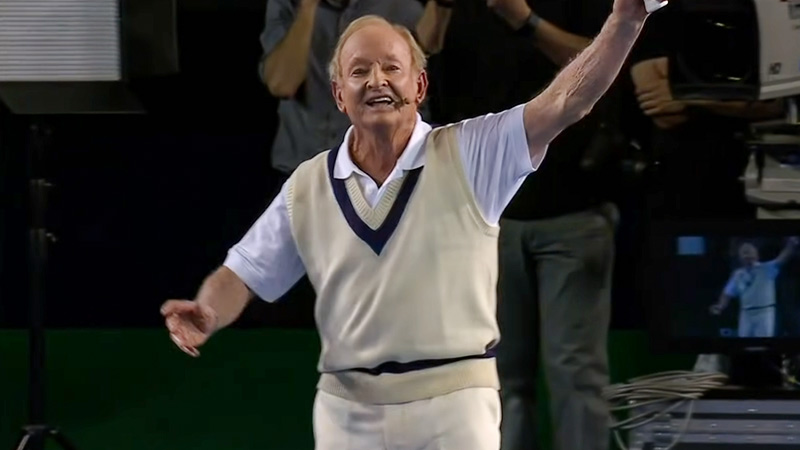
Rod Laver is the only male player in history to achieve the Calendar Grand Slam twice, winning all four majors in 1962 and 1969.
While modern stars like Novak Djokovic hold higher official title counts, Laver remains the sport’s definitive benchmark due to his unrivaled dominance across amateur and professional eras.
Despite a five-year ban during his prime, he captured a record 200 career titles and revolutionized tennis with heavy topspin and aggressive play. His legacy as a titan is cemented by his ability to conquer every competitive structure the game ever offered.
Why is Rod Laver the Most Influential Tennis Legend?
To understand the magnitude of Laver’s skill, one must look past the trophies and examine how he fundamentally altered the physics of the sport.
Before his emergence, tennis was characterized by a delicate approach involving flat strokes, touch, and frequent volleys.
Pioneering the Aggressive Topspin Game
Despite standing only 5-foot-8 and weighing 145 pounds, Laver possessed a massive, muscular left forearm that served as the engine for his revolutionary style.
He did not just hit the ball; he whipped it with heavy topspin, allowing him to strike screaming winners from the baseline that were previously thought impossible with wooden rackets.
This aggressive, high-velocity approach is the direct ancestor of the power-baseline game that dominates the modern ATP Tour today.
His ability to blend this power with traditional net-rushing made him a dual threat that no contemporary could consistently neutralize.
Unifying the Amateur and Professional Eras
Laver’s career serves as the bridge between two disparate worlds of tennis history. Before 1968, the sport was fractured: amateurs played the prestigious Grand Slams for no prize money, while the best players turned “Pro” to play in traveling exhibition circuits for cash, subsequently facing bans from the majors.
Laver dominated both sides of this divide with equal ferocity. When the “Open Era” finally arrived in 1968, he immediately proved his supremacy by winning Wimbledon and then sweeping all four majors the following year, effectively validating his status as the undisputed king of both the amateur and professional ranks.
Analyzing the Statistical Dominance of “The Rocket”
The sheer volume of Laver’s success is staggering when viewed through a modern lens. His career spanned 24 years, from 1956 to 1980, during which he maintained an elite level of performance regardless of the surface or the stakes.
| Achievement Category | Statistical Milestone |
|---|---|
| Total Career Singles Titles | 200 (All-time record) |
| Official Grand Slam Titles | 11 |
| Pro Slam Titles (Pre-1968) | 8 |
| Open Era Win Percentage | 81.0% |
| Hard Court Win Percentage | 85.0% |
| Davis Cup Championships | 5 (with Australia) |
| Single-Season Title Record | 18 titles in 1969 |
The Unmatched Record of 200 Singles Titles
While modern fans often focus exclusively on Grand Slam counts, Laver’s 200 career singles titles represent a level of consistency that is likely never to be repeated.
This total includes 53 titles on the amateur circuit, 72 on the grueling professional tour during his ban, and 75 during the Open Era.
Winning 18 titles in a single season (1969) remains the all-time men’s Open Era record, highlighting a peak performance level that modern players, despite their advanced training, have yet to eclipse.
Unparalleled Efficiency Across All Surfaces
Laver was a true generalist in an era where court conditions varied wildly. He was the first player in history to win titles on all five variations of playing surfaces used during his time: grass, clay, hard court, carpet, and wood.
His 85% win rate on hard courts—a surface that was less common in his prime—shows that his game was perfectly suited for the future of the sport.
Whether it was the red clay of Paris or the slick grass of London, “The Rocket” possessed the tactical flexibility to dismantle any opponent.
How Many Grand Slams Did Rod Laver Really Win?
The most common point of contention in the “Greatest of All Time” debate is Laver’s official count of 11 Grand Slam titles compared to the higher tallies of the modern “Big Three”.
However, this number is widely considered a massive underrepresentation of his actual prowess.
The Five-Year Professional Ban (1963–1967)
At the absolute zenith of his physical powers, Laver was barred from competing in 20 consecutive Grand Slam tournaments.
After winning the Calendar Grand Slam as an amateur in 1962, he turned professional to earn a living, which resulted in an immediate ban from the majors until the sport “opened” in 1968.
Historians and statisticians estimate that had he been permitted to play during these five missing years, he likely would have won an additional 10 to 15 majors.
This would have placed his total between 21 and 26 Grand Slams, a figure that would put him neck-and-neck with modern records.
The 1967 Pro Slam: A Forgotten Masterpiece
Just before the Open Era began, Laver showcased what the world had been missing by sweeping the 1967 “Pro Slam,” winning the US Pro, Wembley Pro, and French Pro titles.
These tournaments featured the highest level of competition available at the time, often including other legends who were also banned from the traditional majors.
By winning all three, Laver signaled that he was still the premier player on the planet, a claim he would officially prove to the public just one year later by reclaiming the Wimbledon trophy in 1968.
The Calendar Grand Slam: An Unrivaled Achievement
Winning the Australian Open, French Open, Wimbledon, and the US Open in a single calendar year is the ultimate test of endurance, skill, and mental fortitude. Laver did it twice, a feat no other male player has ever matched.
1962: The Amateur Peak
As a 24-year-old amateur, Laver tore through the 1962 season with a combination of raw power and tactical ingenuity.
This first Calendar Grand Slam established him as the dominant force in the amateur world and served as the catalyst for his move to the professional ranks.
It was during this period that his nickname, “The Rocket,” became synonymous with a level of play that seemed decades ahead of its time.
1969: The Open Era Masterclass
Returning to the majors as a seasoned professional in 1969, Laver produced perhaps the greatest single season in the history of the sport. He won 18 titles that year, culminating in his second Calendar Grand Slam.
This achievement is particularly significant because it happened in the Open Era, where he had to face both the established professionals and the rising amateur stars in a unified field.
To date, modern legends like Roger Federer, Rafael Nadal, and Novak Djokovic have never achieved a Calendar Grand Slam, underscoring just how difficult it is to maintain such high-level performance across four different majors in a single trip around the sun.
Tactical Brilliance in the “Spike” Final
The 1969 US Open final against Tony Roche provided a legendary example of Laver’s adaptability. Heavy rain had turned the grass court into a slippery, treacherous surface, and Laver found himself struggling for footing.
In a move that demonstrated his will to win, he received special permission to wear all-metal logging spikes on his shoes halfway through the match.
The sudden increase in traction allowed him to regain his aggressive movement, storm back into the match, and secure the victory that completed his second historic sweep.
Rod Laver vs. The Modern Big Three: Who is the GOAT?
The debate over the “Greatest of All Time” often pits the statistical mountains of the modern era against the historical impact of pioneers like Laver. While the metrics have changed, the criteria for greatness remain rooted in the standards he set.
Statistical Volume vs. Historical Impact
Novak Djokovic currently holds the record for the most Grand Slam titles, but Laver’s supporters argue that his 200 titles and two Calendar Grand Slams represent a higher “peak” of dominance.
Laver was ranked as the world’s number-one player for seven consecutive years (1964–1970), a stretch that covers both the end of the pro-ban era and the start of the Open Era.
This sustained excellence across different competitive landscapes is a unique credential that modern players cannot claim.
Technological and Athletic Evolution
It is important to contextualize Laver’s success within his era of wooden rackets and flannel trousers. Modern tennis features carbon-fiber technology and extreme athletic training that has globalized the depth of the player field.
However, Laver’s ability to revolutionize the game using “primitive” equipment suggests that his natural talent would have translated seamlessly to any era.
His transition from the touch-based game of the 50s to the high-spin game of the 70s proves he was an evolutionary force who would likely excel with modern technology.
Frequently Asked Questions About Rod Laver’s Career
Is Rod Laver better than Roger Federer or Novak Djokovic?
In terms of raw Grand Slam titles, modern players have surpassed him. However, Laver is the only player to achieve two Calendar Grand Slams, a feat neither Federer nor Djokovic has accomplished.
Many experts consider Laver the “benchmark” because he dominated every era he was allowed to play in.
Why is the main stadium in Melbourne named after him?
The Australian Open’s central show court was named the Rod Laver Arena to honor his status as an Australian national hero and his five Davis Cup titles. It serves as a permanent reminder of his contribution to the global growth of tennis.
What was Rod Laver’s winning percentage?
In the Open Era, Laver maintained an 81.0% winning percentage on the ATP Tour. Even more impressively, his Grand Slam match win rate was 82.9%, and his all-time hard court win rate was a staggering 85.0%.
How much prize money did Rod Laver win?
Laver was a financial pioneer in the sport. In 1971, he became the first tennis player in history to surpass $1,000,000 in career prize money, paving the way for the multi-million dollar earnings seen by today’s top athletes.
The Eternal Legacy of The Rocket
Rod Laver’s career is more than a collection of statistics; it is the blueprint for the modern game. From his 200 career titles to his unmatched two Calendar Grand Slams, he accomplished everything possible within the constraints of his era and the five-year ban that interrupted his prime.
He remains the only player to have truly conquered the sport in its entirety—amateur, professional, and Open Era.
His influence is woven into the very fabric of the sport. Whether it is the prestigious Laver Cup or the legendary arena that bears his name, “The Rocket” continues to inspire new generations of players to chase the impossible.
While the “Greatest of All Time” title will always be subject to debate, Rod Laver’s position as the most influential and historic pioneer of tennis is undisputed.
He didn’t just play the game; he reinvented it, leaving behind a legacy that remains the ultimate gold standard for excellence.