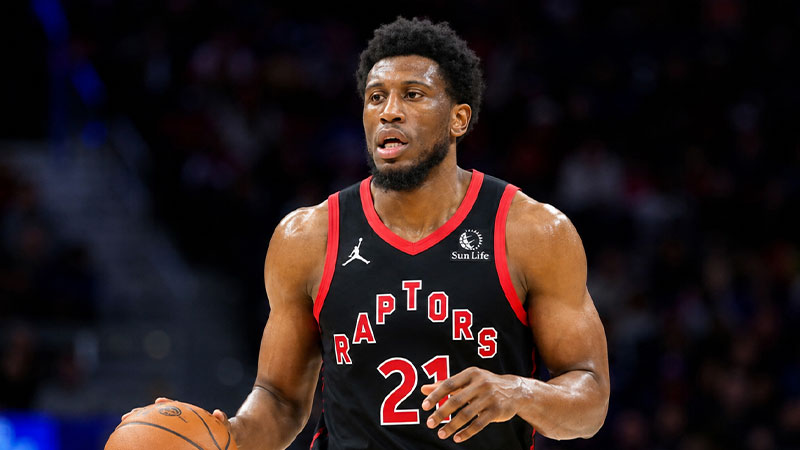
Thaddeus Young is an elite “glue guy” whose 17-season NBA career is defined by extreme consistency, high basketball IQ, and versatile defense.
While never an All-Star, his impact is reflected in 1,172 games played and membership in a rare statistical club alongside Michael Jordan and LeBron James.
He excelled as a defensive disruptor, ranking high in deflections and charges, while offensively utilizing a signature “baby hook” and short-roll playmaking.
Today, his legacy stands as the gold standard for role players who provide winning contributions through durability and veteran leadership.
What Is Thaddeus Young’s Statistical Legacy?
To truly understand how good Thaddeus Young has been, one must look past the lack of All-Star appearances and focus on the metronomic consistency he provided for nearly two decades.
Throughout his journey, he evolved from a high-flying athletic slasher into a savvy, high-IQ veteran capable of anchoring a bench unit or starting in a playoff series.
The following table highlights his career-long stability and his peak production during his tenure with the Philadelphia 76ers:
| Statistic | Career Average | Peak Season (2013-14) |
|---|---|---|
| Points per Game | 12.1 | 17.9 |
| Rebounds per Game | 5.6 | 6.0 |
| Assists per Game | 1.8 | 2.3 |
| Steals per Game | 1.4 | 2.1 |
| Field Goal % | 50.3% | 45.4% |
The “Elite Company” Statistical Phenomenon
One of the most famous aspects of Young’s career is a 2018 broadcast graphic that became a viral legend within NBA subculture.
This graphic noted that Young was one of only five players in league history—joining Michael Jordan, LeBron James, Magic Johnson, and Larry Bird—to play at least 800 games while averaging 13.5 points, 5.9 rebounds, 1.4 steals, 49% field goal shooting, and 30% from three-point range.
While the criteria were highly specific, the comparison illustrates his rare combination of scoring, rebounding, and defensive playmaking that few players in history have replicated over such a long duration.
Decades of Durability and Milestones
Young’s longevity is a testament to his professional approach and physical conditioning. He played 1,172 regular-season games, placing him among the most durable players of his generation.
By the end of his 17th season, he had accumulated over 14,000 points, 6,000 rebounds, and 1,600 steals.
These totals place him in the top 250 in NBA history for multiple fundamental categories, cementing his status as a player who didn’t just exist in the league but actively contributed at a high level every year.
What Makes Thaddeus Young an Elite Defender?
Defensive versatility is the cornerstone of Young’s value, and advanced metrics suggest he has often been one of the most impactful defenders in the league.
Unlike traditional rim protectors, Young’s defensive brilliance lies in his ability to “switch” and guard multiple positions on the perimeter while maintaining the strength to battle in the interior.
Perimeter Versatility and Defensive Impact
Young has consistently graded as an “A-” perimeter defender, a rarity for a player of his size and position. His unique foot speed and length allow him to stay in front of smaller, quicker guards, making him a nightmare in modern switching defenses.
His impact is captured by advanced stats like Defensive Player Impact over Replacement Player (DPIPM), where he has frequently ranked near the top of the league, proving that more positive plays happen for his teams when he is on the hardwood.
The Value of “The Little Things”
Beyond individual matchups, Young excels at the non-glamorous tasks that disrupt offensive flow. He is a master of “the little things,” consistently ranking high in:
- Deflections: He was a top-10 player in the league for deflections during his time with the Pacers, using his active hands to interrupt passing lanes.
- Charges Drawn: He frequently ranks in the top 20 for charges drawn, demonstrating a willingness to sacrifice his body for the team.
- Offensive Rebounding: Despite being only 6’8, he holds an “A-” grade in offensive rebounding, often turning missed shots into immediate second-chance points.
How Did His Offensive Game Evolve Over 17 Years?
While Young was never a high-volume three-point shooter, he remained highly effective on offense by mastering specific roles that complimented his teammates.
As the league transitioned toward “positionless” basketball, Young adapted by becoming a “point-forward” who could facilitate the offense from the high post or the short roll.
The “Duck-In” and Post Efficiency
Even with a career 32.8% average from three-point range, Young found ways to score efficiently without mucking up his team’s spacing.
He became one of the NBA’s best at the “duck-in” technique—timing his movements so that when a defender helps on a drive, Young dives to the rim for an easy bucket.
He utilized a highly effective left-handed “baby hook” and floaters to maintain a career field goal percentage of over 50%.
The Short-Roll Maestro and Playmaking
Later in his career, particularly during his tenures with the Chicago Bulls and Toronto Raptors, Young’s basketball IQ became his primary offensive weapon.
He functioned as a playmaker from the short roll, diagnosing defenses in real-time and finding open cutters with precision passing. This evolution allowed him to remain a viable rotation piece even as his raw athleticism began to decline in his mid-30s.
Is Thaddeus Young “washed” or underutilized?
As Young reached his late 30s, questions naturally arose regarding his ability to contribute to winning basketball.
However, analysis of his recent stints suggests that his decline in raw numbers was often a product of team circumstances rather than a lack of capability.
The San Antonio and Toronto Transitions
During his time with the San Antonio Spurs, Young’s minutes dropped significantly as the team prioritized the development of younger players.
Fans and analysts noted that he was still “willing to play and wants to help the team win,” but he was caught in a rebuilding situation where he was essentially waiting for a trade to a contender.
When he was eventually traded to the Toronto Raptors, his veteran presence was immediately hailed as a “pro’s pro” move, with fans noting that he was a perfect fit for a team in need of defensive stability and leadership.
The Impact of Modern Medical Science
The premise that a player is “washed” once they hit their early 30s is becoming an outdated concept in the modern NBA.
With improvements in technology and medical sport science, players like Young, Al Horford, and PJ Tucker have shown they can provide high-level production well into their late 30s.
For Young, his ability to win the 2021 Hustle Award at age 32 served as proof that his work ethic and physical tools remained elite compared to the rest of the league.
Frequently Asked Questions about Thaddeus Young
Why is he called a “glue guy”?
He is referred to as a “glue guy” because he performs the essential tasks that hold a team together but don’t always show up in the box score. This includes making the extra pass, drawing charges, deflecting balls, and providing veteran leadership in the locker room.
What was his best playoff performance?
His peak playoff run occurred in 2018 with the Indiana Pacers. Starting all seven games against LeBron James and the Cleveland Cavaliers, he averaged 11.3 points, 7.7 rebounds, and 1.7 steals while taking on heavy defensive assignments.
How does his efficiency compare to other forwards?
Young has been remarkably efficient throughout his career, maintaining a 50.3% field goal percentage and a 52.5% effective field goal percentage.
His ability to finish at the rim—grading as an “A-” finisher—made him a reliable scoring option even without a consistent outside shot.
What is his reputation among his peers and fans?
Young is widely respected as a “high character guy” and a “pro’s pro”. When he was traded from the Chicago Bulls, the fan base was notably saddened, with many expressing that he was a “fan favorite” due to his hustle and unselfish play.
Final Thoughts: The Legacy of a Professional
Thaddeus Young’s career is a masterclass in how to sustain longevity in the most competitive basketball league in the world.
By focusing on defensive versatility, high-IQ playmaking, and “the little things,” he made himself indispensable to every team he played for, from Philadelphia to Phoenix.
While he may never have been the face of a franchise, his presence consistently made his teammates better and his teams more competitive. He serves as the ultimate archetype for the modern role player: durable, versatile, and perpetually professional.
What is your favorite memory of Thad Young’s 17-year journey? Do you think he belongs in a special category of role players who deserve more recognition for their career totals? Drop a comment below and let’s discuss the legacy of the NBA’s ultimate glue guy!