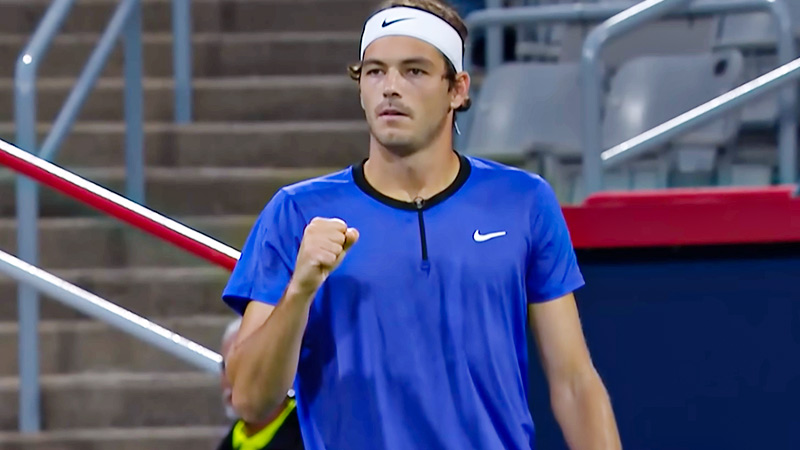
The current landscape of professional tennis is defined by a transitional era where the dominance of the “Big Three” has given way to a highly competitive, data-driven generation. At the center of this evolution for the United States is Taylor Fritz.
As the premier American male player on the ATP Tour, Fritz has fundamentally altered the expectations for American tennis on the global stage.
Evaluating his quality requires looking past mere match results and examining the tactical, mental, and statistical frameworks that have propelled him to a career-high ranking of world No. 4.
The Technical Framework of an Elite Competitor
To understand how good Taylor Fritz truly is, one must analyze the mechanical efficiency of his game. He does not rely on raw athleticism alone; rather, he utilizes a sophisticated “serve-plus-one” style that is perfectly suited for the modern game.
The Serve: A Foundation of Precision
Fritz possesses what is widely considered one of the most effective serves in the professional circuit. Unlike players who rely solely on velocity, his success is built on a sophisticated blend of location and rotation.
- High Unreturned First-Serve Percentage: By prioritizing placement over pure speed, he forces weak returns that allow him to dictate the subsequent point immediately.
- Heavy Spin Profiles: His ability to impart heavy spin makes his delivery difficult to time, particularly on faster surfaces where the ball skids or jumps unpredictably.
- Tactical Variety: He uses his serve to set up his preferred court positions, rarely allowing opponents to find a rhythm during his service games.
The Forehand: Dictating the Rally
The cornerstone of his baseline game is a western-grip forehand. This technical choice allows him to generate a specific type of ball flight that is difficult for opponents to neutralize.
| Technical Element | Impact on Gameplay |
|---|---|
| Western Grip | Allows for extreme top-spin and the ability to hit “up” on the ball while maintaining pace. |
| Sharp Cross-Court Angles | Forces opponents out of the “deuce” and “ad” corners, opening the down-the-line shot. |
| Pace Generation | Despite the spin, Fritz maintains massive velocity, keeping opponents pinned behind the baseline. |
| Flat Groundstrokes | On specific surfaces, he can flatten these shots to accelerate the point finish. |
The Analytical Edge: High Tennis IQ
A recurring theme among experts and observers is the high “Tennis IQ” that Fritz brings to every match. In an era of professional sports where data determines strategy, Fritz is an outlier for his analytical approach. He does not simply play the ball; he plays the percentages.
- Match Preparation: His team utilizes deep data sets to identify opponent patterns, which Fritz executes with disciplined precision.
- In-Game Adjustments: He is known for recognizing when a tactical shift is required, such as changing his return position or altering his serve patterns during high-leverage moments.
- Consistency as a Metric: His analytical mindset has led to him being consistently entrenched near the top of the world rankings. He rarely suffers “bad losses” to lower-ranked opponents in major events, establishing himself as a perennial threat in quarterfinals and semifinals.
Performance Across Surfaces
Fritz’s game is not universal in its dominance, but it is exceptionally optimized for the most common surfaces on the tour. His “serve-plus-one” style and hard-hitting groundstrokes find their maximum utility on fast courts.
- Hard Courts: This is his primary domain. The predictable bounce allows him to set his feet and unload his heavy forehand. His run to the 2024 US Open final serves as the definitive proof of his elite status on this surface.
- Grass Courts: The low bounce and speed of grass reward his aggressive serving and flat-hitting capabilities. He has frequently advanced deep into Wimbledon, confirming his versatility.
- Clay Courts: While he has made strides on clay, the slower surface can sometimes neutralize his serve’s effectiveness and demand a level of defensive movement that is still a work in progress compared to his hard-court prowess.
Comparative Analysis: Fritz vs. The Field
To quantify “how good” he is, we must compare his career trajectory and skill set against the broader ATP landscape.
| Metric | Taylor Fritz | Global Elite (Top 5 Avg) |
|---|---|---|
| Career-High Ranking | World No. 4 | World No. 1 |
| Major Achievement | Grand Slam Runner-up (2024) | Multiple Grand Slam Titles |
| Surface Specialty | Hard / Grass | Multi-surface Dominance |
| Playing Style | Analytical / Power Bascliner | Varied (Defensive/Aggressive) |
| Consistency | High (Perennial Quarterfinalist) | Elite (Constant Finalist) |
Bridging the Gap: The Path to a Major Title
Despite his status as an elite professional, the consensus among analysts is that Fritz still has a “final ceiling” to break through. While he is a top-tier player, winning a Grand Slam requires a level of perfection that he is currently refining.
- Net Game Refinement: To transition from a “threat” to a “champion,” Fritz needs to become more comfortable moving forward. Improving his volleys and transition play would allow him to shorten points and take time away from elite defenders like Carlos Alcaraz or Novak Djokovic.
- Consistency Under Extreme Pressure: The margins at the end of a Major are razor-thin. Analysts note that maintaining his high-level tactical execution during the fourth and fifth sets of a Grand Slam final is the remaining hurdle in his career.
- The Weight of History: As the premier American male, he carries the expectation of a nation that hasn’t seen a male Grand Slam champion in decades. Managing this external pressure is as much a part of his “quality” as his forehand.
The Verdict: How Good is Taylor Fritz?
The answer is multifaceted. If the question is whether he is a world-class athlete, the answer is an unequivocal yes. He has won multiple ATP singles titles and has proven he can compete with anyone in the world on a given day.
Key Takeaways on His Status:
- He is a Tier 1 Gatekeeper: To win a major tournament, a player almost certainly has to go through Fritz. He has become a benchmark for excellence on the tour.
- He is the Strategic Leader of American Tennis: His success has provided a blueprint for other American players, emphasizing that a power game must be paired with an analytical mind.
- His Legacy is Still Being Written: While some debate his place compared to historical greats, his steady presence in the later rounds of Majors proves he is more than just a “hot streak” player; he is a permanent fixture of the elite.
Conclusion: The Future of the American Ace
Taylor Fritz has already secured his place in the history of American tennis by returning the U.S. to the top five of the world rankings.
His blend of power and tactical intelligence makes him a formidable opponent for any player on the tour. While the final step—winning a Grand Slam—remains, his trajectory suggests that he is not merely “good,” but rather a player on the verge of greatness.
For fans and analysts alike, watching Fritz refine his net game and mental fortitude in the coming seasons will be the most compelling storyline in American sports. He has moved past the stage of “potential” and is now firmly in the era of “results”.