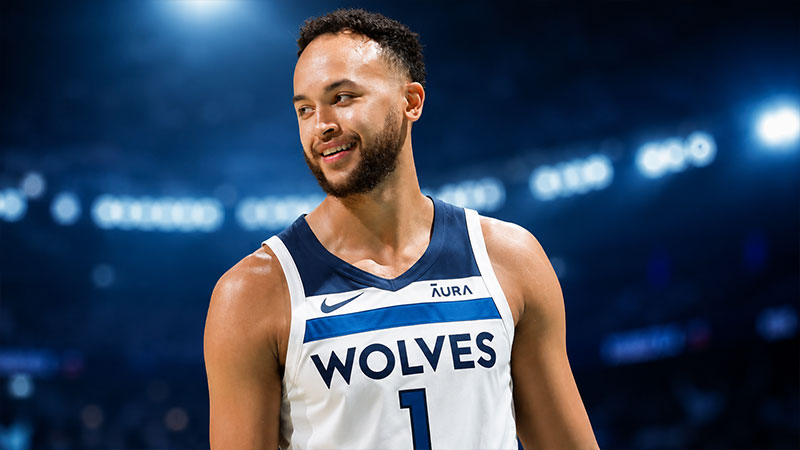
Kyle Anderson, widely known by his nickname “Slo-Mo,” represents one of the most fascinating tactical paradoxes in modern professional basketball.
While the current era of the NBA emphasizes explosive verticality and elite transition speed, Anderson has sustained a high-level 12-year career by intentionally dictating a methodical, deliberate pace.
He does not rely on traditional athleticism; instead, he weaponizes elite basketball intelligence and a massive physical profile to disrupt opponents.
As a versatile “point forward,” he serves as the essential connective tissue for championship-caliber rotations, proving that mental acuity can be just as dominant as raw speed.
The “Slow-Mo” Philosophy: Redefining NBA Speed
To understand how good Kyle Anderson is, one must look past the standard highlight reels of dunks and fast breaks. His game is built on the concept of “pace control,” where he forces the defense to operate at his speed rather than the other way around.
The Advantage of a Methodical Pace
Kyle Anderson’s ability to slow down the game allows him to see passing lanes and defensive rotations before they fully develop. This deliberate approach is a primary reason why he has remained a consistent rotational piece since being drafted 30th overall by the San Antonio Spurs in 2014.
His career is a testament to the idea that being “fast” is often less important than being “on time” with one’s decision-making and positioning.
Pedigree and Evolution
Despite his slow-motion style, Anderson was a high-tier prospect long before entering the professional ranks. In 2012, he held a recruiting rank of 3, placing him among the elite players of his generation before attending UCLA.
Over his 12-year journey, he has evolved from a developmental piece in the Spurs’ system into a seasoned veteran who can be plugged into almost any tactical scheme.
The Point Forward Archetype: Playmaking and IQ
Anderson is frequently categorized as a “point forward,” a role that requires a unique blend of size and guard-like vision. Standing 6-8 and weighing 230 lbs, he possesses the frame of a frontcourt player but the mind of a floor general.
Facilitating Elite Offense
Anderson’s primary offensive value is his playmaking. He rarely rushes a possession, preferring to probe the defense until a high-efficiency look opens for a teammate.
His career average of 2.8 assists per game belies his true impact, as he often makes the “hockey assist” or the entry pass that triggers a scoring sequence.
In the 2022-23 season with the Minnesota Timberwolves, he showcased this elite vision by averaging a career-high 4.9 assists per game.
| Season | Team | Assists Per Game (APG) | Assist Percentage (AST%) |
|---|---|---|---|
| 2020-21 | Memphis Grizzlies | 3.6 | 18.3% |
| 2022-23 | Minnesota Timberwolves | 4.9 | 22.6% |
| 2023-24 | Minnesota Timberwolves | 4.2 | 25.0% |
| 2025-26 | Utah Jazz (Stint) | 3.1 | 20.6% |
Data indicates that when Anderson is on the floor, the offensive flow becomes more organized, particularly for second units that lack a primary ball-handler.
High-Efficiency Decision Making
His basketball IQ is reflected in his shooting efficiency from close range. While not a high-volume shooter, he understands positioning.
In the 2025-26 season, while playing for the Memphis Grizzlies, he shot a staggering 78.9% from the field across a 4-game stint. Over his career, he has maintained a solid field goal percentage of 48.0%, largely by taking smart shots within the flow of the offense.
Defensive Masterclass: The 7-Foot-3 Advantage
Defense is where Kyle Anderson truly separates himself from standard role players. His defensive impact is not driven by lateral quickness but by an extraordinary physical reach and elite anticipation.
Multi-Positional Versatility
Armed with an expansive 7-foot-3 wingspan, Anderson can effectively guard multiple positions, ranging from agile wings to interior big men. This length allows him to contest shots and disrupt passing lanes without needing to be right on top of his opponent.
His career defensive metrics are consistently strong; for instance, he recorded a career-high Defensive Box Plus/Minus (DBPM) of 3.8 during the 2017-18 season with San Antonio.
Anticipation Over Athleticism
Anderson’s defensive game is a chess match. He excels at “reading” the offensive player’s intent, often stepping into passing lanes for steals or using his length to block shots from the weak side.
He has averaged 1.0 steals and 0.6 blocks per game throughout his career, with a career total of 744 steals and 467 blocks. These numbers highlight his ability to accumulate “stocks” (steals + blocks) through positioning and timing.
Analyzing the 2025–26 Season Journey
The 2025–26 season served as a perfect case study for Anderson’s “Swiss Army Knife” utility. He split time between three different franchises—the Utah Jazz, the Memphis Grizzlies, and the Minnesota Timberwolves—providing immediate value to each.
Uniform Impact Across Franchises
Regardless of the jersey he wore, Anderson’s per-game contributions remained remarkably steady, highlighting his reliability as a veteran bench piece.
- Utah Jazz (20 Games): Anderson averaged 7.1 points, 3.3 rebounds, and 3.1 assists while shooting 52.3% from the floor.
- Memphis Grizzlies (4 Games): In a brief but highly efficient stint, he averaged 9.3 points on 78.9% shooting.
- Minnesota Timberwolves (19 Games): Returning to a familiar system, he averaged 4.6 points and 3.3 assists, serving as a secondary playmaker off the bench.
A Vital Insurance Policy
Coaches view Anderson as a “safety net” for their rotations. His ability to adjust to different systems mid-season is a rare trait that makes him highly sought after by teams with postseason aspirations.
Even in limited minutes during high-stakes games, such as the Western Conference Semifinals, his presence provides a calming influence on the court.
Advanced Metrics: The Hidden Value of Slo-Mo
Standard box scores often fail to capture the full extent of Anderson’s contributions. To truly answer “how good” he is, we must examine advanced analytics like VORP (Value Over Replacement Player) and Win Shares.
Value Over Replacement (VORP)
Anderson has accumulated a career VORP of 15.1, indicating that he is significantly more valuable than a league-average replacement player.
His peak VORP of 2.5 came during the 2020-21 season with Memphis and again in 2022-23 with Minnesota, showcasing his longevity and consistent impact.
Win Shares and Defensive Impact
His career total of 41.3 Win Shares proves that he is a winning player. A large portion of this value comes from the defensive side; his Defensive Win Shares (DWS) have been positive every single year of his 12-year career. This statistical consistency is a hallmark of a player who understands his role and executes it at an elite level.
Understanding the Strategic Limitations
While Anderson is an exceptional role player, he does have specific limitations that teams must manage through roster construction and lineup pairings.
Scoring Volume and Usage
Anderson is a low-usage, pass-first player. He rarely looks to create his own shot and has a career scoring average of 6.8 points per game. Because he is not an aggressive scorer, he is most effective when surrounded by high-volume shooters and finishers who can capitalize on his playmaking.
Perimeter Shooting Constraints
Though he shot a career-high 41.0% from three-point range in 2022-23, Anderson is generally not considered a high-volume perimeter threat, with a career average of 34.0%. Defenses will occasionally “sag” off him to clog the paint.
However, his high IQ often mitigates this, as he will use the space to act as a “hub” for the offense or cut to the basket for high-percentage looks.
The “Swiss Army Knife” Legacy
In conclusion, Kyle Anderson is an elite-level role player whose value is derived from his ability to do everything well without needing the spotlight.
Structural Integrity
He fills the “structural cracks” in a team’s roster. Whether a team needs a backup ball-handler, a small-ball power forward, or a defensive stopper for a superstar wing, Anderson can provide those minutes.
This versatility is what has allowed him to earn over $69 million in his career while playing for some of the most respected organizations in the league.
Final Assessment
How good is Kyle Anderson? He is a premier tactical tool. He is the player coaches love and opponents find frustrating because his impact isn’t tied to speed or strength. His 12-year career is a masterclass in using intelligence, length, and a unique rhythm to win the game of basketball on his own terms.
Frequently Asked Questions
What is Kyle Anderson’s nickname?
Kyle Anderson is famously known as “Slo-Mo” due to his deliberate and methodical style of play that often appears slower than the rest of the players on the court.
Which teams has Kyle Anderson played for?
Throughout his 12-year career, Anderson has played for the San Antonio Spurs, Memphis Grizzlies, Minnesota Timberwolves, Golden State Warriors, Miami Heat, and Utah Jazz.
What are Kyle Anderson’s career-high stats?
Anderson has recorded career highs of 28 points, 14 rebounds, 12 assists, and 6 steals in individual games. He has also recorded 4 triple-doubles during his time in the NBA.
How tall is Kyle Anderson and what is his wingspan?
Kyle Anderson stands 6 feet 8 inches tall and possesses a massive 7-foot-3 wingspan, which he uses to great effect on the defensive end.
Has Kyle Anderson won an NBA championship?
As of the current 2025-26 season data, Kyle Anderson has won 0 NBA championships, though he has been a consistent contributor to various playoff teams.