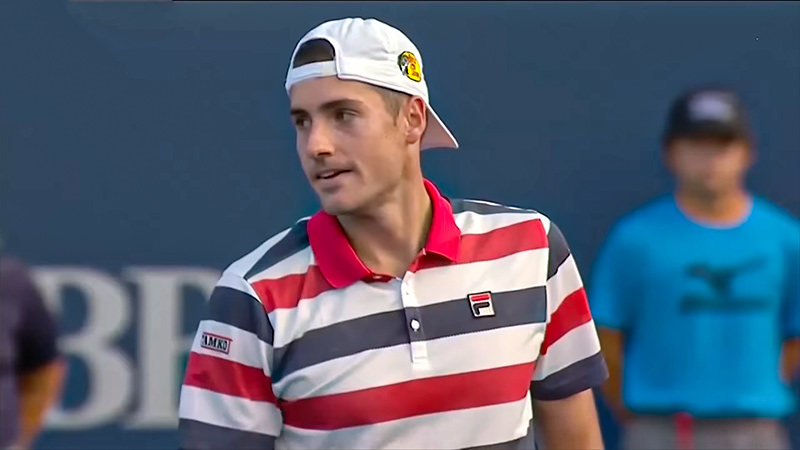
John Isner was an elite, world-class tennis player who dominated the ATP Tour for over a decade with a historic power game. Reaching a career-high ranking of World No. 8, he carried American men’s tennis for eight seasons as the nation’s top-ranked player.
Known as the “Ace King,” Isner holds the all-time record for career aces and transformed the sport’s rules following his legendary 11-hour marathon at Wimbledon.
While his massive frame presented mobility challenges, he maximized his physical gifts to remain a top-tier competitor, winning 16 singles titles and becoming the first player to win 500 career tiebreaks.
How Good Is John Isner? Career Statistics Snapshot
To accurately evaluate the professional standing of John Isner, one must look at the raw data that defined his sixteen-year tenure on the tour.
He was not merely a tall player with a big serve; he was a model of consistency and endurance in a sport that often favors younger, more agile athletes.
Before his retirement at the 2023 US Open, he compiled a resume that places him among the most successful American players of the modern era.
| Metric | Achievement |
|---|---|
| Singles Titles | 16 ATP Titles (including 2018 Miami Masters) |
| Doubles Titles | 8 ATP Titles (including 5 Masters 1000s) |
| Career Record | 489 Wins – 317 Losses (60.7% Win Rate) |
| Grand Slam Best | Wimbledon Semifinalist (2018) |
| Ranking Peak | World No. 8 |
| Top 10 Victories | 29 Career Wins over Top 10 Players |
| Top 20 Consistency | Finished in Top 20 for 10 Consecutive Years (2010–2019) |
Why Was the John Isner Serve Considered the Greatest?
The John Isner serve was far more than a simple point-starter; it functioned as a complete offensive system that dictated the rhythm of every match he played.
Standing at 6’10”, his height provided a biological advantage that few could replicate, allowing him to strike the ball from a height that created extreme downward angles.
The Geometry of a 6’10” Frame
The primary reason his serve remained “untouchable” was the unique leverage his height afforded. Most players have to hit up or across the ball to clear the net, but Isner could hit down into the court.
This created a trajectory that made the ball skip and rise rapidly after the bounce, often forcing opponents to attempt returns well above their shoulder height.
This physical reality meant that even if a returner could touch the ball, they rarely had the control necessary to start a meaningful rally.
Breaking the Record for All-Time Aces
Statistically, Isner stands alone at the pinnacle of serving history. He holds the official ATP Tour record for the most career aces, having blasted an incredible 14,470 during his time as a professional.
His ability to find the corners of the service box with pinpoint accuracy, combined with a fastest recorded serve of 157.2 mph (253 kph), made him the most efficient “ace machine” the sport has ever seen.
This level of production ensured that he could bail himself out of trouble in almost any service game.
The Defensive Power of the High-Bounding Kick Serve
While many players are known for a powerful first serve, Isner’s second serve was equally devastating. He utilized a high-bounding “kick” serve that utilized massive amounts of topspin.
Because the ball bounced so high and away from the returner, it effectively neutralized any aggressive intent from his opponents. This contributed to his astonishing 91.8% service games won percentage, one of the highest in the history of the ATP Tour.
The Historic Impact of the Wimbledon 2010 Marathon
John Isner’s name is permanently etched into the history books for his role in the longest tennis match ever recorded.
This legendary battle did more than just test the limits of human endurance; it highlighted the specific strengths of Isner’s game and eventually forced the governing bodies of tennis to reconsider the very laws of the sport.
Reliving the 11-Hour Epic Against Nicolas Mahut
During the 2010 Wimbledon Championships, Isner faced Nicolas Mahut in a match that lasted 11 hours and 5 minutes, played over the course of three days. The final set alone ended with a score of 70-68. This marathon was a testament to Isner’s mental toughness and physical stamina.
Despite the grueling nature of the contest, neither player could find a way to break the other’s serve for hours on end, illustrating just how difficult it was to capitalize on any opening when Isner was standing at the baseline.
Forcing a Permanent Change to Tennis Regulations
The fallout from the 70-68 finish, followed by Isner’s another extended 26-24 final set in the 2018 Wimbledon semifinals, became a catalyst for global change.
Tournament directors realized that such long matches were unsustainable for player health and television scheduling.
Consequently, this led to the institution of the “Isner Rule,” where all four Grand Slams abandoned extended final sets in favor of a universal 10-point final-set tiebreaker. Isner literally changed the way the game is played.
Why Did John Isner Win So Many Tiebreaks?
Because Isner’s serve was nearly impossible to break, and because his own return game was statistically lower than his peers, his matches frequently reached a stalemate that could only be resolved by a tiebreaker.
In these high-pressure moments, his mental fortitude became his secondary weapon, allowing him to thrive when the margin for error was non-existent.
Mental Endurance Under High-Pressure Stakes
Isner developed a reputation as a “clutch” player who could maintain focus during the most intense moments of a match.
Winning a tiebreak requires a player to avoid unforced errors while maintaining aggressive intent, a balance Isner mastered over his 16-year career.
His confidence in his serve meant that he always felt he was only one or two good points away from winning a set, a psychological edge that often wore down his opponents.
The Statistics of the Tiebreak King
The numbers support his reputation as the “Tiebreak King.” He holds the Open Era record for the most tiebreaks won, surpassing the 500 mark in early 2023.
He was the first player in history to reach this milestone, a feat that highlights both his longevity and his effectiveness in close sets. For a decade, Isner was a mainstay in the year-end Top 20 because he could consistently win the critical points that decided matches.
What Were the Main Limitations of John Isner’s Game?
Despite his world-class serve and elite ranking, Isner was generally tiered just below the legendary “Big Three”—Roger Federer, Rafael Nadal, and Novak Djokovic.
His physical profile, while an asset for serving, created significant drawbacks that prevented him from winning multiple Grand Slam titles.
Lateral Movement and Baseline Defense Challenges
A massive 6’10” frame is naturally less suited for the rapid lateral movement required in elite baseline rallies. While Isner had remarkably soft hands and could hit clean groundstrokes, he struggled when opponents pulled him from side-to-side.
His defensive footwork and reaction times were slower than smaller, more nimble players, making him vulnerable if an opponent could successfully neutralize his serve and force him into a running rally.
The Liability of a Subpar Return Game
The most significant gap in Isner’s game was his return of serve. His large wingspan did not translate to a high break-point conversion rate; instead, his slow reaction times meant he rarely secured easy service breaks.
This lack of mobility on the return meant that almost every match he played was decided by slim margins, putting an immense physical tax on his body.
In the best-of-five format at Grand Slams, the cumulative fatigue of playing multiple tiebreak sets often capped his ceiling in long-distance tournaments.
Frequently Asked Questions About John Isner’s Career
Was John Isner a good tennis player?
Yes, he was an exceptional, world-class competitor who remained in the Top 20 for ten consecutive seasons and reached a career-high of World No. 8.
How many aces did John Isner hit?
He holds the all-time ATP record with 14,470 career aces.
What was John Isner’s fastest serve?
His fastest officially recognized serve was clocked at 157.2 mph (253 kph).
Who won the longest tennis match in history?
John Isner defeated Nicolas Mahut at Wimbledon 2010 in a match that lasted 11 hours and 5 minutes.
Did John Isner ever win a Masters 1000 title?
Yes, he won the 2018 Miami Masters, which remains one of the highlights of his singles career.
Why did they change the rules for Grand Slam final sets?
The rule change was prompted by Isner’s exceptionally long matches at Wimbledon, which demonstrated that playing until a two-game lead in the fifth set was too physically demanding for modern athletes.
The Lasting Legacy of an American Powerhouse
John Isner maximized his physical gifts to a degree few players ever achieve. While he may not have secured a Grand Slam trophy, he became a player that no one—not even the greatest legends of the sport—wanted to face in a tournament bracket.
He stripped away the control of his opponents and forced them to play on his terms, a unique brand of dominance that defined an entire era of American tennis.
His departure marks the end of a specific style of power play, but his records for aces and tiebreaks, along with the “Isner Rule,” ensure that his influence on the game will be felt for generations to come.