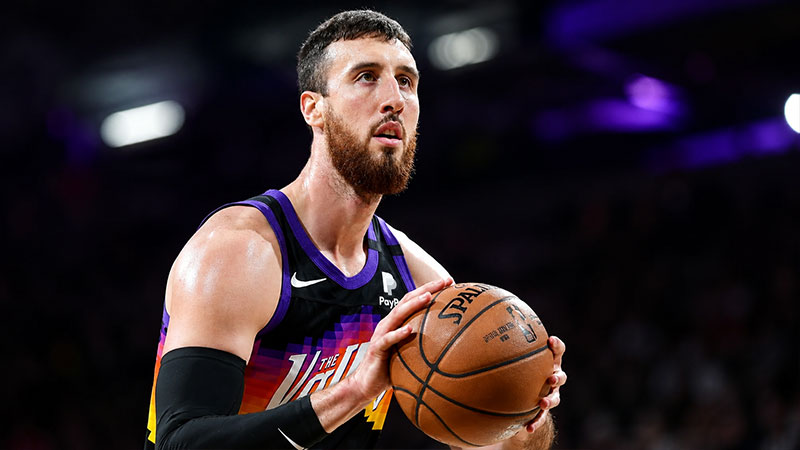
Frank Kaminsky remains one of the most intriguing case studies in modern basketball history. Known affectionately by fans as “Frank the Tank,” he represents the quintessential bridge between the traditional back-to-the-basket center and the modern floor-spacing big man.
While some critics focus on his defensive limitations, his career trajectory provides a masterclass in offensive versatility.
From a unanimous college legend at the University of Wisconsin to a reliable rotational piece in the NBA and an elite international starter, Kaminsky’s value lies in his unique ability to manipulate defensive spacing and punish traditional interior protectors from the perimeter.
The College Apex: Why Frank Kaminsky Was a Legend
Kaminsky’s tenure at the University of Wisconsin wasn’t just successful; it was historically dominant. He transformed the Badgers into a national powerhouse, culminating in a senior season that saw him sweep the most prestigious individual honors in collegiate sports.
Dominating the NCAA Landscape
The Wisconsin offensive system allowed Kaminsky to showcase a skillset rarely seen in seven-footers at the time. In his final collegiate year, he averaged 18.8 points and 8.2 rebounds per game while adding 1.5 blocks.
More impressively, he shot a staggering 41.6% from behind the three-point arc. This efficiency forced opposing defenses to abandon their traditional rim protection schemes just to contest his outside shot, fundamentally breaking the standard defensive geometry of the NCAA.
The 2015 National Player of the Year
His senior campaign was rewarded with a unanimous sweep of the National Player of the Year titles, including the Wooden, Naismith, and Kareem Abdul-Jabbar awards. He famously led the Badgers to back-to-back Final Four appearances in 2014 and 2015.
This sustained excellence solidified his status as an elite collegiate talent, leading to his selection as the 9th overall pick in the 2015 NBA Draft by the Charlotte Hornets.
The Impact of Collegiate Experience
One factor often discussed by scouts was Kaminsky’s age during his peak years. As a senior, he was a 23-year-old “grown man” competing against freshmen who were often four years younger.
This maturity gave him a physical and mental edge in the high-pressure environment of the NCAA tournament, allowing him to use his advanced footwork and basketball IQ to outmaneuver more athletic but less experienced prospects.
NBA Career Performance: A Deep Dive Into the Data
Transitioning from a primary collegiate option to an NBA rotational player requires significant adjustments. Kaminsky managed an eight-year professional career in the United States by leaning into his role as a “stretch big” who could facilitate offense from the high post.
Career Statistics and Consistency
Over 413 career games, Kaminsky maintained a reputation as a reliable offensive contributor off the bench. While he never reached All-Star status, his ability to provide spacing remained a valuable asset for several franchises. His career averages reflect a player who understood his role and executed it with professional discipline:
- Games Played: 413
- Points Per Game: 8.8
- Rebounds Per Game: 3.8
- Assists Per Game: 1.6
- Career Three-Point Percentage: 34.9%
- Free Throw Percentage: 74.6%
Team-by-Team Impact Analysis
Kaminsky’s journey took him through several organizations, each utilizing his shooting and passing in different capacities. The following table highlights his production across his various NBA stops:
| Team | Seasons | Games Played | PPG | RPG | FG% |
|---|---|---|---|---|---|
| Charlotte Hornets | 4 | 282 | 9.8 | 4.0 | 41.9% |
| Phoenix Suns | 3 | 95 | 8.2 | 4.3 | 46.8% |
| Atlanta Hawks | 1 | 26 | 2.7 | 1.4 | 56.8% |
| Houston Rockets | 1 | 10 | 1.8 | 1.6 | 31.6% |
His most productive years came in Charlotte, where he averaged nearly double digits in scoring over four seasons. In Phoenix, his field goal percentage improved significantly, peaking at 54.5% during the 2021-22 season, albeit in a smaller sample size.
The “Stretch Big” Skillset: Strengths and Limitations
To understand how good Frank Kaminsky truly is, one must look past the raw box score and examine the technical aspects of his game. His longevity was fueled by a high basketball IQ that allowed him to compensate for certain physical hurdles.
Offensive Versatility and Perimeter Shooting
Kaminsky’s primary asset was his “pop” ability in the pick-and-roll. By stepping out to the three-point line, he effectively pulled rim protectors out of the paint, creating driving lanes for his guards.
Furthermore, he possessed excellent baseline footwork and was a highly skilled passer for a player of his stature. His career-high of 8 assists in a single game serves as a testament to his vision and unselfishness on the court.
Defensive Challenges and Athleticism
The main hurdle for Kaminsky in the NBA was a relative lack of lateral quickness. In a league that increasingly prioritizes defensive switching, faster guards often targeted him on the perimeter.
Additionally, his limited explosive leaping ability and “lift” made him a less effective interior rim protector compared to more traditional defensive centers. Scouts often noted his smaller wingspan for his height, which contributed to these defensive struggles.
Technical Efficiency
Despite his physical limitations, Kaminsky’s shooting profile remained respectable. His effective field goal percentage (eFG%) for his career stands at 50.1%, peaking at 69.3% during his brief stint with Atlanta in 2022-23.
He was particularly effective from the free-throw line for a big man, shooting 74.6% over his career and even reaching 90% in his final season with Phoenix.
The Infamous Kentucky Matchup: Fact vs. Fiction
A frequent point of debate among basketball analysts is Kaminsky’s performance against Kentucky’s 2015 front line. This matchup featured future NBA stars Karl-Anthony Towns and Willie Cauley-Stein, and it remains a cornerstone of the “how good is Kaminsky” discussion.
Examining the Performance Data
While some fans remember Kaminsky “destroying” the Kentucky front line, a detailed breakdown of the 20-point performance reveals more nuance.
Analysis of the game shows that Kaminsky scored only 3 of his 20 points while being directly defended by Karl-Anthony Towns. Most of his production actually came against Willie Cauley-Stein, or through strategic switches that forced smaller defenders onto him.
Experience vs. Potential
Critics of Kaminsky’s NBA transition often pointed to this specific game as an example of experience over raw talent. As a senior, Kaminsky used his polished offensive moves to confuse the younger Kentucky big men.
However, experts correctly predicted that while these moves worked against collegiate freshmen, they would be harder to execute against seasoned NBA veterans like Blake Griffin or Anthony Davis, who possessed both the size and the athleticism to contest his shots.
The Role of System and Pace
Wisconsin’s “system” also played a role in the perception of Kaminsky’s dominance. The Badgers played at one of the slowest paces in Division 1 basketball, which emphasized half-court execution and individual efficiency.
In the NBA, where the game is significantly faster and requires quick transitions, Kaminsky sometimes struggled to maintain the same level of impact he had in the controlled collegiate environment.
Professional Success Overseas: The International Impact
Since his last NBA appearance in 2023, Kaminsky has transitioned into a premier talent in international leagues. His skillset, which was considered “serviceable” in the NBA, is viewed as elite in the European and Asian markets.
Thriving in the EuroLeague
Playing for Partizan Belgrade in the EuroLeague, Kaminsky has been a highly efficient offensive weapon. In a professional environment that often prioritizes half-court execution, high basketball IQ, and floor spacing over raw athleticism, Kaminsky has thrived.
He shot 40% from deep during his European tenure, proving that his “stretch” capabilities are a massive advantage on the global stage.
A Global Veteran and Top-Tier Import
Beyond Europe, Kaminsky has continued his career with stints in leagues in China and Japan. In these regions, his combination of 7-foot stature and perimeter shooting makes him a top-tier import player.
He remains a sought-after professional because he provides the veteran leadership and specialized skillset that modern global teams require to compete at the highest levels.
Frank Kaminsky Career FAQ and Key Insights
How tall is Frank Kaminsky?
He stands 7-0 (213 cm) tall.
What was his draft status?
He was selected 9th overall by the Charlotte Hornets in the 1st round of the 2015 NBA Draft.
What positions did he play?
He functioned primarily as a Center and Power Forward.
What are his career earnings?
He made at least $22,131,044 during his professional basketball career.
What are his nicknames?
He is most commonly known as “Frank the Tank” or “Moose”.
When did he last play in the NBA?
His last NBA season was in 2023, where he played for the Atlanta Hawks and Houston Rockets.
What were his career highs?
His career-highs in the NBA include 31 points, 13 rebounds, and 8 assists.
The Final Verdict: A Versatile Legacy
Frank Kaminsky may not have become the NBA superstar that some envisioned after his legendary college run, but he has carved out a respectable and lucrative career through sheer versatility.
His ability to adapt from a dominant collegiate force to a reliable NBA role player, and finally to an elite international starter, speaks to his profound understanding of the game.
In an era where 7-footers are increasingly expected to be “unicorns,” Kaminsky was an early adopter of the stretch-big archetype, paving the way for the next generation of perimeter-oriented centers.
Whether you evaluate him by his unanimous National Player of the Year awards or his eight years of service in the world’s toughest league, it is clear that Frank Kaminsky was, and continues to be, a very good basketball player.