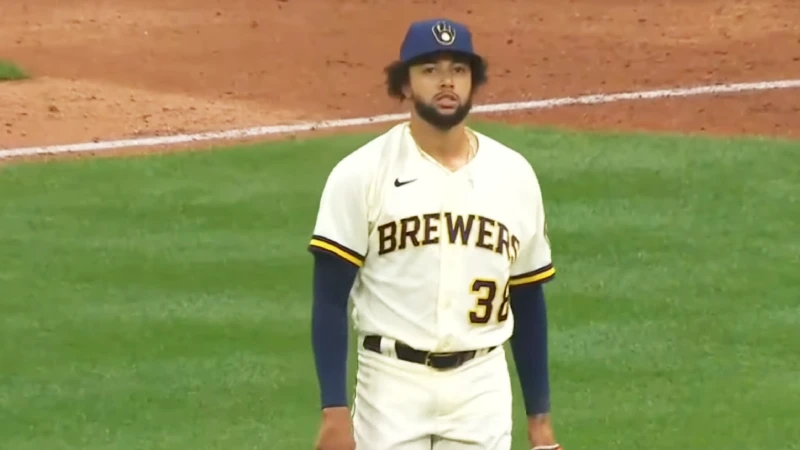
Devin Williams stands as one of the most compelling and discussed relief pitchers in Major League Baseball today.
Known throughout the league for possessing a pitch so devastating that fans and analysts universally refer to it as “The Airbender,” Williams has established a reputation as an elite late-inning weapon capable of completely neutralizing opposing lineups.
However, as with any high-leverage reliever navigating the long grind of a major league career, his trajectory has featured both breathtaking heights and complex rotational adjustments.
To evaluate how good Devin Williams truly is, one must look beyond surface-level win-loss records and examine the intersection of historical dominance, underlying pitch architecture, recent physical setbacks, and predictive analytical indicators.
The Anatomy of Dominance – Peak Form in Milwaukee
To appreciate the ceiling of Devin Williams, it is essential to review his rise to stardom during his foundational years with the Milwaukee Brewers.
During his peak tenure in Milwaukee, Williams transformed from a high-upside prospect into one of the most unhittable relief pitchers in modern baseball history.
Historical Accolades and Sub-2.00 ERA Consistency
Williams burst onto the national scene during the shortened 2020 campaign, earning the National League Rookie of the Year award following an astounding display of late-inning dominance.
He followed that stellar arrival by securing multiple All-Star selections and twice capturing the prestigious Trevor Hoffman National League Reliever of the Year Award.
What set Williams apart from standard high-leverage relievers was not merely a single dominant season, but his sustained excellence over time.
For three consecutive years serving as Milwaukee’s primary closer, he maintained a sub-2.00 ERA—a benchmark achieved only by the absolute upper echelon of major league closers.
His ability to step into the ninth inning and consistently protect tight leads established him as a premier bullpen anchor.
Macro Career Numbers
Across 350 career appearances spanning his time with the Milwaukee Brewers, New York Yankees, and New York Mets, Williams has compiled an enviable track record:
- Career Record: 34–18
- Earned Run Average (ERA): 2.70
- Walks plus Hits per Inning Pitched (WHIP): 1.11
- Strikeout Total: 516 strikeouts across 336.1 innings pitched
A career average of nearly 1.4 strikeouts per inning over more than 330 innings underscores a fundamental truth: when Devin Williams is locked in, hitters rarely make meaningful contact.
Decoding the New York Chapter – Surface Struggles and Physical Setbacks
Transitioning to high-pressure media markets often brings heightened scrutiny, particularly when a player encounters a down stretch.
After being traded and subsequently signing a multi-year deal with the New York Mets—following a turbulent stretch with the New York Yankees—Williams encountered the most challenging statistical stretch of his professional career.
Analyzing the 2026 Surface-Level Numbers
During the 2026 regular season with the Mets, Williams posted surface-level statistics that appeared noticeably out of character when measured against his career averages:
- Appearances / Innings: 42 games (38.2 innings pitched)
- Win-Loss Record: 3–2
- Earned Run Average (ERA): 4.66
- WHIP: 1.66
- Saves: 16
A 4.66 ERA and a 1.66 WHIP represent a significant departure from his sub-2.00 ERA baseline in Milwaukee. For casual observers, these numbers suggested a potential decline in overall effectiveness.
Contextualizing Injury Factors
Any thorough analysis of Williams’ recent performance must account for health. During his time with the Mets, Williams spent dedicated time on the 15-day injured list due to a shoulder injury.
Shoulder ailments for high-velocity relief pitchers frequently disrupt release point consistency, pitch command, and overall stamina.
The elevated walk rates and expanded WHIP witnessed during this stretch correlate heavily with period-specific command issues rather than a systemic loss of raw pitch quality.
Under the Hood – Pitch Metrics and Underlying Resilience
While surface statistics such as ERA and WHIP reflect past outcomes, underlying pitch metrics provide a far more accurate forecast of future performance.
When dissecting the pitch characteristics of Devin Williams, analytical models reveal that his core skill set remains overwhelmingly intact.
The Mechanics of “The Airbender”
The cornerstone of Williams’ repertoire is his signature changeup, universally dubbed “The Airbender”.
Unlike traditional changeups that rely primarily on velocity differential and gentle tumbling action, Williams imparts an extraordinary amount of sidespin and pronation.
This creates a trajectory that mimics a sharp, late-breaking screwball while dropping completely out of the strike zone.
Analytical evaluations confirm that the raw movement on his primary offering has not eroded:
- Breaking Pitch Rating: His breaking and offspeed offerings continue to grade out at an elite 99 out of 100 break rating.
- Strikeout Dominance: Despite elevated ERAs and walk rates, Williams continues to strike out over 34% of the batters he faces.
Command vs. Pitch Quality
The primary difference between Williams’ peak years in Milwaukee and his recent stretch in New York lies in location rather than raw movement.
Striking out more than a third of all faced batters proves that opposing hitters still struggle immensely to make solid contact against his offerings.
The inflation in his ERA stems almost entirely from free passes and extended inning pitch counts resulting from temporary command lapses.
Because pitch movement and missed-bat rates remain elite, baseball analysts view Williams as a primary candidate for a major statistical bounce-back once his location and health fully stabilize.
Strategic Adjustments and the Bounce-Back Outlook
Identifying how Devin Williams can return to elite sub-2.00 ERA status requires examining minor mechanical and tactical refinements.
- Command Refinement: The single most crucial objective for Williams is reducing his walk rate. When he establishes his fastball early in the count, hitters are forced to protect the entire plate, making “The Airbender” virtually unhittable out of the zone.
- Health and Shoulder Maintenance: Ensuring long-term shoulder durability following his injured list stint will allow Williams to maintain a repeatable arm slot. Consistency in arm speed directly drives the late pronation required for his changeup.
- Leverage Optimization: Utilizing Williams in structured high-leverage scenarios where he can focus on aggressive attack zones maximizes his strikeout profile while minimizing multi-runner situations.
Given that his strikeout rate (over 34%) and pitch break grade (99/100) remain at top-of-the-league levels, the foundation for dominant output is firmly in place.
Conclusion
How good is Devin Williams? When evaluating the complete body of work alongside advanced metric profiles, the answer is clear: Devin Williams remains one of the most naturally gifted and dominant relief pitchers in professional baseball.
While surface-level statistics during his 2026 campaign with the New York Mets reflected a challenging adjustment period impacted by a shoulder injury, his fundamental skills—highlighted by a 34%+ strikeout rate and a 99/100 pitch break grade—demonstrate that his core ceiling is unchanged.
With refined command and sustained health, Williams possesses every tool required to reclaim his standing among the game’s elite closers.