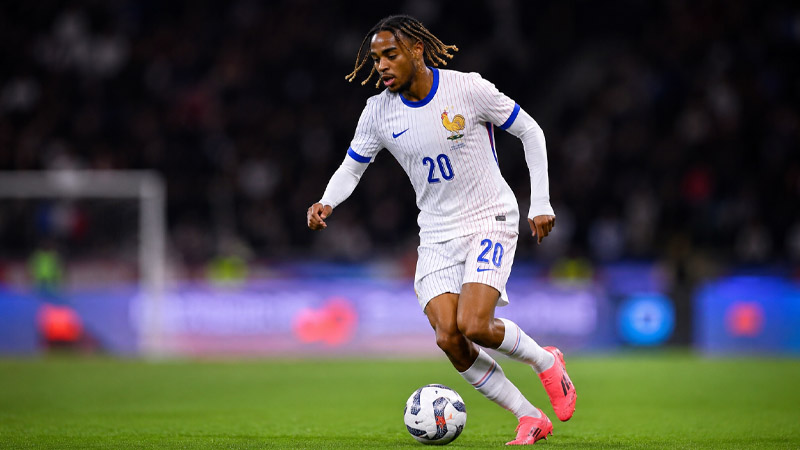
At only 23 years old, Bradley Barcola has emerged as one of the most devastating attacking forces in European football, cementing his status as a cornerstone for both Paris Saint-Germain and the French national team.
His rapid ascent from a promising talent in Lyon’s academy to a back-to-back Champions League winner has captured the attention of global scouting networks and elite Premier League clubs.
With a market valuation now exceeding €130 million, Barcola represents the modern archetype of an explosive, high-efficiency winger who balances individual brilliance with tactical discipline.
The Statistical Evolution: From Prospect to Productive Powerhouse
The trajectory of Barcola’s career is defined by explosive year-on-year growth, moving from a rotational youngster to a marquee forward whose output matches his immense physical potential.
His ability to maintain high efficiency while increasing his volume of play is a primary indicator of his world-class ceiling.
Breakdown of Senior Career Performance
To understand the scale of his impact, one must analyze his productivity across domestic and continental competitions.
His development at Paris Saint-Germain has seen him evolve into a player who consistently delivers in high-stakes environments, such as the UEFA Champions League finals.
| Season | Club | Appearances | Goals | Assists | Key Achievement |
|---|---|---|---|---|---|
| 2021–22 | Lyon | 13 | 0 | 1 | Senior Debut |
| 2022–23 | Lyon | 31 | 7 | 10 | Breakthrough Season |
| 2023–24 | Lyon / PSG | 38 | 5 | 9 | First Ligue 1 Title |
| 2024–25 | PSG | 52 | 21 | 17 | Career-best Productivity |
| 2025–26 | PSG | 47 | 13 | 6 | Retained UCL Title |
| Total | Career | 181 | 46 | 43 | Multitude of Trophies |
Efficiency and High-Stakes Reliability
Barcola’s value is not merely in the volume of his goals but in his efficiency during elite-level knockout tournaments. He has recorded 43 Champions League appearances, contributing 6 goals and 9 assists, proving he can perform when the pressure is highest.
Furthermore, his 88% pass completion rate in European play highlights a level of technical security rarely seen in high-speed transition wingers.
Tactical Profile: The Anatomy of a Modern Wide Threat
Barcola’s game is built on a foundation of elite physical traits paired with a maturing tactical intelligence that allows him to thrive in multiple offensive systems.
He is more than just a traditional winger; he is a multi-functional asset who can dismantle defenses through various methods.
Physical Dominance and Transition Speed
Standing at 6’2″, Barcola possesses a rare combination of height and “sizzling pace,” having been clocked at a top sprint speed of 36.72 km/h.
This athleticism makes him nearly impossible to contain in open space, where he can use his long strides to outpace recovery defenders during counter-attacks.
His acceleration allows him to lead transitions with devastating effectiveness, often turning defensive clearances into immediate scoring opportunities.
Elite Dribbling and 1v1 Proficiency
The French international excels at isolating full-backs and utilizing progressive carries to move his team up the pitch. He frequently drives to the byline to provide cut-back assists or slices inside to unleash powerful strikes with his favored right foot.
This dual-threat capability—being able to go both ways—forces defenders into passive positions, creating space for his teammates.
Unselfish Play and Defensive Work Rate
One of Barcola’s most respected traits is his “selfless” nature on the pitch. Unlike many star wingers who neglect their defensive duties, Barcola is known for his high work rate, tracking back heavily and excelling in high-pressing systems.
This defensive diligence provides tactical balance to the squad, allowing more aggressive full-backs like Achraf Hakimi to push forward with confidence.
The Scouting Debate: Is He a “Killer” or a “Bambi”?
Despite his glittering trophy cabinet, Barcola remains a subject of intense debate among fans and analysts who question whether he is a truly independent “killer” or a product of an elite system.
This division in perspective often centers on his perceived consistency and his ability to “go it alone” against elite opposition.
Analyzing the “Killer Instinct” Gaps
Critics sometimes refer to him as a “Bambi” on the ball, suggesting a perceived lack of raw aggression or solo-scoring ability compared to peers like Vinícius Júnior or Kylian Mbappé.
Some fans argue that he is primarily a chance creator rather than a direct attacking threat who can dribble past entire defenses to score “solo” goals.
There is a lingering sentiment that he needs to improve his finishing to become a truly undisputed world-class individual.
Countering the “System Player” Narrative
Proponents of Barcola argue that his selflessness is actually his greatest strength, as he prioritizes team cohesion over individual highlight reels.
His ability to adapt to changing roles—such as when stars like Khvicha Kvaratskhelia joined PSG—demonstrates a high tactical IQ.
Supporters point to his 98th percentile ranking for Non-Penalty Expected Goals (npxG) as evidence that his positioning and movement are already at an elite level, even if he isn’t a “flair” player in the traditional sense.
Comparative Analysis: How Barcola Measures Up to His Peers
To truly gauge “how good” Barcola is, he must be measured against the gold standards of modern wingers, such as Nico Williams, Vinícius Júnior, and Jamal Musiala.
While he may not yet possess the global branding of some peers, his underlying data suggests he is on a similar, if not superior, developmental curve.
Barcola vs. Nico Williams and the Elite Tier
When comparing Barcola to Nico Williams, several analysts argue that Barcola offers a more well-rounded profile for a high-possession team.
In the 2025/26 season context, Barcola’s goal and assist tallies often exceeded those of Williams, with some fans asserting he is “well ahead of the graph” compared to other young stars like Musiala at the same age.
Key Performance Indicators Comparison
- Goal Contribution: Barcola has shown a higher floor for goal involvements (G+A) per 90 minutes in Ligue 1, ranking in the 93rd percentile.
- Tactical Flexibility: While some wingers are strictly “touchline” players, Barcola’s ability to play both wings effectively makes him a more versatile tool for coaches like Luis Enrique.
- System Integration: Unlike players with “bad attitudes” or high-maintenance playstyles, Barcola is frequently cited as a “main component of the project” due to his professional conduct and willingness to follow complex tactical instructions.
International Pedigree: A Future French Icon
Barcola’s impact extends beyond club football into the prestigious ranks of the French national team. His debut in 2024 marked the beginning of what many believe will be a decade-long tenure as a starter for Les Bleus.
His performance on the international stage has served to silence many of his domestic critics who doubted his ability to perform outside of the PSG system.
2026 FIFA World Cup Impact
Currently representing France at the 2026 World Cup, Barcola has already made his mark with a highlight-reel chipped goal against Senegal.
This moment of individual brilliance on the world’s biggest stage has acted as a significant “trust signal” for his potential, proving he can deliver moments of magic under intense global scrutiny.
With 9 caps and 2 goals already to his name, he is quickly becoming an indispensable part of the French attack.
The Transfer Landscape: A €130M Transformational Asset
The combination of his age, statistical profile, and tactical flexibility has made Barcola the primary target for several “powerhouse” clubs in the Premier League.
As clubs look for players who can instantly upgrade an elite attack without disrupting team chemistry, Barcola’s name sits at the top of the list.
Arsenal and Liverpool Interest
Both Arsenal and Liverpool have been linked with heavy transfer bids for the winger. Arsenal, in particular, are reportedly “closely monitoring” Barcola as they seek a new top talent for their left wing to compete at the highest level of the Premier League and Champions League.
His profile fits the “Arsenal mold”—technically secure, physically dominant, and tactically disciplined.
Market Value and Investment Potential
With a valuation upwards of €130 million (£112m), any move for Barcola would be one of the most expensive in football history.
However, elite clubs view this not just as a cost, but as an investment in a player who has already proven he can win the biggest trophies in the sport twice before the age of 24.
His potential to grow further under a different coaching style or in a faster league like the Premier League makes his ceiling “staggeringly high”.
Frequently Asked Questions About Bradley Barcola
Is Bradley Barcola better than Nico Williams?
While both are elite, Barcola currently boasts a more decorated trophy cabinet with back-to-back Champions League titles and statistically superior G+A metrics in recent seasons.
His defensive work rate is often cited as a distinguishing factor that makes him more suitable for high-pressing systems.
What is Barcola’s best position?
Barcola is primarily a left winger who excels at cutting inside onto his right foot. However, his tactical flexibility allows him to play effectively on the right wing or even as a high-impact weapon off the bench, depending on the team’s needs.
Does he struggle against defensive teams?
Yes, one of his documented limitations is the “Low-Block Conundrum”. Because he relies on his 36.72 km/h pace to devastate opponents, he can occasionally find it difficult to influence games when opponents sit deep and restrict the vertical space behind the defense.
Why is his market value so high?
His €130m+ valuation is driven by his age (23), his consistent production in the Champions League, his elite physical traits, and his status as a key player for the French national team. He is viewed as a “transformational piece” for any elite attacking unit.
Conclusion: A World-Class Talent in the Making
Bradley Barcola is no longer just a “prospect”; he is a borderline world-class talent whose presence on the pitch fundamentally changes how opponents must defend.
While debates regarding his “solo” goal-scoring ability persist, his statistical output, defensive diligence, and trophy-winning pedigree speak for themselves.
Whether he remains at Paris Saint-Germain to continue their era of dominance or makes a blockbuster move to the Premier League, Barcola is destined to remain at the pinnacle of the sport for years to come.
For clubs and fans alike, the verdict is clear: Barcola is an elite, unselfish, and explosive weapon who represents the very best of modern footballing excellence.