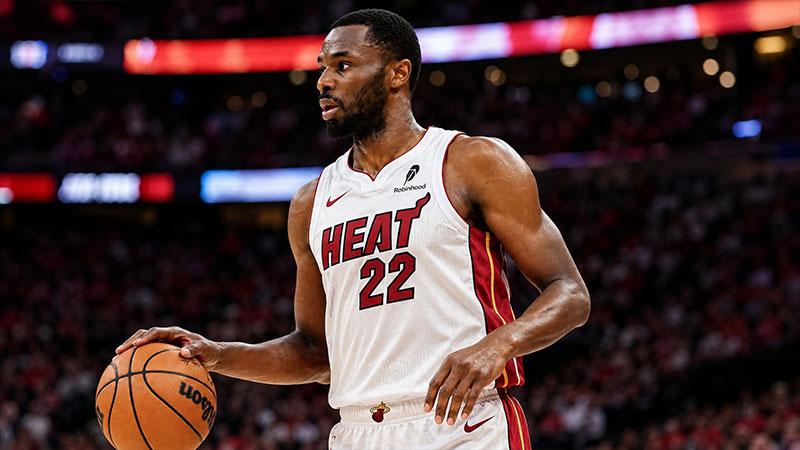
Andrew Wiggins has navigated one of the most fascinating career arcs in modern basketball history.
Transitioning from the high-pressure mantle of a number-one overall pick to an elite championship-caliber wing, he has proven that professional success is often a matter of finding the right environment.
Over a 12-year NBA tenure, Wiggins has successfully moved away from the “franchise savior” narrative to become an indispensable two-way force.
By analyzing his scoring milestones, defensive metrics, and role evolution, we can accurately measure his true value as a premier starter for a championship contender today.
The Evolution of a Number One Overall Pick
To understand how good Andrew Wiggins is today, one must first examine the burden of expectations he carried during his early years in the league.
Entering the NBA as the “Maple Jordan,” Wiggins was immediately cast as the cornerstone of the Minnesota Timberwolves franchise, a role that defined the first half of his career.
From Minnesota’s Leading Man to Championship Piece
During his tenure in Minnesota, Wiggins was required to be a high-volume scoring engine. He delivered on this expectation early, winning the NBA Rookie of the Year award in the 2014–15 season and securing a spot on the NBA All-Rookie First Team.
In this environment, his game was characterized by raw athleticism and a heavy offensive workload, which allowed him to amass a significant portion of his 15,214 total career points.
However, analysts often noted that while his scoring totals were high, his impact on winning was limited by a lack of efficiency and defensive consistency.
Assessing the Scoring Legacy and Volume
Across 834 regular-season games, Wiggins has maintained a career average of 18.2 points per game. This consistency is a testament to his durability and scoring instincts.
In Minnesota, he frequently averaged over 20 points per game, but these numbers were often viewed through the lens of “empty stats” because they did not translate to postseason success.
It wasn’t until his trade to a more structured environment that the true utility of his scoring ability—specifically his ability to thrive as a secondary or tertiary option—was fully realized.
Decoding the Statistical Impact of a 12-Year Career
Evaluating Wiggins requires looking beyond the basic box score to see how his efficiency has shifted over time. His career is essentially a tale of two different players: the high-volume prospect and the hyper-efficient veteran.
The following table highlights his cumulative career production and efficiency metrics, illustrating his longevity and steady contribution to the three franchises he has represented:
| Statistic | Career Average | Cumulative Career Total |
|---|---|---|
| Games Played (GP) | — | 834 |
| Points (PTS) | 18.2 PPG | 15,214 |
| Rebounds (TRB) | 4.5 RPG | 3,753 |
| Assists (AST) | 2.3 APG | 1,918 |
| Field Goal % (FG%) | 45.1% | — |
| 3-Point % (3P%) | 36.2% | 1,211 Made 3PM |
| Win Shares (WS) | — | 37.6 |
Understanding the Player Efficiency Rating (PER)
Wiggins’ career Player Efficiency Rating (PER) stands at 15.1, which is remarkably close to the NBA league average of 15.0. This number is a perfect encapsulation of his journey.
It reflects a blend of his early years, where high volume and lower efficiency dragged the metric down, and his later years, where he has cleared the 56–57% True Shooting threshold in optimized roles.
This balance suggests that while he may not be a statistical outlier in terms of efficiency, he is a highly reliable and productive professional who performs at or above league standards for over a decade.
The Golden State Breakthrough and Defensive Mastery
The true turning point in assessing how good Andrew Wiggins is came during his time with the Golden State Warriors.
It was here that he shed the “bust” label and transformed into a championship-winning piece, proving that his defensive ceiling was much higher than previously thought.
The 2022 Postseason and Neutralizing Superstars
The 2021–22 season remains the pinnacle of Wiggins’ professional career. He was selected as an NBA All-Star starter and played a pivotal role in the Warriors’ championship run. His most significant contribution was not his scoring, but his elite on-ball defense.
During the 2022 NBA Finals, he was widely credited with neutralizing Boston Celtics superstar Jayson Tatum, using his length and lateral quickness to disrupt one of the league’s best offensive players.
Many experts argue that Wiggins was the Warriors’ second-best player during that championship series, providing the defensive backbone required to win at the highest level.
Scaling Down for Maximum Team Efficiency
In Golden State, Wiggins mastered the “scaled-down” starter role. By functioning as a third or fourth offensive option, he was able to focus his energy on elite perimeter defense and hitting open three-pointers.
This role optimization is a key lesson in modern basketball: a player’s value is often determined by how well they fit into a winning ecosystem. Wiggins proved he could be a “star in his role,” a transformation that solidified his reputation as a premier two-way wing.
The Miami Heat Era: Elite Shooting and Versatility
Now a veteran presence for the Miami Heat, Wiggins has continued his evolution, refining his game to match the needs of a modern, space-oriented offense.
His current production in the 2025–26 season demonstrates a player who has reached his final form as a lethal “3-and-D” specialist.
Precision Shooting and Tactical Spacing
In his current tenure with Miami, Wiggins is posting a career-high 3-point accuracy of 41.4%. This is a massive leap from his early career, where he was considered a shaky outside shooter.
By hitting over 40% of his attempts from deep, he provides the essential floor spacing that allows teammates to operate in the paint.
While his raw scoring has dipped to a career-low 15.4 points per game, his efficiency from the field has risen to 47.5%, indicating that he is taking—and making—smarter shots.
Defensive Disruptor in the Miami System
The Miami Heat’s defensive philosophy has further highlighted Wiggins’ ability to impact the game without scoring. This season, he is averaging 2.1 “stocks” (steals plus blocks), making him a premium on-ball disruptor.
His 4.8 rebounds per game also provide solid value for a perimeter wing, helping his team secure possessions and transition into the fast break.
| 2025–26 Season Metric | Statistics | Impact Context |
|---|---|---|
| Points Per Game | 15.4 | 55th in the NBA |
| 3-Point Percentage | 41.4% | Career-High Accuracy |
| Defensive Stocks | 2.1 | Elite Perimeter Disruption |
| Field Goal % | 47.5% | High-Efficiency Selection |
Core Strengths and Strategic Value
When evaluating a player of Wiggins’ caliber, it is essential to identify the specific traits that make him a target for top-tier organizations.
His athletic profile and refined skill set allow him to fill gaps that are often the difference between a playoff exit and a championship.
- Elite On-Ball Defense: Wiggins possesses the rare combination of length, lateral quickness, and verticality. This allows him to guard multiple positions and disrupt the rhythm of the league’s most dangerous scoring wings.
- Modern Three-Point Threat: Having transformed into a lethal floor spacer, his 41% accuracy from deep makes him a constant threat in catch-and-shoot situations.
- Athletic Transition Finishing: He remains a high-end athlete who can play above the rim. This makes him a weapon in transition and allows him to generate second-chance points through active offensive rebounding.
- Durability and Reliability: With 834 games played over 12 years, he has proven to be a durable asset who can be counted on for heavy minutes (33.5 MPG career average).
Identifying the Gaps: Playmaking and Consistency
No analysis of Wiggins would be complete without addressing the limitations that have kept him from entering the superstar tier. While he is an elite role player, his game has specific ceilings that teams must manage when building a roster around him.
The Playmaking Ceiling
One of the primary reasons Wiggins is better suited as a “scaled-down” starter is his lack of dynamic playmaking for others. Throughout his 12-year career, he has averaged only 2.3 assists per game.
His tight-space dribbling and court vision are not at the level required to run an offense as a primary initiator. When asked to carry a heavy playmaking load, his efficiency typically suffers, making him much more effective when paired with a high-level point guard.
Managing the “Motor” and Engagement
A recurring critique of Wiggins throughout his career has been his consistency and “motor.” Critics have often noted stretches where he seems to blend into the background rather than asserting his physical dominance.
While his 2022 championship run silenced many of these doubters, the narrative persists that he requires a strong team culture to stay fully engaged. In Miami and Golden State, this has been less of an issue, but it remains a factor that defines his career profile.
Enhanced FAQ: Understanding the Wiggins Legacy
Is Andrew Wiggins considered a “bust” given his #1 pick status?
While he didn’t become a perennial MVP candidate, he is far from a bust. He is an NBA Champion, an All-Star starter, and has over 15,000 career points. He has successfully transitioned into one of the most valuable archetypes in the league: the elite two-way wing.
How does his defense compare to the league’s elite?
Wiggins is currently in the upper echelon of perimeter defenders. His 2.1 stocks per game in 2025–26 and his historic performance against Jayson Tatum in the 2022 Finals prove he can neutralize the best scorers in the world.
What is his most improved skill?
His three-point shooting is his most improved attribute. He went from a shaky shooter early in his career to a 41.4% marksman this season.
Will he reach the Hall of Fame?
It is a difficult path. While his scoring totals (15,214) are impressive, his lack of multiple All-NBA selections and a career PER of 15.1 suggest he is currently in the “Hall of Very Good” rather than the Hall of Fame.
Conclusion: The Final Verdict on Wiggins
Andrew Wiggins is a master of role optimization. He has proven that a player doesn’t need to be the primary option to be a “star” in the context of winning.
By embracing his strengths as a defensive stopper and an efficient shooter, he has carved out a 12-year career that many top picks would envy. He is a tier-two NBA starter whose presence on a roster significantly raises a team’s defensive floor and offensive ceiling.