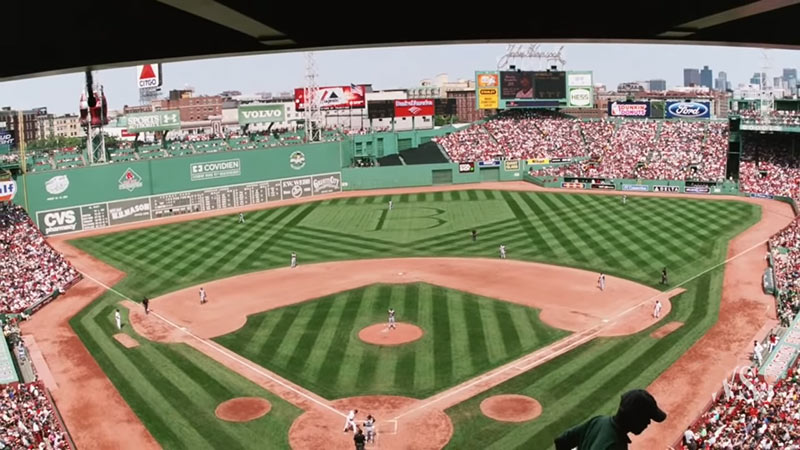
A well-kept ballpark is one of sports’ classic sights. Fans see crisp shapes in the outfield grass. Major League fields can have neat, straight stripes. Some have grids with lines that cross. Others show rows of diamond shapes.
For years, many fans have guessed how crews make them. Some think crews use green dye or paint. Others think they plant dark and light grass types. They assume each type grows in its own neat row.
The real cause is how grass bends and reflects light. A heavy roller on a mower bends the blades. Crews bend one row one way. They bend the next row the other way.
Each row then reflects light in a different way. This makes some rows look light and others dark. Crews use this effect to form clear shapes. They use the same grass, with no paint or dyes.
1: The Optical Physics of Grass Striping
Grass patterns come from how grass bends under force. Light then changes how the bent blades look. This does not change the grass’s own color. It changes how light hits each blade.
Bending Mechanics vs. Chemical Coloring
The stripes come from bent blades, not paint or dye. A mower has a roller or brush behind its blades. As the mower moves, this tool presses the grass down. The grass bends flat in the same way the mower goes.
The mower then turns and cuts the next strip. It goes back the other way on this pass. The roller bends that strip the other way, too.
The Role of Light Reflection and Shadow
Light and shade make the strips look different:
- Light Stripe Dynamics: Grass bent away from you looks much lighter. Sunlight hits the wide, flat side of each blade. This broad side sends more light back to your eyes.
- Dark Stripe Dynamics: Grass bent toward you looks much darker. You see the shaded tips and dark gaps between blades. Less of each blade’s broad side is in view. The strip seems to soak up light, which gives it a deep, rich look.
2: Solar Position, Viewing Angles, and Spatial Perspective
A mower bends grass blades to form stripes. The sun and your view shape how strong they look. As these angles change, the stripes change too.
Viewing Vectors and Solar Alignment
Striped grass looks different based on where you stand. The sun’s path and the mower’s tracks both play a role.
- Walking With the Light: Look or walk in the same direction as sunlight. The rows that reflect light look bright and clear. They have a pale sheen.
- Viewing Against the Sun: Look toward the source of the sunlight. Light falls into the shade cast by the blades. Those rows look deep and dark.
Perspective Shifts and Disappearing Patterns
Grass stripes are a trick of reflected light. A change in your view can change their look. As you walk round a field, the contrast shifts. The light and dark rows may stand out less.
From some sharp side angles, the stripes grow faint. They may also fade when you look across them. At times, they seem to vanish from view.
Keep walking round the field, and they may return. When your view lines up with the sun again, the stripes look sharp. The light and dark bands stand out once more.
This helps explain the bold stripes seen at ballparks. They look striking from press boxes and high stands. From these spots, the height and light angles work together. They make the contrast in reflected sunlight stand out.
3: Pattern Geometry – From Parallel Lines to Complex Designs
Turf crews use set mowing routes to make patterns. Some are plain stripes that serve a clear use. Others form bold designs on the field.
Classic Parallel Stripes
Straight stripes are the base of turf striping. Crews mow back and forth in straight lines. This makes light and dark stripes side by side.
First, mow one straight strip down the field. At the edge, turn 180 degrees. Then mow the next strip in the reverse direction.
Intersecting Patterns (The Ballpark Checkerboard)
Crews mow in two directions to make checkerboard designs. This gives the field a classic ballpark look. First, they mow north to south. Then, they mow east to west.
To make a checkerboard:
- First Pass: Mow the whole field in north-south lines. Switch direction with each new strip.
- Second Pass: Turn 90 degrees. Mow east-west lines across the same grass. Switch direction with each new strip.
- Refraction Interaction: Bright squares form where two light rows cross. Deep, dark squares form where two dark rows cross. Where light and dark rows meet, the shade falls between the two.
4: Equipment Standards and DIY Application for Home Lawns
Achieving ballpark-quality turf striping is not restricted to professional stadium crews with multi-million-dollar facility budgets. Residential lawn enthusiasts can implement these exact physical principles on home lawns using accessible equipment.
Striping Gear Mechanisms
Professional turf equipment features heavy steel rollers integrated into the rear chassis of large gang mowers or reel mowers. For home application, homeowners utilize specialized lawn stripe kits.
Products such as a Big League lawn stripe kit can be attached to the rear of almost any mower type—including standard push mowers, lawn tractors, riding mowers, and commercial zero-turn mowers.
These aftermarket kits feature weighted rubber or steel rollers filled with sand or water, mounted directly behind the cutting deck. As the mower cuts the grass, the trailing kit applies continuous, uniform downward pressure to bend the freshly cut blades.
Matching Equipment to Turf Conditions
To ensure crisp definition without compromising plant health, the equipment setup must consider:
- Roller Mass: Sufficient weight is required to lay the blades flat, but excessive weight can cause soil compaction over repeated passes.
- Deck Height: Cutting grass slightly taller allows longer blade surface area to bend, creating significantly deeper contrast compared to ultra-short grass cuts.
5: Step-by-Step Execution Guide for Professional-Grade Lawn Striping
To achieve crisp, stadium-quality striping on a residential or commercial property, follow this structured operational framework:
1: Pre-Mow Planning and Route Mapping
- Analyze Solar Geometry: Identify the primary viewing angle (e.g., from a back patio, front porch, or street facing) and assess how sunlight strikes the lawn during peak viewing hours. Align your primary passes along the axis of sunlight to maximize visual contrast.
- Clear Obstacles: Ensure the turf is free of debris, fallen branches, and obstacles that could disrupt straight pass trajectory or damage the striping attachment.
2: Equipment Setup
- Attach Striping Kit: Securely mount the striping attachment (such as a Big League lawn stripe kit) behind the mower deck, verifying that the roller rests firmly on the turf surface.
- Set Cutting Height: Raise the mower deck slightly higher than normal to provide adequate blade length for dramatic bending without scalping the turf.
3: Executing the Mowing Passes
- Establish a Benchmark Line: Focus on a fixed object in the distance (such as a fence post or tree) to maintain a straight first pass across the lawn.
- Alternate Pass Directions: At the perimeter boundary, execute a smooth turn. Mow the return pass immediately adjacent to the first strip, traveling in the exact opposite direction.
- Complete the Layout: Continue this back-and-forth process across the entire lawn area for classic parallel stripes.
4: Constructing Complex Designs (Optional)
- For a classic ballpark checkerboard, repeat Phase 3 at a precise 90-degree angle to your original passes.
- Finish by mowing a clean perimeter boundary pass around the entire lawn to outline the internal pattern and conceal turning marks.
Summary
Transforming turf into a visually stunning, stadium-caliber showcase is an exercise in applied light physics and methodical lawn care mechanics.
By understanding that grass striping relies on bending blades to manipulate light reflection rather than applying dyes or multi-species seed mixes, homeowners and field operators alike can achieve professional visual results.