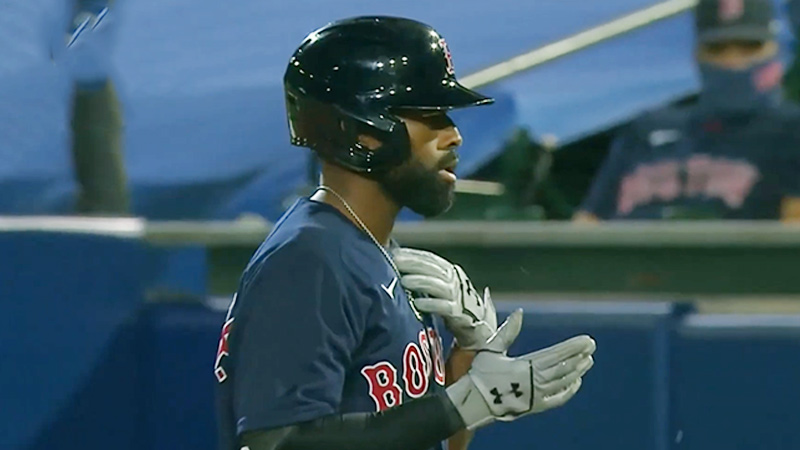
The journey of a Major League Baseball player is rarely a straight line. For every “phenom” who arrives and dominates instantly, there are dozens of players who must weather the storm of inconsistency, the mental grind of the minor leagues, and the crushing pressure of a high-stakes market like Boston.
Jackie Bradley Jr. (often referred to as JBJ) is the quintessential example of a player whose “break” into the Major Leagues was not a single moment, but a multi-year process of refinement, resilience, and remarkable defensive wizardry.
This post explores the detailed path Jackie Bradley Jr. took from a standout college performer to one of the most respected center fielders in the history of the Boston Red Sox.
The Genesis of a Defensive Legend: From South Carolina to the Pros
Jackie Bradley Jr.’s path to professional baseball was paved with collegiate success. He was a cornerstone of the University of South Carolina baseball program, where his performance caught the eyes of scouts across the nation.
His ability to track fly balls that seemed destined for the gaps became his calling card long before he ever donned a Red Sox uniform.
In the 2011 MLB Draft, the Boston Red Sox selected Bradley Jr. in the supplemental first round (40th overall). This was a compensation pick, and the Red Sox demonstrated their belief in his high ceiling by signing him for a $1.1 million bonus.
Dominating the Diamond: Minor League Accolades and Rapid Ascent
After signing in 2011, Bradley Jr. did not waste any time proving that his collegiate success would translate to the professional level.
He experienced quick success in the minors, moving through the system with an efficiency that suggested he was nearly Major League-ready within a year of being drafted.
The defining characteristic of his minor league tenure was his glove. In 2012, he was named the Red Sox’ Minor League Defensive Player of the Year.
This accolade highlighted his elite skill set in center field, a position that requires immense range, a powerful arm, and a high baseball IQ—all of which Bradley Jr. possessed in spades. By the end of 2012, the conversation in Boston had shifted from whether he would play in the majors to when.
Opening Day 2013: A Dream Realized and the Reality of the “Bigs”
Following an exceptionally strong 2013 spring training, the Red Sox made the bold decision to include Bradley Jr. on the Opening Day roster. For a young prospect, making the jump to the Major Leagues on Opening Day is the ultimate validation of talent. He officially made his MLB debut in 2013.
However, the transition was not seamless. While his defense remained spectacular, his bat struggled to catch up to the velocity and movement of Major League pitching.
This period marked the beginning of a “turbulent” few seasons where his offensive output did not match his defensive contributions.
Contextual Note: The 2013 Red Sox were a veteran-heavy team on a mission to win the World Series. For a rookie like Bradley Jr., finding consistent playing time amidst a championship-caliber roster added an extra layer of pressure that is common for top-tier prospects in Boston.
Navigating the “Boston-to-Pawtucket Shuttle”
One of the most difficult phases of Jackie Bradley Jr.’s career was his experience with the “Boston-to-Pawtucket shuttle”. In baseball parlance, this refers to the frequent movement of a player between the Major League club and its Triple-A affiliate (at the time, the Pawtucket Red Sox).
Between 2013 and 2014, Bradley Jr. was optioned multiple times. These stints in Pawtucket were designed to help him:
- Refine his offensive approach.
- Adapt to the nuances of Major League pitching.
- Regain confidence away from the intense scrutiny of the Boston media.
Despite the frustration that often comes with being sent down, Bradley Jr. maintained what coaches described as a “high mental approach to the game”.
He earned his spot not just through raw physical talent, but through a consistent approach and professional at-bats, even when the hits weren’t falling.
The Turning Point: Adjusting to the Pitchers
The primary hurdle for Bradley Jr. during his early “shuttle” years was offensive consistency. In the Major Leagues, once a pitcher finds a “hole” in a hitter’s swing, the entire league exploits it until the hitter proves they can adjust.
Bradley Jr. eventually proved his worth by adjusting to opposing pitchers’ tendencies. This was a crucial evolution. Rather than trying to change his entire identity as a player, he focused on the chess match between hitter and pitcher.
By studying how pitchers were attacking him during his first few turbulent seasons, he began to turn the tide.
The 2016 Breakout: From Defensive Specialist to All-Star
Everything changed in 2016. This was the year Jackie Bradley Jr. officially solidified his spot in the Red Sox lineup.
He transitioned from being viewed primarily as a “defensive specialist”—someone who stayed in the lineup solely for his glove—to an All-Star contributor.
The 2016 season was a testament to his hard work and consistent play. He put together a career-best offensive performance that, combined with his gold-glove caliber defense, earned him a long-term role in the organization.
Conclusion: The Legacy of Persistence
Jackie Bradley Jr.’s “break” into the Major Leagues is a story of persistence over perfection. He arrived with the pedigree of a first-round pick and the accolades of a defensive genius, but he had to fight through years of offensive “shuttling” to become a complete player.
Ultimately, his journey shows that elite defense provides a floor, but mental toughness and the ability to adapt to the league’s best pitchers provide the ceiling.
For Red Sox fans, JBJ remains a symbol of the era—a player who could change a game with a single catch in the “Triangle” at Fenway or a clutch home run when it mattered most.