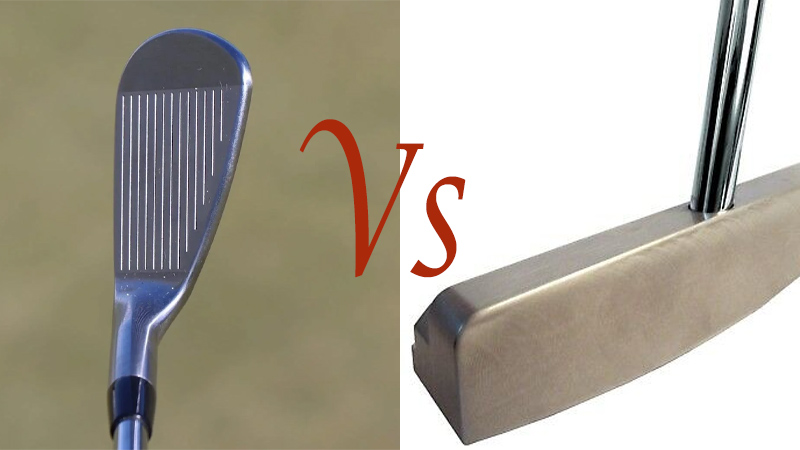
Whether you are browsing the latest game-improvement irons or eyeing a set of sleek tour blades, you’ve likely noticed a distinct visual difference in how the clubhead sits relative to the shaft. This design feature is known as offset, and it is one of the most debated topics in golf equipment.
While some golfers swear by it for curing a slice, others find it aesthetically “ugly” or difficult to control. Here is everything you need to know about the battle between offset and no-offset irons.
What Exactly is Iron Offset?
In technical terms, offset refers to the distance the leading edge of the clubhead is set back from the hosel or neck of the club. In a standard or “no-offset” club, the face is typically positioned directly in line with the shaft.
When a club has offset, the manufacturer intentionally bends the hosel to push the clubface slightly behind the shaft. This subtle shift is designed to help the average golfer square the clubface more effectively at impact.
The Benefits of Offset Irons
Offset design isn’t just a visual quirk; it serves several functional purposes designed to help high-handicap and beginner golfers:
- Squaring the Face: By setting the clubhead back, golfers gain a fraction of a second longer to square the face before impact. This helps reduce the “open face” position that causes a slice.
- Higher Launch: Offset moves the club’s center of gravity (CG) further back and down. This encourages a higher launch angle and more spin, which is particularly helpful for players with slower swing speeds who need more distance.
- Increased Forgiveness: Offset irons generally have a higher Moment of Inertia (MOI) because the center of mass is further from the shaft. This makes the club more resistant to twisting on off-center hits.
- Improved Hand Position: It naturally encourages the player’s hands to be in front of the clubhead at address and impact, promoting a cleaner strike.
The legendary PING Eye 2, released in 1982, is often cited as the iron that revolutionized this concept, combining healthy offset with perimeter weighting to create what many consider the easiest iron to hit in history.
The Case for No-Offset (or Minimal Offset)
If offset is so helpful, why do professional and low-handicap golfers often prefer “straight neck” or no-offset irons?
- Precise Control: Clubs with little to no offset allow skilled players to better manipulate the ball’s flight and “shape” shots (draws and fades).
- Direct Feedback: These irons provide more immediate feedback and a more “responsive” feel, helping seasoned players refine their mechanics.
- Traditional Aesthetics: Many experienced golfers prefer the “clean” and traditional look of a clubface that is perfectly aligned with the shaft.
- Preventing Hooks: For players who naturally close the face too much, significant offset can actually exacerbate a hook, causing the ball to veer too far left.
Fact vs. Fiction: Debunking the Myths
There are several common misconceptions about how offset actually impacts your game:
- Myth: Offset forces a hook. Reality: If a player hooks with an offset iron, it is often due to their psychological setup at address—aiming the face more closed than they realize—rather than the physics of the club itself.
- Myth: The timing difference is massive. Reality: Mathematical analysis suggests that the difference in time an offset club gives you to close the face is only about 66 milliseconds. While tiny, proponents argue that in the delicate balance of a golf swing, even these minuscule adjustments matter.
- Myth: Offset is only for beginners. Reality: While common in game-improvement sets, many intermediate players use offset to maintain a consistent ball flight, and some modern “player distance” irons offer a compromise of minimal offset with significant forgiveness.
Which Should You Choose?
The choice between offset and no-offset is ultimately a matter of skill level and personal preference.
If you are battling a persistent slice and need help getting the ball in the air, offset irons are a proven tool to keep you in the fairway. However, if you value a direct feel and want the ability to shape your shots with precision, you may find that minimal or no-offset designs complement your swing better.
The best way to decide is to ignore the “look” of the clubhead and focus on the leading edge when lining up your shot. Testing both styles with a professional fitter will reveal which design actually delivers the results your game needs.