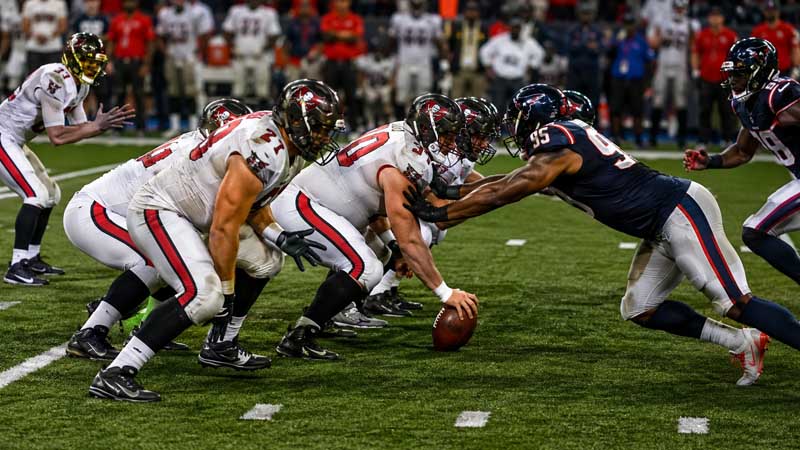
The boundaries of a playing field are not merely lines painted on turf; they represent the structural framework within which athletic strategy, physical execution, and competitive fairness operate.
In professional sports, the integrity of these boundaries is maintained by a complex set of rules designed to regulate player positioning and movement. Among these rules, few terms cause as much cross-sport confusion as encroachment.
While both American football and soccer utilize the term “encroachment” to designate a rule violation, the infraction refers to completely distinct physical actions, athletic contexts, and gameplay consequences in each sport.
In American football, encroachment is a defensive violation centered on premature physical contact across the line of scrimmage.
In soccer, encroachment is a spatial violation concerning the restricted boundaries of the penalty area during one of the most high-stakes moments of the game: the penalty kick.
Understanding the precise mechanics, strategic implications, and rule differences of these infractions is essential for any professional analysis of the field.
This guide provides a comprehensive breakdown of encroachment in both sports, clearing up traditional fan confusion and outlining how these rules dictate the flow of play.
Encroachment in American Football — The Mechanics of Pre-Snap Contact
In American football, the period directly preceding the start of a play is governed by strict rules regarding player alignment and movement.
Before a play can begin, both the offensive and defensive units must align themselves on their respective sides of the line of scrimmage. The space between these two units is known as the neutral zone.
The Physical Infraction
Encroachment in American football occurs when a defensive player crosses the line of scrimmage before the ball is snapped and makes physical contact with an offensive player or with the football. This element of physical contact is the defining threshold of the penalty.
During the pre-snap phase, defensive players, particularly edge rushers and defensive backs, constantly look for any competitive advantage.
They often attempt to “jump the snap,” predicting the exact moment the quarterback will call for the ball to launch their rush with maximum momentum.
However, this anticipation carries a high margin of error. If a defender jumps forward too early and crosses the line of scrimmage, they commit a violation.
If the defender realizes their mistake, they are permitted to jump back across the line to their proper side of the field without penalty, provided they do so before the ball is snapped and without touching any opponent.
However, the moment that premature crossing results in physical contact—whether they bump an offensive lineman, brush against a receiver, or touch the ball itself—the play is instantly dead, and encroachment is called.
The Operational Consequences: Why It Is a Dead-Ball Foul
Encroachment is strictly classified as a dead-ball foul. This classification has major operational significance for how the game is officiated and played:
- Instant Whistle: The moment a defender makes contact with an offensive player across the line before the snap, the officials blow their whistles immediately.
- No Play: Because the whistle blows instantly, the play is dead before it can even begin. No blocks are thrown, no passes are completed, and no run plays are executed.
- The Penalty: The offending defensive team is penalized 5 yards, and the down is replayed.
By blowing the play dead instantly, the rule prioritizes player safety and prevents the chaos of an unaligned line of scrimmage.
It ensures that the offense is not forced to run a play when a defender has already breached the line and initiated physical contact before the snap.
The Pre-Snap Spectrum — Encroachment, Offsides, and Neutral Zone Infractions
To fully appreciate the tactical nuances of American football, one must distinguish encroachment from other closely related pre-snap penalties.
The defensive unit can commit three distinct boundary violations before or at the moment of the snap, each carrying different rules and consequences.
| Penalty Type | Physical Action Required | Timing of the Violation | Live-Ball or Dead-Ball? | Tactical Outcome |
|---|---|---|---|---|
| Encroachment | Defender crosses the line of scrimmage and makes physical contact with an opponent or the ball. | Before the snap occurs. | Dead-Ball (play is stopped immediately). | Defensive team is penalized 5 yards; down is replayed. |
| Offsides | Defender is positioned across the line of scrimmage or in the neutral zone. | At the exact moment the ball is snapped. | Live-Ball (play continues to completion). | Offense gets a “free play” with a low-risk opportunity. |
| Neutral Zone Infraction | Defender enters the neutral zone and causes an offensive player to jump or react early. | Before the snap occurs. | Dead-Ball (play is stopped immediately). | Defensive team is penalized 5 yards; down is replayed. |
The Neutral Zone Infraction Contrast
A neutral zone infraction serves as the middle ground between encroachment and offsides.
In this scenario, a defensive player moves across the line of scrimmage before the snap and causes an offensive player to move or jump in response. Crucially, there is no physical contact between the players.
Under older rules, an offensive player jumping early would be penalized for a false start.
However, because the defender’s illegal pre-snap movement directly triggered the offensive player’s reaction, the neutral zone infraction rule penalizes the defense instead. Like encroachment, this is a dead-ball foul that stops the game instantly and costs the defense 5 yards.
The Live-Ball Offsides Contrast and the “Free Play”
The distinction between encroachment (dead-ball) and offsides (live-ball) represents one of the most critical strategic elements of football game management.
If a defensive player crosses the line of scrimmage before the snap, does not touch anyone, and does not cause an offensive player to jump early, there is no immediate dead-ball whistle.
If the ball is snapped while that defender is still standing across the line or in the neutral zone, the infraction is ruled as offsides.
Because offsides does not involve pre-snap contact or premature offensive movement, the officials do not blow the play dead. They drop a penalty flag but allow the play to continue to its natural conclusion. This creates a free play for the offense.
During a free play, the offense operates with zero risk:
- Low-Risk Shots: Recognizing that a penalty flag has been thrown for offsides, quarterbacks will frequently throw deep, highly risky passes down the field.
- The Choice: If the pass is completed for a massive gain or a touchdown, the offensive coordinator will decline the offsides penalty and take the results of the play.
- The Safety Net: If the pass is incomplete or intercepted, the offense will simply accept the 5-yard offsides penalty, erasing the turnover and replaying the down.
Elite quarterbacks excel at spotting a defender caught offsides, immediately urging the center to snap the ball to lock in this high-reward, zero-risk opportunity. Consequently, many analysts argue that standard offsides is a far more damaging penalty for a defense than encroachment.
While encroachment penalizes the defense 5 yards, it kills the play. Offsides, by comparison, also penalizes the defense 5 yards but exposes them to the devastating tactical threat of a deep pass completion on a free play.
There is, however, a critical safety exception to the live-ball offsides rule known as being unabated to the quarterback.
If a defender crosses the line of scrimmage so early or so cleanly that they have a direct, unobstructed path to the quarterback before the snap is completed, the referee will blow the whistle and kill the play instantly.
This judgment call is made solely to protect the quarterback from taking a severe, unexpected hit when they are in a vulnerable pre-snap position.
Soccer Encroachment — Spatial Integrity of the Penalty Kick
When we move from the gridiron to the soccer pitch, encroachment takes on a completely different meaning.
Soccer encroachment has nothing to do with physical collisions, lines of scrimmage, or pre-snap counts. Instead, it is a strictly spatial rule designed to govern the execution of a penalty kick.
The Spatial Boundaries of the Penalty Kick
A penalty kick is a highly regulated, one-on-one contest between the attacking kicker and the defending goalkeeper. To ensure that this contest is executed fairly without external interference, the rules dictate strict spatial boundaries:
- The ball is placed on the penalty spot.
- The defending goalkeeper must stand on their goal line.
- The Restricted Area: Every other player from both teams must remain completely outside the penalty area (the “18-yard box”) and outside the adjacent “D” arc at the top of the box.
- No player may enter these restricted spaces until the kicker has made contact with the ball and the kick is officially taken.
Defining Soccer Encroachment
Soccer encroachment occurs when any player other than the kicker or the goalkeeper steps inside the penalty area or the “D” arc before the penalty kick is taken. This early entry violates the protective space around the penalty spot.
Unlike American football, where encroachment results in an immediate stoppage of play, soccer is a game characterized by continuous flow.
Therefore, soccer referees do not blow the whistle the exact instant a player steps across the line.
Instead, they allow the kick to be completed and apply the penalty conditionally, depending on which team committed the encroachment and whether the kick resulted in a goal.
The Conditional Consequences of Soccer Encroachment
The referee evaluates the outcome of the penalty kick and applies the rule based on a structured matrix of possibilities:
Defending Team Encroachment
If a defender enters the penalty area or the “D” arc too early:
- If a Goal is Scored: The goal stands. The defending team is not permitted to benefit from their own violation to cancel a successful goal.
- If a Goal is Missed or Saved: The referee orders the penalty kick to be retaken. This ensures the defending team does not gain an advantage by illegally crowding the area to block potential rebounds or distract the kicker.
Attacking Team Encroachment
If a member of the kicker’s own team enters the penalty area or the “D” arc too early:
- If a Goal is Scored: The goal is disallowed, and the referee orders the penalty kick to be retaken. The attacking team cannot use an illegal spatial advantage to secure a goal.
- If a Goal is Missed: The play is typically stopped, and the defending team is awarded an indirect free kick, or play continues depending on the specific tournament guidelines (as the attacking team cannot benefit from a missed kick where they encroached).
Through this conditional framework, soccer’s encroachment rule neutralizes any unfair positional advantage that players might gain by breaching the spatial boundaries of the penalty area early.
Summary of Key Rule Differences
To maintain a firm grasp on how these rule sets govern their respective fields, keep these core differences in mind:
- The Trigger: Football encroachment requires physical contact across the line of scrimmage before the snap. Soccer encroachment requires early spatial entry into the penalty area or “D” arc before the penalty kick is taken.
- The Timing of the Whistle: Football encroachment triggers an instant whistle, killing the play immediately. Soccer encroachment is evaluated after the kick is completed, with the referee applying the penalty conditionally based on the outcome of the play.
- The Penalty Metric: A football encroachment penalty is measured in yards (a 5-yard regression for the defense). A soccer encroachment penalty is measured in play outcomes (requiring a retake of the penalty kick).
By establishing these strict boundaries and consequences, both sports protect the integrity of their most critical competitive moments, ensuring that games are decided by athletic skill and tactical execution rather than early head starts.