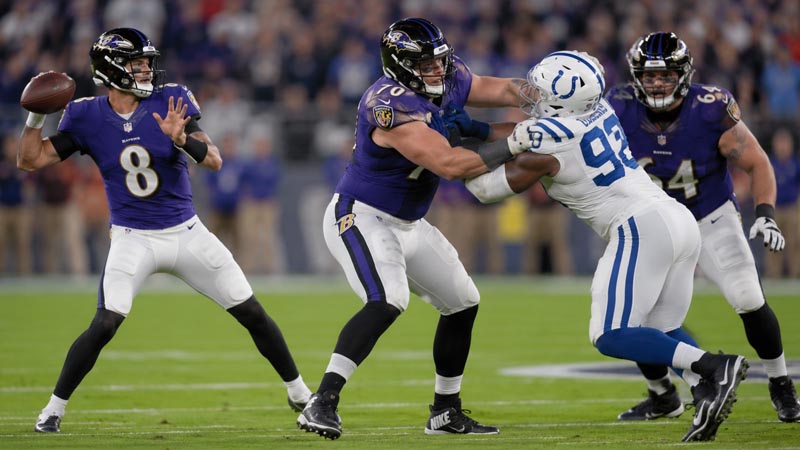
In the modern landscape of gridiron football, few infractions generate as much passionate debate, spectator frustration, and strategic drama as offensive holding.
It is a penalty that can instantly dismantle a beautifully executed drive, wipe out a spectacular touchdown run, or alter the course of a championship game.
Yet, despite its frequency, it remains one of the most misunderstood rules in sports.
To truly understand the game, one must look closely at the mechanical boundaries of a legal block, the specific physical actions that cross into illegal territory, the subjective nature of on-field officiating, and the severe team consequences of a flagged infraction.
The Formal Rulebook Foundation
At its core, blocking is the legal obstruction of an opponent to protect a ball carrier or passer.
However, the line between an exceptionally physical block and an illegal hold is razor-thin. To understand this boundary, we must look directly at the official regulations governing the conduct of players.
Under the standard rulebook—specifically outlined in NCAA Rule 9, Article 3—an offensive player is granted the right to block an opponent using their shoulders, hands, the outer surface of their arms, or any other part of their body.
However, this permission is strictly conditional on several highly specific spatial and physical parameters regarding how the hands and arms are deployed.
1. Hand Position Relative to the Elbow
First and foremost, the blocker’s hands must be positioned in advance of the elbow.
This rule prevents blockers from tucking their elbows tight to their chest and using their forearms in a sweeping, lifting, or clubbing motion that would leverage their body weight in an uncontrolled, dangerous manner.
By keeping the hands in front of the elbows, the blocker is forced to engage the defender with a forward-facing, hand-first strike.
2. The Frame of the Opponent’s Body
The most famous guideline in blocking is the concept of the “frame.” A blocker’s hands must be kept inside the frame of the opponent’s body.
The frame is generally defined as the front torso of the defensive player, stretching from shoulder to shoulder. Keeping the hands inside this boundary is the primary indicator of a clean block.
However, there is a crucial exception to this rule: when the opponent turns their back to the blocker.
If a defensive lineman uses a spin move or otherwise turns their back mid-play, the blocker is not immediately penalized simply because their hands are now positioned on the defender’s back or side.
The rule adapts to the defender’s movement to avoid unfairly penalizing a blocker who was initially engaged legally.
3. Height Restrictions
The hands of the blocker must remain at or below the shoulders of both the blocker and the opponent. This restriction is vital for player safety, minimizing the risk of hands slipping up into the neck, helmet, or face mask of an opposing player.
Just like the frame rule, this standard features a common-sense exception: when the opponent squats, ducks, or submarines.
If a defender deliberately lowers their center of gravity—either by squatting to power through a block, ducking to slip under an arm, or “submarining” low to the turf—the blocker is not penalized if their hands end up above the defender’s shoulders.
Because the defender initiated the extreme change in height, the blocker is not held liable for the resulting high hand placement.
4. Independence of the Hands
Blockers must keep their hands apart and never in a locked position. Clasping the hands together or locking the fingers around a defender essentially creates an unbreakable physical clamp. This completely deprives the defender of their physical freedom and is a direct trigger for a penalty flag.
5. Palm Orientation
Finally, the rules regulate the orientation of the palms during contact. The blocker’s hands must be open with the palms facing the frame of the opponent, or they must be closed or cupped with the palms not facing the opponent.
This ensures that the blocker cannot turn their palms outward to hook or grasp the outer edges of the defender’s pads, keeping the contact concentrated squarely on the chest plate.
The Core Mechanics of Holding
When an offensive player fails to maintain these strict physical boundaries, their actions shift from a legal block to an illegal hold.
The official rules state that the hands and arms shall not be used to grasp, pull, hook, clamp, or encircle in any way that illegally impedes or obstructs an opponent.
This typically occurs when an offensive lineman is beaten by a faster pass rusher. When a defender uses speed, agility, or a powerful pass-rush move to get past a blocker, the blocker’s body positioning is compromised.
In a desperate bid to prevent the defender from reaching the quarterback or the ball carrier, the blocker will resort to illegal physical restraint.
To better understand this, we can analyze the physical actions that trigger a flag into three primary categories:
| Offensive Holding Mechanics | Description |
|---|---|
| Jersey & Pad Grabbing |
|
| Impeding Progress |
|
| Tackling a Defender |
|
1. Grabbing the Jersey and Pads
This is the most common and highly visible form of holding. It involves holding onto a defender’s jersey or shoulder pads from the side or behind.
When a defender successfully swats away a blocker’s hands or gains a step on the outside edge, a blocker will often reach out and grab the loose fabric of the jersey or the hard edge of the shoulder pads.
This grabbing action physically anchors the defender, pulling them backward and preventing them from using their natural acceleration to pursue the play.
2. Impeding Progress through Hooking and Twisting
Even if a blocker does not physically grip the fabric of the jersey, they can still commit an infraction by hooking, twisting, or pulling a defender so they cannot change their direction or pursue the play.
For instance, if a defender attempts to shed a block and redirect their pursuit inside, a beaten blocker might wrap their arm around the defender’s waist or shoulder, hooking them.
This action physically rotates the defender away from the play, robbing them of their lateral mobility and their competitive opportunity to make a tackle.
3. Tackling a Defender
The most egregious and undeniable form of holding is bringing a defensive player to the ground to prevent them from making a tackle.
This is a desperate, last-ditch effort. When a blocker is completely beaten and realizes the defender has a clean, unobstructed path to the quarterback, they may simply wrap their arms around the defender and drag them to the turf.
While this is a highly visible infraction that almost always draws a flag, blockers sometimes make a conscious decision to commit this penalty to protect their quarterback from a devastating, blind-side hit.
The Officiating Dilemma: Subjectivity and the “Judgment Call”
If you watch any high-level football game, you will inevitably see moments where a defender appears to be held, yet no flag is thrown.
This leads to the common refrain among fans and analysts that holding happens on every single play.
In a literal sense, because of the chaotic, high-speed physical contact that occurs in the trenches, minor elements of grabbing, pulling, and hand-fighting are constant.
Because of this reality, offensive holding is not a black-and-white rule like a false start or roughing the kicker; it is ultimately a judgment call.
Officials cannot and should not throw a flag on every minor instance of hand contact, as doing so would ruin the flow of the game and render the product unwatchable.
Instead, officiating crews must apply a set of practical, subjective criteria to determine whether an infraction warrants a penalty.
The Impact-on-the-Play Standard
The primary guiding principle for modern officiating is whether the holding action actually impacted the play. Officials are trained to assess if the hold prevented the defensive player from having a fair opportunity to make a play on the ball carrier or passer.
- No Impact, No Flag: If a wide receiver commits a minor hold on a cornerback on the far-left sideline while the running back is executing a sweep to the far-right sideline, the hold is highly unlikely to impact the outcome of the play. In this scenario, officials will generally keep their flags in their pockets.
- Direct Impact, Immediate Flag: Conversely, if an offensive tackle holds a defensive end who has a clear path to sack the quarterback from behind, that action directly alters the play’s outcome and must be flagged.
The Beat-and-Release Phase
Officiating crews pay incredibly close attention to what happens once a defensive player gets past an offensive blocker.
When a defender uses a successful pass-rush move to gain leverage and bypass the blocker, the blocker is legally required to let go with their hands as the defensive player pulls away.
If the blocker refuses to let go and continues to grab, pull, or drag the defender from behind, the hold becomes highly obvious and egregious.
This “beat-and-release” window is when holding penalties are called most consistently, as the visual evidence of a defender being physically pulled back while trying to escape is impossible for officials to ignore.
The Playoff Officiating Standard
In high-stakes postseason games, the subjective nature of the penalty becomes even more pronounced. Playoff football is notorious for crews only calling fouls that are highly egregious.
In these crucial matches, there is a strong officiating philosophy to “let the players play” and avoid letting minor, technical infractions decide the outcome of a championship season.
However, this elevated threshold can lead to severe inconsistencies. During critical moments, a lack of holding calls can feel tremendously unfair to defensive units.
For example, in high-leverage situations—such as a long quarterback scramble that sets up a game-winning field goal—a star defensive player might be literally tackled from behind by a beaten blocker.
When such blatant infractions go uncalled, it can fundamentally alter the outcome of an entire season, highlighting the ongoing struggle for consistency in officiating.
The Evolution of Blocking Philosophy
To understand why offensive holding is such a deeply contested rule, it helps to examine how the sport has evolved historically. Decades ago, the physical philosophy of blocking was entirely different. Grabbing with the hands in any capacity was strictly prohibited.
| Historical Era | Modern Era |
|---|---|
| Strict prohibition on hand use | Hand contact is legally permitted within the chest frame |
| Blockers had to use shoulders, chest, and closed forearms. | Rules are designed to enhance player safety and limit dangerous cut blocks. |
| Clear, objective boundary: any hand use was an infraction. | Creates a larger gray area requiring subjective officiating. |
In the early eras of the game, blockers were forced to engage opponents using only their shoulders, chest, and the outer surface of their forearms, keeping their hands tucked tightly against their bodies.
This made the rule exceptionally easy to officiate: if a blocker extended their arms and grabbed a defender with their hands, it was an automatic, objective penalty.
Over time, the rules changed to permit blockers to extend their arms and engage with open hands inside the frame.
This shift was largely driven by a desire to protect players. By allowing hand-grabbing within the chest plate, the game could phase out more dangerous blocking styles—such as cut blocking (hitting defenders low at the knees) and high blocks above the shoulders.
However, while open-hand blocking made the game safer, it introduced a permanent gray area. Once hands were legally allowed to contact the opponent’s body, drawing a clean, consistent line between a legal hand engagement and an illegal grab became incredibly difficult.
Today, this rule change heavily benefits offensive production. Because audiences love high-scoring games, allowing a degree of physical hand-fighting on the line of play naturally facilitates explosive offenses and exciting, high-yielding plays.
The Strategic and Tangible Consequences
When a referee does throw a flag for offensive holding, the penalty enforcement is severe, designed to thoroughly punish the offense and restore competitive balance.
- The 10-Yard Penalty: A flagged infraction results in a 10-yard penalty assessed against the offense.
- Enforcement Spot: The 10 yards are marked back from the previous spot of the play. This means any positive yardage gained on the play is completely wiped out.
- Replaying the Down: Unlike other major infractions, a holding penalty does not cause the offense to lose a down. The offense simply replays the down from the new, penalized spot. For example, if a team commits a hold on 1st and 10, they are pushed back 10 yards and must attempt a highly difficult 1st and 20.
The End Zone Safety Exception
There is one critical, game-ending exception to the standard enforcement rules. If an offensive player commits a holding penalty in their own end zone, it results in an immediate safety.
This rule is a vital defensive safeguard. If a quarterback is about to be sacked in their own end zone—which would result in a safety anyway—an offensive lineman might be tempted to deliberately hold or tackle the rushing defender to save their quarterback.
To prevent teams from abusing this tactic, the rulebook dictates that any offensive holding in the end zone immediately awards two points to the defensive team and forces the offense to surrender possession via a free kick.