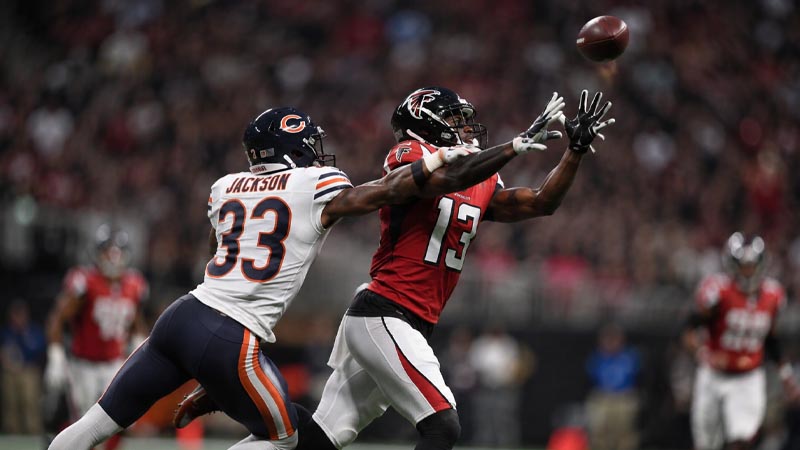
There is a familiar scene played out in stadiums and living rooms every single weekend: a quarterback drops back, lofts a high, spiral pass down the sideline, and the wide receiver and defensive back leap simultaneously.
They collide in mid-air, the ball falls harmlessly to the turf, and a yellow flag comes fluttering down onto the grass. Instantly, half the stadium erupts in cheers while the other half groans in absolute frustration.
Pass interference is arguably the most game-changing, highly debated, and subjective penalty in modern football.
Because its enforcement can shift the entire momentum of a game in a single play, it remains a constant point of friction among fans, players, and coaches alike.
At the heart of this controversy lies a fundamental paradox: both the offensive receiver and the defensive player have an equal, legal right to the path of the ball.
How do officials draw the line between a legal, physical defensive play and an illegal obstruction?
To truly appreciate the game and understand why certain calls are made, we must dissect the official rulebook, explore the historical evolution of the penalty, and break down the differences between offensive and defensive infractions.
The Core Rule: What Constitutes Pass Interference?
To understand pass interference, we must look directly at the official framework of the game. According to the standard rules of football—specifically outlined in Rule 8, Section 5, Article 1—pass interference occurs when any physical act by a player more than one yard beyond the line of scrimmage significantly hinders an eligible opponent’s opportunity to catch a thrown ball.
For a play to be ruled as pass interference, several key conditions must be met:
- The Ball Must Be in the Air: Pass interference can only occur while a forward pass is traveling through the air from behind the line of scrimmage.
- Location on the Field: The physical contact must occur more than one yard past the line of scrimmage. Contact within that one-yard zone is governed by different rules.
- The Target Restriction: The restriction applies specifically to eligible receivers and the defenders guarding them.
- The Timing Window: The rule goes into effect the moment the pass is thrown and ends the exact millisecond any player touches the football. Once the ball is touched by any eligible player, the pass interference restrictions terminate instantly, and players are free to initiate contact to tackle or knock the ball loose.
The word “significantly” is the pivot upon which the entire rule swings. Football is a highly physical contact sport, and some level of contact is expected on almost every play.
It is up to the official’s real-time judgment to decide whether physical contact was merely incidental or if it crossed the line into actively and unfairly impeding a player’s ability to make a clean play.
The Evolution of the Rule: A Historical Timeline
Pass interference was not always the complex, highly scrutinized rule we see today. In the infancy of American football, passing was practically nonexistent. The game was defined by grinding ground attacks, and the rules reflected a sport played entirely in the trenches.
However, as forward passing grew into a central offensive strategy, officials recognized the need to protect players and regulate the defensive tactics used to stop downfield threats.
The penalty actually evolved from the “illegal use of hands” infraction. Here is how the rules changed over the decades in college football, which pioneered many of the passing rules before they were adopted by professional leagues:
- 1908: The first formal restrictions were instituted. Illegal use of the hands during a pass play resulted in a 15-yard penalty against the offense and a smaller 5-yard penalty against the defense.
- 1910: The stakes were raised. An offensive infraction resulted in a complete loss of down, while a defensive violation cost the defense 10 yards.
- 1916: The penalty was standardized, raising the cost to a 15-yard penalty for both the offense and the defense.
- 1917: Defensive pass interference became a spot foul. Despite significant pushback from coaches who felt the penalty was too harsh, the spot foul remained the standard in college football for decades.
- 1984: College football modified the rule, establishing that defensive pass interference would be penalized as a 15-yard penalty, unless the foul occurred less than 15 yards from the line of scrimmage, in which case it remained a spot foul.
In the professional ranks of the NFL, the spot foul remains one of the most punitive and feared rulings in sports, capable of advancing an offense 40 or 50 yards down the field in a single whistle.
Defensive Pass Interference (DPI): The Spot Foul Nightmare
Defensive Pass Interference (DPI) occurs when a defender illegally disrupts a receiver’s attempt to catch a pass. In the NFL, the penalty for DPI is uniquely severe: it is a spot foul.
This means that if a defender commits interference 45 yards down the field, the ball is placed at that exact spot, and the offense is awarded an automatic first down.
In college football, DPI is assessed as a 15-yard penalty and an automatic first down, unless the infraction occurs within 15 yards of the line of scrimmage, where it is treated as a spot foul.
Because the penalty can instantly change the course of a game, officials look for very specific physical actions to determine if a defender has acted illegally. The five primary categories of DPI include:
Hooking
This occurs when a defender wraps an arm around the receiver’s body or arm, turning them away from the ball. By hooking the receiver’s arm, the defender prevents them from lifting both hands to secure the catch.
Grabbing
Grabbing is a direct physical restriction. This happens when a defensive player clutches the receiver’s jersey, shoulders, or arms, physically slowing them down or preventing them from leaping for the ball.
The Arm Bar
An arm bar is called when a defender extends their arm horizontally across the receiver’s chest. This physical barrier prevents the receiver from running along their desired path to intercept the flight of the ball.
Early Contact
A defender is not permitted to tackle, push, or hit a receiver while the football is still in flight. The defender must wait until the ball arrives or is touched before initiating this level of physical contact. Tackling a receiver downfield before the ball gets there is one of the easiest DPI calls for an official to make.
Face Guarding
Face guarding is a unique infraction where a defender does not turn their head to look at the incoming football. Instead of playing the ball, they look directly at the receiver and wave their hands or arms directly in front of the receiver’s face to block their vision.
Offensive Pass Interference (OPI): The Underappreciated Infraction
While defensive pass interference gets the majority of the media attention, the rules apply equally to the offense.
Offensive Pass Interference (OPI) occurs when an offensive player—usually a wide receiver or tight end—illegally blocks, pushes, or impedes a defender who is trying to make a play on the ball.
In the NFL, the penalty for OPI is a 10-yard loss from the previous spot, and the down is replayed (though some rule interpretations cite it as a 10-yard penalty and an automatic first down in specific league contexts). In college football, OPI is assessed as a 15-yard penalty with an automatic first down.
While less common than DPI, OPI still occurs consistently across the football landscape. The four core categories of OPI include:
Pushing Off
A wide receiver cannot physically push a defender to create separation. Shoving a defensive back’s chest or shoulders to gain a split-second advantage right as the ball arrives is strictly illegal.
Blocking More Than One Yard Downfield
During a pass play, offensive players are not allowed to block defenders more than one yard past the line of scrimmage before the ball is touched.
This rule is frequently violated on quick, designed screen passes, where wide receivers begin blocking their defenders downfield before the quarterback has actually thrown the ball to the target.
The Pick Play
A “pick play” occurs when an offensive player intentionally runs a route designed to collide with or block a defender who is guarding a teammate.
While a pick play is legal if the offensive player simply runs their route to naturally shield a defender without initiating contact, it becomes OPI if the offensive player actively initiates contact to block the defender.
Not Playing the Ball
If a receiver realizes they have been beaten on a route and that the defender is positioned to make an interception, the receiver might intentionally grab or push the defender to prevent the turnover.
While this results in an OPI penalty, players will occasionally accept the penalty yardage as a strategic business decision to prevent the opposing team from securing the ball.
Clearing the Confusion: When Is It NOT Pass Interference?
Because pass interference relies heavily on real-time human officiating, it is easy for fans to experience confusion and perceive inconsistency in how the rule is called.
However, the rulebook outlines several specific scenarios where downfield physical contact is entirely legal.
Incidental Contact
If both the receiver and the defender are running down the field, tracking the ball in the air, and they naturally bump into each other, it is considered incidental contact.
If both players are making a simultaneous, genuine effort to catch or bat down the ball, minor physical contact is permitted because both players have an equal right to the path of the ball.
The “Looking Back” Nuance
While the direction a defender is looking is not explicitly written into the text of the rulebook, it serves as the ultimate piece of evidence for the officials. If a defender turns their head back toward the quarterback to track the ball, they are legally “playing the ball”.
A defender who is looking at the ball has a right to their path on the field, and any collision that occurs while they are trying to catch or deflect the ball is usually ruled legal.
Conversely, if a defender never looks back at the ball and collides with the receiver, the official will almost always throw a flag because the defender is playing the player, not the ball.
A classic example of legal downfield contact is Malcolm Butler’s famous Super Bowl-winning interception.
Butler physically shouldered the intended receiver aside to intercept the pass, but the play was completely legal because he was actively tracking and making a play directly on the ball.
Hand Fighting vs. Holding
As a receiver and defender run their routes, they are permitted to jockey for arm position. This “hand fighting”—where players attempt to place their arms above their opponent’s arms to gain an advantage—is tolerated by officials as long as neither player actively grabs, holds, or pulls the other’s jersey or hands.
Timing of the Hit
One of the most common points of confusion for fans is seeing a defender deliver a massive hit to a receiver right as the ball arrives, causing an incompletion. If the defender hits the receiver the exact moment the ball touches the receiver’s hands, the play is legal.
Because pass interference restrictions end the moment anyone touches the ball, a perfectly timed hit designed to jar the ball loose before the receiver can secure it is a textbook defensive play, not a penalty.
Uncatchable Passes
If a quarterback throws a wildly off-target pass—such as sailing the ball ten yards out of bounds or throwing it far over the receiver’s head—pass interference will not be called.
If the official determines that the ball was completely uncatchable by any player on the field, any physical contact downfield is dismissed, and no flag is thrown.
How Elite Players Legally Guard the Pass
Guarding elite wide receivers in today’s passing-oriented football leagues is one of the most difficult responsibilities in all of sports. To be successful, defensive backs must master specific techniques to shut down passing lanes without drawing costly penalties.
- Bumping within the Five-Yard Window: Defensive backs are legally allowed to use their bodies and hands to bump and slow down a receiver within five yards of the line of scrimmage. This physical disruption can throw off the timing of the entire passing play. However, if the defender continues to bump or hold the receiver beyond this five-yard zone, they will be flagged for an “illegal contact” penalty (a 5-yard infraction) or “defensive holding”.
- Focusing on the Ball: Elite defenders train themselves to read the receiver’s eyes and hands. The moment the receiver’s eyes widen or their hands go up to catch the ball, the defender must turn their head back to look for the football. By turning their head and locating the ball, they earn the legal right to compete for the catch, turning a potential pass interference penalty into a clean, game-saving deflection or interception.
Conclusion: The Human Element of Football
Ultimately, pass interference is a rule designed to keep the game balanced and exciting, ensuring that both offenses and defenses have a fair opportunity to make plays downfield.
While the rulebook provides clear definitions of what is legal and illegal, the rapid speed of modern football means that officials must make highly subjective, split-second decisions.
Understanding the nuances of pass interference—from the crucial timing of the ball being touched to the physical definitions of hooking and pushing off—helps fans look past the initial frustration of a yellow flag and appreciate the incredible technique required to play the game at its highest level.