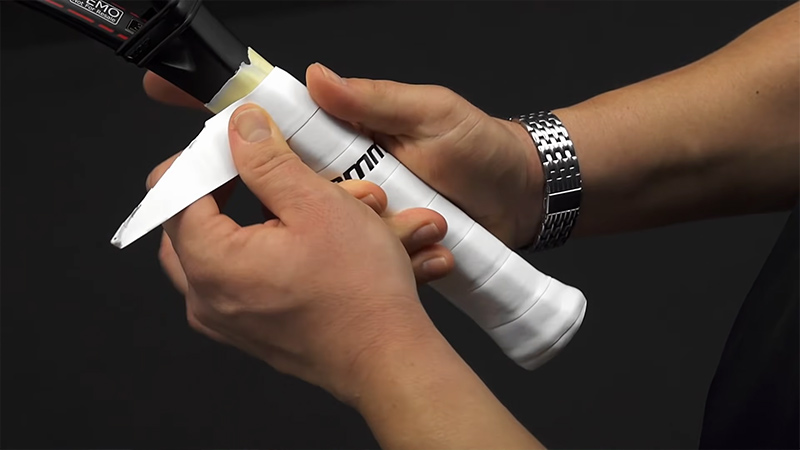
In the competitive landscape of modern athletics, the margin between victory and defeat is often found in the nuances of equipment management.
While many players invest significant capital in high-performance frames and advanced string technology, they frequently overlook the most critical component of their gear: the handle.
The handle serves as the sole physical interface between the athlete and the racket, the primary conduit for power transfer and mechanical control.
Neglecting this interface can lead to diminished performance, increased physical fatigue, and preventable injuries.
This analysis provides an exhaustive framework for mastering racket handle maintenance, sizing, and technical customization to ensure peak on-court efficiency.
The Architectural Foundation: Anatomy of the Racket Handle
To achieve professional-level control, an athlete must first understand the underlying geometry of their equipment. The handle of a premium tennis racket is not a simple cylinder; rather, it is an engineered octagonal structure.
The Engineering of Bevels
The handle consists of eight distinct flat surfaces known as bevels. These bevels are designed to facilitate tactile communication between the equipment and the hand, allowing a player to identify the exact orientation of the racket face without visual confirmation.
As a player transitions between various shot types, such as shifting from a forehand to a backhand, these bevels provide the necessary feedback to ensure the strings are angled with mathematical precision.
The Layered Grip Ecosystem
Effective handle management involves a two-tiered system of materials designed for specific functional roles: replacement grips and overgrips.
- Replacement (Base) Grips: This is the primary cushioning layer installed directly onto the handle’s core. Typically measuring between 1.5mm and 2.5mm in thickness, these grips utilize an adhesive backing to remain fixed. Their primary function is to define the shape of the bevels and provide foundational shock absorption.
- Overgrips: These are ultra-thin, disposable tapes—usually 0.4mm to 0.6mm thick—wrapped over the base layer. They are designed for frequent replacement, often every 10 to 15 hours of play, to manage moisture and provide a specific surface feel, such as tackiness or high absorbency.
The Strategic Necessity of Overgrips
Beyond mere comfort, the use of overgrips is a strategic decision employed by nearly all elite professionals to maintain consistency.
Moisture and Thermal Management
During high-intensity matches, perspiration can compromise the security of a player’s hold, leading to racket rotation at the moment of impact.
High-quality overgrips utilize moisture-wicking materials that maintain a firm, anti-slip surface even in extreme humidity. This ensures that the racket remains stable, allowing for the precise execution of powerful strikes.
Ergonomic Protection and Fatigue Reduction
The added cushioning of an overgrip serves a dual purpose in injury prevention. By absorbing a portion of the impact energy from ball strikes, overgrips reduce the cumulative hand fatigue that can lead to blisters.
Furthermore, maintaining a fresh grip surface reduces the need for the athlete to over-grip or squeeze the handle excessively, which is a primary factor in the development of chronic overuse injuries like tennis elbow.
Capital Equipment Preservation
From a maintenance perspective, overgrips act as a sacrificial layer. They protect the more expensive replacement grip from the corrosive effects of sweat, dirt, and friction.
By replacing an inexpensive overgrip regularly, players can extend the operational lifespan of their base grip and the racket handle itself.
Precision Sizing: The Ergonomic Fit Protocol
A technically perfect swing cannot compensate for an incorrectly sized handle. If the grip is poorly fitted, the athlete’s control over the racket face is fundamentally compromised.
Understanding Global Sizing Standards:
Racket manufacturers generally follow two standardized scales for handle circumference.
- European Scale (EU): Ranges from 0 to 5.
- United States Scale (US): Measured in inches, typically from 4″ to 4 1/2″.
A quick reference for these standards includes:
- EU 0: 4 inches
- EU 1: 4 1/8 inches
- EU 2: 4 1/4 inches
- EU 3: 4 3/8 inches
- EU 4: 4 1/2 inches
- EU 5: 5 inches
The Handshake and Index Finger Diagnostic
To determine the optimal fit, athletes should utilize a three-step diagnostic process. First, the handle should be held in a “handshake” position, with the racket face perpendicular to the ground.
Second, the athlete should observe the natural gap between the tips of their fingers and the heel of their palm. Finally, the “Index Finger Test” is applied: the athlete attempts to slide the index finger of their non-dominant hand into that gap.
- Optimal Fit: The index finger fits snugly into the gap without forcing the other fingers away.
- Undersized: The fingers touch the palm, or the gap is too narrow for the index finger. This can lead to excessive wrist strain.
- Oversized: There is significant “wiggle room” or excess space around the index finger. This prevents the player from “feeling” the bevels and can lead to a loss of racket head speed.
The Technical Bevel System: Mapping Hand Placement to Performance
The term “grip” in professional tennis also refers to the specific orientation of the hand on the handle’s bevels. Modern performance is dictated by the ability to utilize the correct bevel for specific shot requirements.
The Continental Grip (Bevel 2)
Historically, the universal standard, the Continental grip, is achieved by placing the index finger’s base knuckle on the second bevel. In the modern era, it remains the essential choice for serves, volleys, overheads, and slices.
Its neutral racket face orientation allows players at the net to handle both forehands and backhands without the need for time-consuming grip adjustments.
The Eastern Forehand Grip (Bevel 3)
By moving the knuckle to the third bevel, the player adopts the Eastern grip, famously utilized by clinical ball-strikers like Roger Federer.
This position places the palm directly behind the handle, facilitating a flat, powerful strike that drives through the ball with high efficiency.
The Semi-Western Grip (Bevel 4)
As the most prevalent grip in contemporary professional tennis, the Semi-Western involves placing the knuckle on the fourth bevel.
This orientation naturally tilts the racket face slightly downward, making it the ideal configuration for generating the high levels of topspin favored by players like Novak Djokovic and Rafael Nadal.
The Western Forehand Grip (Bevel 5)
The Western grip represents the end of the spectrum, with the knuckle placed on the fifth bevel, essentially underneath the handle.
This grip is primarily the domain of specialists who prioritize extreme, looping topspin, though it requires significant physical strength to maintain effectively.
Operational Maintenance and Troubleshooting
Maintaining a professional-grade handle environment requires a proactive approach to equipment care. Athletes should monitor their handles for three primary indicators of degradation.
Slippage and Moisture Saturation
If the handle feels slick or the racket rotates in the hand during off-center hits, the grip has lost its functional integrity. In high-perspiration environments, players should opt for overgrips with fast-drying, anti-slip properties.
If the issue persists, the underlying replacement grip may need to be inspected for moisture saturation that has compromised the adhesive or the cushioning.
Thickness and Cushioning Compression
Over time, the cellular structure of a replacement grip will compress, leading to a “hard” feel that transmits more vibration to the arm. If the handle feels too thin or if the bevels feel overly sharp and uncomfortable, it is likely time to install a new base grip.
Conversely, if a handle is slightly undersized, adding an extra overgrip can provide a cost-effective way to increase the circumference and improve comfort.
The Replacement Cycle
While touring professionals may change their overgrips every match, recreational athletes should aim for a change every 10 to 15 hours of play to ensure a consistent feel.
Replacement grips should be swapped every few months to a year, depending on the frequency of play and the environmental conditions.
VII. Frequently Asked Questions (Performance Focus)
Can I use standard tapes to wrap my racket?
No, specialized equipment is required for proper handle maintenance. Standard tapes, such as masking or electrical tape, lack the necessary cushioning and can be either too slick or excessively sticky, compromising the handle’s ergonomic function.
What is the fastest way to increase my grip size?
The most efficient method is to wrap an overgrip over your existing replacement grip. This adds approximately 0.4mm to 0.6mm of thickness while providing a fresh surface for better control.
How do I know if my hands need a “tacky” or “dry” grip?
This depends on your personal physiology and local climate. If you struggle with excessive sweat, a “dry” or highly absorbent overgrip is essential to prevent slipping. If you play in cooler, drier conditions and want the racket to feel “locked” into your hand, a “tacky” grip is the superior choice.
Why do my hands get blisters even with a new racket?
Blisters are often the result of an incorrectly sized grip or a grip that has become worn and lost its cushioning. Ensure your grip size passes the “Index Finger Test” and replace your overgrip regularly to maintain adequate padding.
Conclusion: Integrating Handle Mastery into Your Game
Mastering the technical aspects of the racket handle is an affordable and highly effective method for fine-tuning performance.
By ensuring the correct grip size, maintaining fresh overgrips for moisture control, and understanding the biomechanics of the bevel system, an athlete can significantly enhance their precision and power on the court.
Proper handle management is not merely a matter of aesthetic preference; it is a fundamental requirement for any player serious about their development.
Investing the time to understand and maintain this critical contact point will lead to a more comfortable, productive, and injury-free tenure in the sport.