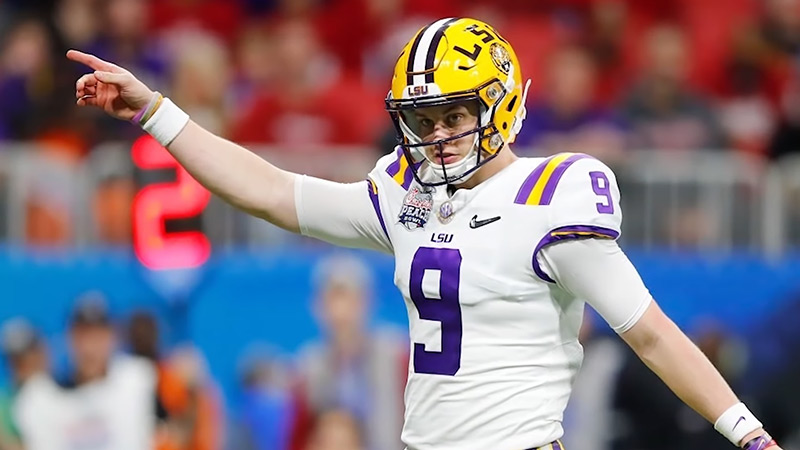
When looking back at the modern landscape of collegiate and professional sports, few trajectories match the meteoric rise of Joe Burrow.
In a span of just two seasons, he transitioned from an overlooked backup quarterback in Columbus to an undefeated National Champion, a Heisman Trophy winner, an NCAA record holder, and the absolute consensus number-one overall pick in the NFL Draft. It is a narrative so perfectly cinematic that it has naturally generated its own folklore.
Among the most persistent pieces of modern sports folklore is a fascinating story regarding a high-stakes family wager. For years, social media platforms have circulated a captivating claim: did Joe Burrow’s father, Jimmy Burrow, place a massive bet on his son to win the Heisman Trophy before his historic 2019 season?
To understand the truth behind this viral legend, we must separate digital fiction from strategic reality.
By analyzing verified documentation, the historical context of collegiate athletics, and the actual mechanics of what it means to take a calculated professional risk, we can uncover the blueprint of Burrow’s success—and the real story behind the myth.
Debunking the Myth: Did Jimmy Burrow Place a Heisman Bet?
The rumor itself is highly specific, which is precisely why it achieved such widespread viral traction across major social media networks like X, Facebook, and Instagram.
The story goes that ahead of the 2019 college football season, Jimmy Burrow—himself a veteran sports figure—placed a $2,000 wager on his son to win the Heisman Trophy at longshot odds of 200/1, which would have yielded a staggering $400,000 payout.
It is a narrative of ultimate paternal confidence. However, the reality is entirely straightforward: the claim is completely false.
Verified athletic records and family statements confirm there is no factual evidence or documentation that Joe Burrow’s father placed any such wager.
The entire story originated as an unverified social media rumor created by a random online account.
So, where did this legend come from? The mix-up likely stems from a genuine, real-life event involving an unrelated individual.
Ahead of LSU’s historic 2019 campaign, an actual sports bettor famously placed a longshot wager on Joe Burrow to win the Heisman Trophy.
When Burrow defied all odds to claim the award in a landslide, this genuine bettor’s story went viral. Over time, through the natural telephone game of internet forums and sports discussion boards, the identity of the bettor was falsely attributed to Joe’s father.
While the family wager never occurred, Jimmy Burrow’s relationship with his son has always been defined by quiet support and pragmatic humor. Rather than placing wild financial wagers, the family’s reality was much more grounded.
When Joe eventually signed his landmark $36.1 million rookie contract with the Cincinnati Bengals, Jimmy jokingly told the press, “We finally got him outta our basement”.
This grounded perspective highlights that the real support within the household was rooted in stability and humor rather than speculative gambling.
Jimmy Burrow’s Actual Legacy and Sports Influence
Though Jimmy Burrow did not gamble on his son’s collegiate success, his influence on Joe’s football career is undeniable. Jimmy was not merely an encouraging parent; he possessed a deep, professional understanding of the sports industry and the rigorous demands of elite competition.
In football circles, Jimmy Burrow is recognized for a long and respected career in both playing and coaching. Notably, his professional journey intersected with legendary figures of the game.
For instance, he served on the coaching staff of the Iowa Barnstormers of the Arena Football League during the exact period that NFL Hall of Fame quarterback Kurt Warner was playing there.
Growing up with a father who understood the strategic, physical, and psychological elements of elite quarterback play provided Joe Burrow with an invaluable foundation.
The younger Burrow did not need a financial bet to know his family believed in his capabilities; he had a lifetime of structured preparation, professional guidance, and athletic mentorship.
The Transfer Debate: What “Betting on Yourself” Truly Means
If the physical wager by Jimmy Burrow was a myth, the metaphorical gamble made by Joe Burrow was incredibly real. In the spring of 2018, Burrow faced a massive crossroads.
After spending three years at Ohio State, he found his path to the starting quarterback position blocked. Dwayne Haskins, who put together an extraordinary and historic season for the Buckeyes, was named the starting quarterback in Columbus.
Confronted with the prospect of remaining a backup, Burrow made the pivotal decision to transfer. He entered the transfer market and ultimately selected Louisiana State University (LSU).
This decision ignited a profound debate among sports analysts and fans that persists to this day regarding the true nature of career risk:
The Traditionalist Critique
Some traditionalists argue that leaving a program when faced with competition contradicts the pure philosophy of proving oneself.
From this viewpoint, a true competitor stays put, embraces the depth chart battle, and defeats the rival in practice to win the job. They argue that transferring to another institution represents seeking a path with less resistance.
The Modern Strategic Business Model
The counter-argument, which has become the dominant philosophy in the modern era of sports, is that remaining in a situation with no clear pathway to advancement is not competitive—it is counterproductive.
Believing you possess elite capabilities and deliberately choosing to move to a platform where you can actually put those capabilities on display is the ultimate form of self-belief.
At Ohio State, Dwayne Haskins was performing at an elite level and had secured the confidence of the coaching staff. If Burrow had stayed, his talent would have languished on the bench simply due to timing, regardless of his skill level.
By recognizing that his development required game repetitions and a coaching staff fully committed to his leadership, Burrow’s transfer was a calculated career adjustment.
This strategic movement has redefined how elite athletes navigate their college years. Far-sighted prospects have increasingly recognized that they must manage their careers like independent enterprises.
Prominent quarterbacks like Justin Fields, Kyler Murray, Jalen Hurts, and Baker Mayfield all executed similar strategic transfers to secure the playing time required to reach the NFL.
Rather than viewing a transfer as a retreat, the modern landscape views it as an essential optimization of talent.
The Invisible Ledger: Survivor Bias and Failed Gambles
When analyzing the concept of transferring as a career strategy, it is easy to fall victim to survivor bias.
Because Joe Burrow’s gamble resulted in the ultimate payoff—an undefeated national championship and a selection as the top draft pick—the public often views the decision to transfer as a guaranteed formula for success.
However, archived athletic records reveal that Burrow is the exception, not the rule. For every high-profile success story, there are dozens of athletes whose transfers or career gambles resulted in professional stagnation.
Consider the contrasting outcomes of other highly-touted prospects who attempted to navigate similar paths:
- Tate Martell: A highly publicized recruit who transferred multiple times (including a stint at Miami) in search of a starting role but was never able to secure a consistent position. His journey serves as a stark reminder that changing environments does not automatically resolve developmental or competitive hurdles.
- Nerlens Noel: In professional basketball, Noel famously bet on his long-term value by turning down a lucrative four-year, $70 million contract extension. Unfortunately, subsequent injuries and market shifts meant that the only contract offers he received afterwards were for a fraction of that initial valuation, eventually signing a two-year deal worth just $4 million.
- Historic College Football Examples: Sports history is littered with players who took substantial career risks that did not yield the intended outcomes, including Mike Williams, Cardale Jones, Maurice Clarett, and Marcus Dupree.
These examples illustrate that transferring is not a simple cheat code for athletic advancement. The outcome is highly dependent on situational alignment.
As analysts have noted, Burrow’s success was not merely a product of his exit from Ohio State; it was because he landed in an offensive system and culture at LSU that was perfectly tailored to maximize his specific mental and physical skill sets.
While recent modifications to collegiate transfer regulations have lowered the administrative barriers for athletes seeking new programs, the inherent professional risk remains incredibly high.
Taking a gamble on oneself requires not just courage, but an objective analysis of the destination’s depth chart, coaching philosophy, and overall compatibility.
Beyond the Field: Leveraging Personal Capital for Social Good
The ultimate measure of a successful career gamble is not merely the financial or professional rewards gathered by the individual, but how that newly acquired platform is utilized to benefit others. This is perhaps where Joe Burrow’s historic run truly separated itself from typical sports narratives.
During his emotional Heisman Trophy acceptance speech in December 2019, Burrow did not focus solely on his coaches, teammates, or personal achievements.
Instead, he used his national platform to speak candidly about the harsh realities of poverty and systemic food insecurity affecting his hometown community in Athens County, Ohio.
“I’m up here for all those kids in Athens and Athens County that go home to not a lot of food on the table, hungry after school,” Burrow shared during the broadcast. “You guys can be up here, too.”
The impact of those words was immediate and profound. Inspired by his vulnerability and leadership, thousands of viewers and sports fans took action, collectively raising over half a million dollars in donations for the Athens County Food Pantry.
This charitable movement demonstrated that Burrow’s willingness to make difficult decisions and stand by them ultimately built a platform capable of driving tangible, real-world change.
The true reward of his career gamble was not just the $36.1 million contract or the national championship ring; it was the generation of crucial aid that directly fed families in need in his home state.