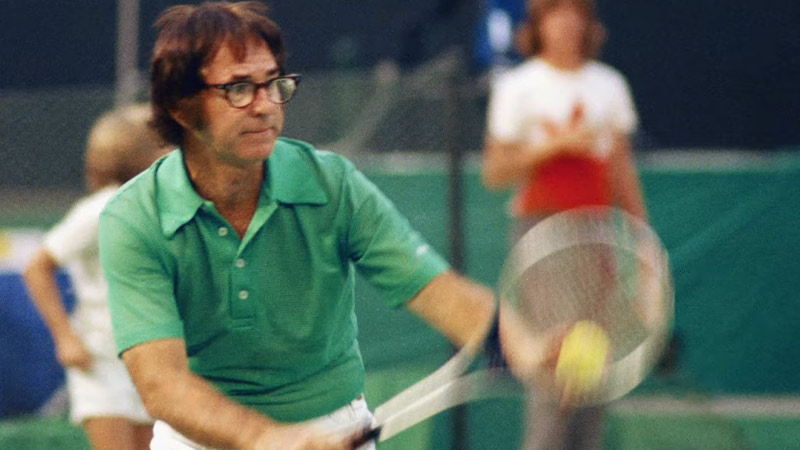
Bobby Riggs famously won the Wimbledon Championships in 1939, securing a historic “Triple Crown” by winning the Singles, Doubles, and Mixed Doubles titles in the same year.
As a 21-year-old amateur, Riggs displayed tactical brilliance and unparalleled endurance, finishing the tournament with a perfect 20–0 match record across all three divisions.
This extraordinary feat makes him one of only three men in history to achieve such dominance at the All England Club.
Despite his later association with the “Battle of the Sexes,” his 1939 Wimbledon performance remains one of the greatest individual achievements in tennis history.
How Many Times Did Bobby Riggs Win Wimbledon?
While many modern sports fans associate Bobby Riggs with his high-profile exhibition matches in the 1970s, his professional pedigree was established decades earlier on the grass courts of London.
Interestingly, although he is considered one of the greatest players of his era, Bobby Riggs only competed in the main draw at Wimbledon once.
This single appearance in 1939 was so dominant that he left the tournament with every major trophy available to a male competitor.
Because he turned professional shortly after his victory and because international play was halted by global conflict, Riggs never had the opportunity to defend his titles.
This creates a unique statistical anomaly where he maintains a 100% win rate in every match he ever played at the tournament.
He is a member of an elite group of only three men—including Don Budge and Frank Sedgman—to have swept all three titles in a single year at the All England Club.
| All-Time Wimbledon Match Record | Matches Won | Matches Lost | Win Percentage |
|---|---|---|---|
| Gentlemen’s Singles | 7 | 0 | 100% |
| Gentlemen’s Doubles | 6 | 0 | 100% |
| Mixed Doubles | 7 | 0 | 100% |
| Total Career Record | 20 | 0 | 100% |
The Unprecedented 1939 Triple Crown Sweep
The 1939 Wimbledon campaign was a grueling test of physical and mental stamina, as Riggs was required to play an exhausting number of sets across three different brackets over a two-week period.
Entering the tournament as the No. 2 seed, he was not the overwhelming favorite, yet he managed to outmaneuver the world’s best amateurs through what observers called “court chess”.
This strategic approach relied on tactical lobs, precise ball placement, and the ability to outlast opponents in long, defensive rallies.
The Gentlemen’s Singles Championship
Riggs’ journey to the singles title required seven consecutive match victories. The final was a legendary encounter against his own doubles partner and close friend, Elwood Cooke.
Cooke initially took the lead, winning the first and third sets, putting Riggs in a precarious position. However, Riggs’ legendary endurance and tactical adjustments allowed him to regain control.
He eventually wore Cooke down to win the match in a five-set marathon with a final score of 2–6, 8–6, 3–6, 6–3, 6–2. This victory propelled him to the World Amateur No. 1 ranking.
Dominating the Gentlemen’s Doubles
In an incredible display of professional focus, Riggs had to transition immediately from being Cooke’s opponent in the singles final to being his partner in the Gentlemen’s Doubles final. The duo faced off against the British team of Charles Hare and Frank Wilde.
Despite the physical toll of the previous five-set singles match, Riggs and Cooke demonstrated excellent chemistry on the court. They secured the championship with a score of 6–3, 3–6, 6–3, 9–7, marking Riggs’ second major trophy of the fortnight.
A Mixed Doubles Masterclass with Alice Marble
To complete the historic Triple Crown, Riggs partnered with American legend Alice Marble in the Mixed Doubles division.
This partnership was particularly historic because Marble was on her own quest for a Triple Crown sweep in the women’s division that same year.
They faced the team of Frank Wilde and Nina Brown in the final. Riggs and Marble dominated the match, winning in straight sets with a score of 9–7, 6–1.
By the end of the day, both Riggs and Marble had achieved the Triple Crown, a coincidence that has never been repeated in the history of the tournament.
Statistical Dominance: Analyzing the 20–0 Record
To truly understand the level of dominance Riggs exerted in 1939, one must look at the path he took through the singles bracket. He did not merely win; he dismantled his opponents with efficiency, losing only five sets during his entire seven-round singles run.
| Round | Opponent | Final Score | Result |
|---|---|---|---|
| Round of 128 | Frank Froehling (USA) | 6–3, 6–0, 6–4 | Win |
| Round of 64 | Douglas Snart (GBR) | 6–2, 6–4, 6–1 | Win |
| Round of 32 | Henry Billington (GBR) | 6–4, 6–4, 3–6, 6–1 | Win |
| Round of 16 | Jacques Brugnon (FRA) | 6–2, 6–3, 6–2 | Win |
| Quarterfinals | Ghaus Mohammad (IND) | 6–2, 6–2, 6–2 | Win |
| Semifinals | Henner Henkel (GER) | 2–6, 6–4, 6–3, 7–5 | Win |
| Finals | Elwood Cooke (USA) | 2–6, 8–6, 3–6, 6–3, 6–2 | Win |
Key Career Milestones from 1939:
- Sets Won vs. Lost (Singles): 21 sets won compared to only 5 sets lost throughout the tournament.
- Tournament Seeding: He entered as the No. 2 seed and successfully upset the projections to take the title.
- Ranking Impact: His performance at Wimbledon solidified his status as the No. 1 amateur player in the world.
- Historical Rarity: He remains one of only three men to ever achieve the Triple Crown at this specific venue.
The Legendary £100 Bet: Betting on Perfection
Beyond his athletic prowess, Bobby Riggs was equally famous for his persona as a prolific gambler and “hustler”. He viewed every match not just as a sporting contest, but as an opportunity for financial gain.
This mindset led to one of the most audacious gambles in the history of professional sports, where Riggs effectively bet on his own ability to achieve the impossible.
Financial Stakes and the Bookmaker’s Risk
Upon arriving in England for the 1939 season, Riggs visited a London bookmaker to place a wager on his upcoming performance. He placed a £100 bet on himself to win the Triple Crown—Singles, Doubles, and Mixed Doubles—at 25-to-1 odds.
At the time, such a sweep was considered highly improbable given the depth of the field and the physical exhaustion involved in playing three different brackets.
However, as Riggs progressed through the rounds, the bookmakers began to realize the massive liability they had created by underestimating the young American.
Strategic Wealth: Funding a Professional Transition
When Riggs successfully completed the sweep, he reportedly cashed out £21,600. In 1939, this was a staggering sum of money, equivalent to roughly $105,000 at the time, or over $2.3 million in today’s currency.
According to his autobiography, Riggs was so wary of the sheer volume of cash that he hid it in his hotel room wardrobe.
This payout was more than just a gambling win; it provided the necessary capital to fund his transition from the amateur ranks to the lucrative professional tour in late 1941.
Why Did Bobby Riggs Only Play Wimbledon Once?
It is rare for a defending champion to never return to the site of their greatest victory, yet Riggs’ Wimbledon career ended the moment he stepped off the court in 1939.
His absence from the tournament for the remainder of his prime was the result of a combination of global politics and the restrictive rules of tennis at the time.
Impact of World War II on Tennis
The primary reason Riggs could not defend his titles in 1940 was the outbreak of World War II later in 1939. The conflict led to the immediate suspension of the Wimbledon Championships, which did not resume until 1946.
By the time the tournament returned to the All England Club, the world—and Riggs’ career—had changed significantly. The war effectively robbed Riggs of at least six years of potential Grand Slam dominance during his absolute physical prime.
The Amateur-Professional Divide in the 1940s
In late 1941, Riggs made the decision to turn professional. During this era of tennis, there was a strict divide between amateurs and professionals.
Grand Slam tournaments, including Wimbledon, were strictly reserved for amateurs, and any player who accepted money for playing was banned from competing in these traditional events.
Consequently, because Riggs had turned pro to earn a living from the sport, he was ineligible to enter the Wimbledon main draw for the rest of his career.
While this preserved his perfect 100% win record, it also meant that his legendary 1939 run would be his only contribution to the tournament’s history books.
Frequently Asked Questions About Bobby Riggs at Wimbledon
Did Bobby Riggs ever lose a match at Wimbledon?
No. Bobby Riggs maintains a perfect 20–0 record at Wimbledon. Because 1939 was his only year competing in the tournament, he never suffered a single match loss in Singles, Doubles, or Mixed Doubles.
Who were the three men to win the Wimbledon Triple Crown?
Bobby Riggs is one of only three men to achieve this feat. The others are Don Budge (who did it in 1937 and 1938) and Frank Sedgman (who achieved it in 1952).
How much money did Bobby Riggs win from his Wimbledon bet?
Riggs reportedly won £21,600, which was worth approximately $105,000 in 1939. When adjusted for inflation, this is equivalent to over $2 million today, a sum he used to launch his professional career.
Conclusion
Bobby Riggs’ victory at the 1939 Wimbledon Championships stands as a testament to tactical intelligence and self-belief.
By securing the Triple Crown and cashing in on a legendary gamble, he cemented his place as an elite competitor who understood both the game on the court and the stakes off it.
While history often remembers him for a single match in his later years, his unbeaten record at Wimbledon remains a gold standard of excellence that few have ever approached.