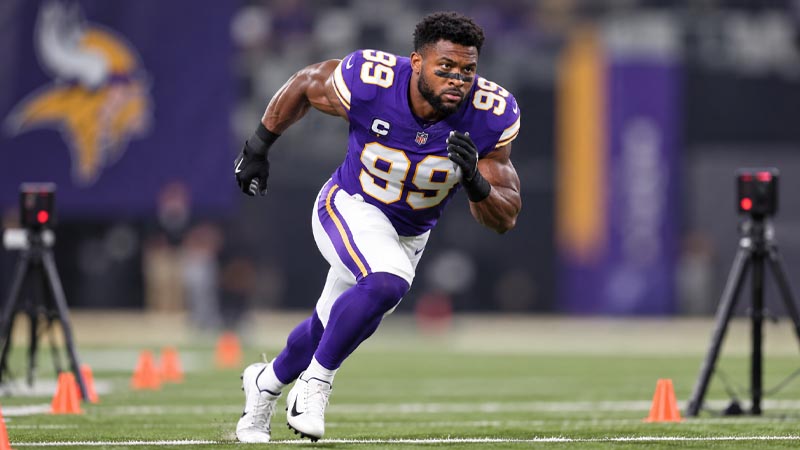
In the world of professional football, the NFL Scouting Combine serves as the ultimate proving ground where collegiate potential meets the cold, hard reality of stopwatches and measuring tapes. While many athletes perform well, only a handful produce results that fundamentally alter their professional trajectory.
In February 2015, Danielle Hunter, a defensive end out of LSU, delivered one of those rare, trajectory-shifting performances.
The narrative surrounding Hunter at the time was one of “untapped potential.” He was viewed as a long, lean athlete who had yet to fully refine his technical skills but possessed a physical frame that scouts dream of.
When he stepped onto the track in Indianapolis, he didn’t just meet expectations; he shattered the conventional understanding of how fast a 252-pound man could move.
The Physical Profile in Power
Before looking at the sprint times, it is essential to understand the physical frame Hunter was moving. Standing at 6 feet 5 inches and weighing 252 pounds, Hunter arrived with the ideal “long” frame that modern NFL teams covet for the edge rusher position.
| Metric | Official Result | Position Rank (DL) |
|---|---|---|
| Height | 6’5″ | Elite |
| Weight | 252 lbs | Standard (Edge) |
| 40-Yard Dash | 4.57 seconds | 1st |
| Vertical Jump | 36.5 inches | Top Tier |
| Broad Jump | 10’10” | Elite |
| Bench Press | 25 reps | Solid |
The 40-Yard Dash: Redefining Edge Speed
The 40-yard dash remains the crown jewel of the combine, and Hunter’s performance in this drill is what truly captured the league’s attention. He clocked an official time of 4.57 seconds.
This was not merely “fast” for a defensive lineman; it was the fastest time recorded by any defensive lineman at the 2015 combine.
To put this number into perspective, we must look at how he compared to his peers. Hunter’s speed allowed him to outpace several highly touted prospects who were expected to be early-round selections.
- Elite Comparisons: Hunter’s 4.57s beat out Owamagbe Odighizuwa from UCLA, who ran a very impressive 4.64s.
- The Gap to the Field: Other top performers like Tavaris Barnes and Ryan Russell were nearly two-tenths of a second slower, posting times of 4.75s and 4.77s respectively.
- Contrasting Philosophies: While Hunter represented the “speed-to-power” evolution, other prospects relied on pure mass. For instance, Danny Shelton, a 339-pound defensive tackle, ran a 5.66s. While scouts did not hold the slow time against Shelton due to his role, Hunter’s speed made him a unique chess piece in a league that was becoming increasingly pass-heavy.
Explosiveness Beyond the Sprint
While the 40-yard dash measures top-end speed, the vertical and broad jumps are critical for edge rushers because they measure “explosive power”—the ability to launch off the line of scrimmage the moment the ball is snapped.
Hunter’s 36.5-inch vertical jump and a staggering 10-foot-10-inch broad jump indicated that his 40-yard dash time wasn’t just about long strides; it was about massive force production.
A 10’10” broad jump for a man of his size is an outlier measurement, signaling that he possessed the lower-body explosiveness to turn the corner against even the most agile offensive tackles.
Furthermore, he demonstrated his functional strength by recording 25 reps on the 225-pound bench press. This confirmed that he wasn’t just a “track athlete” in pads but possessed the requisite upper-body strength to hold his own in the trenches.
The Impact on Draft Strategy and Valuation
Heading into the event, Hunter was generally projected as a second-round pick by major outlets such as CBS Sports.
However, the combine serves as a “confirmation bias” tool for scouts. When an athlete with Hunter’s length and collegiate tape also produces elite-level athletic testing, their floor as a prospect rises significantly.
The data suggested that Hunter could “ascend on several teams’ draft boards” because he showcased the “elite top-end speed that NFL defensive ends possess”.
While some prospects like Leonard Williams (who ran a 4.97s) were seen as safer, more technically proficient “Day 1” starters, Hunter was the high-ceiling gambit.
Williams was projected as a potential first-round defensive player off the board, but Hunter’s testing provided a blueprint for a player who could eventually surpass his peers in pure pass-rushing efficiency.
Strategic Insights: Why This Data Matters
For organizations looking to build a championship roster, the 2015 performance of Danielle Hunter offers several key lessons in talent acquisition:
- Athletic Thresholds: Teams often set “minimum thresholds” for positions. Hunter didn’t just meet the speed threshold for a defensive end; he exceeded the thresholds for many linebackers and tight ends.
- Developmental Windows: The combine data suggested that while Hunter’s technique at LSU might have needed refinement, his “physical ceiling” was higher than almost any other player in the class.
- Market Inefficiency: At the time of his testing, some still questioned if his production would match his athleticism. Smart organizations use these metrics to identify players who have been “under-utilized” in collegiate schemes.
Expert Analysis: The Translation of Speed to the NFL
In professional football, a 4.57-second 40-yard dash for an edge rusher translates to “closing speed.”
This is the ability to chase down a quarterback from the backside or to pursue a running back toward the sideline. When a defender is 6’5″, that speed is augmented by a massive wingspan, making the “tackle radius” enormous.
Hunter’s testing profile in 2015 was a harbinger of the modern NFL’s shift toward “positionless” or highly versatile defenders.
He possessed the speed of a smaller man but the frame of a traditional defensive end, allowing defensive coordinators to utilize him in multiple fronts.
Conclusion: A Performance for the Ages
The 2015 NFL Combine will forever be remembered as the moment Danielle Hunter transitioned from a collegiate prospect to a physical phenomenon.
By leading all defensive linemen in the 40-yard dash and backing it up with elite explosion in the jumping drills, he provided a masterclass in how to use the combine to build professional value.
His 4.57-second sprint was more than just a number; it was a statement that the era of the “heavy, slow” defensive end was ending, and the era of the elite, hyper-athletic edge rusher had arrived.
For any student of the game or professional scout, Hunter’s 2015 profile remains the gold standard for what “elite” looks like on paper.