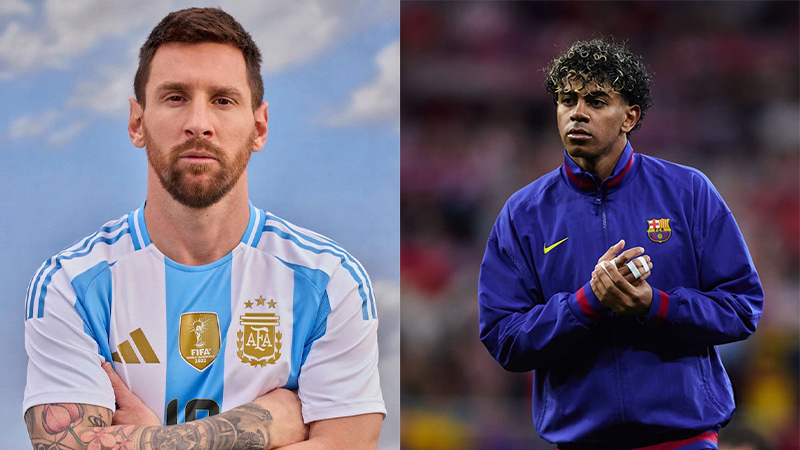
In the high-stakes environment of global football, the concept of a “successor” is often a marketing fabrication designed to sell jerseys or drive digital engagement.
However, rarely does history provide a literal, photographic record of a torch being passed before the recipient is even old enough to walk.
The relationship between Lionel Messi and Lamine Yamal is not merely a coincidence of talent; it is a narrative defined by a surreal encounter in 2007, shared developmental roots, and a technical symmetry that suggests a profound continuation of a single footballing philosophy.
The Genesis: A Prophetic Encounter in 2007
The narrative begins not in a stadium, but in a plastic tub within the locker rooms of the Camp Nou. In 2007, a 20-year-old Lionel Messi—already a rising global phenomenon—participated in a charity calendar photoshoot for UNICEF and Diario Sport.
The photographer, Joan Monfort, captured a series of images that would remain obscure for nearly two decades. In these frames, a long-haired Messi is seen smiling as he bathes a six-month-old infant. That infant was Lamine Yamal. At the time, the photo was simply a gesture of goodwill.
When these images resurfaced in 2024, they immediately went viral, interpreted by the global community as a “baptism” of sorts—a moment where the “Divine Hand” of the greatest player in history touched his future heir.
While the event was a matter of chance, its emergence at the exact moment Yamal began his ascent into the Barcelona first team has created a powerful mythos that transcends the sport.
The La Masia Blueprint: A Shared Laboratory
To understand why Yamal is regarded as the legitimate successor to Messi, one must look toward the institution that shaped them both: La Masia.
Barcelona’s youth academy is more than a training ground; it is a laboratory for a specific brand of football—one defined by spatial awareness, technical precision, and the “Total Football” philosophy inherited from Johan Cruyff.
Both Messi and Yamal are quintessential products of this system. Their development within the same framework ensures a continuity of style that is rare in modern sports.
They were taught to see the pitch in the same dimensions and to solve tactical problems with similar creative tools.
This shared education is the foundation upon which their similarities are built, allowing Yamal to integrate into the senior squad with a familiarity that belies his age.
Technical Symmetry: The Left-Footed Right-Winger
The most visible connection between the two players lies in their technical profile. Both are left-footed right-wingers.
This specific role within the Barcelona tactical setup is crucial; it requires a player who can hug the touchline to provide width, but who is also capable of cutting inside onto their stronger foot to create or finish.
Key technical parallels include:
- Dribbling Mechanics: Both players utilize a low center of gravity and short, rapid strides to navigate tight spaces.
- Creative Vision: Beyond goal-scoring, both are designated as the primary creative hubs of the team, capable of delivering incisive passes that bypass multiple defensive lines.
- The “Inverted” Threat: The constant threat of cutting inside creates a defensive dilemma, forcing opponents to double-team them and opening space for teammates—a hallmark of the Messi era that has returned with Yamal.
The Chronology of Success: Matching the Milestones
While style is subjective, statistics and milestones provide an objective framework for comparison. Yamal’s early career has mirrored Messi’s in ways that feel scripted.
One of the most significant statistical links is their performance in El Clásico. Both players scored their first goals for Barcelona against their historic rivals, Real Madrid.
Scoring in the most pressured fixture in world football as a teenager is a rare feat, and for both to do so as their “arrival” moment solidified the feeling of a repeating history.
Furthermore, their jersey numbers have followed a parallel path. Both players began their professional careers wearing the number 19 jersey.
In footballing culture, the number 19 is often seen as a precursor—a temporary station for a talent that is destined for the ultimate responsibility: the number 10.
Carrying the Mantle: The Inheritance of the Number 10
Ahead of the 2025–26 season, the transition of power was formalized. Lamine Yamal was officially given the iconic number 10 jersey at FC Barcelona.
This is no ordinary kit change. In the wake of Messi’s departure, the number 10 had become a heavy burden, representing the unreachable standard set during the club’s most successful era.
By accepting this shirt, Yamal has accepted the role of the focal point of the club’s future. He is no longer just a “prospect”; he is the designated leader of the post-Messi age.
The Master’s Approval: Messi’s Testimony
The most authentic validation of this succession comes from Messi himself. The veteran has publicly acknowledged the comparisons, stating that Yamal reminds him of his own younger self.
Messi has been quoted as noting that the youngster possesses a “bright future” and a level of maturity that is exceptional for his age.
This endorsement serves as a crucial “trust signal” for the global audience. When the greatest player in history identifies his own traits in a successor, it moves the conversation from media hype to expert observation.
A New Era at the Camp Nou
As of 2026, the transition is complete. The viral photo from 2007 has evolved from a curious anecdote into the foundation of a new era.
Lamine Yamal is not merely playing in Messi’s position; he is inhabiting the space Messi left behind—both on the field and in the hearts of the fans.
The “Divine Hand” narrative suggests that greatness is not just earned; it is sometimes ordained by history.
Whether Yamal reaches the unprecedented heights of Messi’s trophy cabinet remains to be seen, but the technical, statistical, and symbolic evidence suggests that the torch has found its rightful owner.
Frequently Asked Questions
Who took the famous photo of Messi and Lamine Yamal?
The photo was taken by Joan Monfort in 2007 for a charity campaign organized by UNICEF and Diario Sport.
What are the main similarities in their playing styles?
Both are left-footed right-wingers who graduated from La Masia. They share a focus on creative play, high-level dribbling, and the ability to cut inside to influence the game from central positions.
When did Lamine Yamal take over the number 10 jersey?
Yamal was officially handed the number 10 jersey ahead of the 2025–26 season, following in the footsteps of Messi.
What was Lamine Yamal’s first jersey number?
Like Messi, Yamal wore the number 19 jersey during the early stages of his senior career.
Final Thought: Witnessing the Evolution
The story of Messi and Yamal is a reminder that football is a game of cycles. As one legend moves into the twilight of his career, the “Divine Hand” ensures that the beautiful game continues to evolve through those who carry the legacy forward.