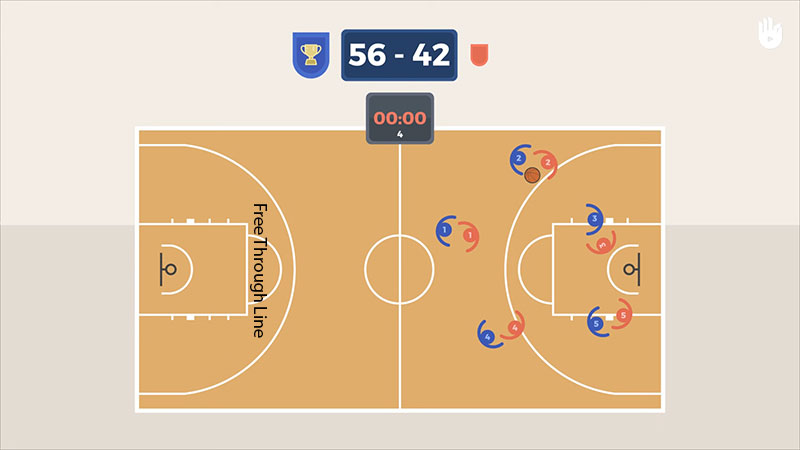
In the landscape of professional basketball, few moments are as tense or as scrutinized as the free throw. It is a singular battle between the athlete and the basket, stripped of defenders, high-speed transitions, and the chaotic variables of open play.
Yet, despite its apparent simplicity, a persistent question continues to circulate among fans, amateur players, and even some commentators: Can you legally jump during a free throw in the NBA?
The confusion often stems from the visual uniformity of the league. If you watch a hundred free throws, you will likely see a hundred variations of a “set shot”—a shot taken with the feet firmly planted on the hardwood.
This prevalence has led to a widespread misconception that jumping is a violation of the league’s rules. However, the reality of the NBA rulebook is more nuanced, balancing technical freedom with practical constraints that dictate the strategies of the world’s most elite shooters.
The Legal Verdict: Deciphering the NBA Rulebook
To address the core question directly: Yes, a player is legally permitted to jump while shooting a free throw in the NBA.
There is no specific clause in the official NBA rulebook that mandates that a shooter’s feet must remain in contact with the ground throughout the duration of the shot.
However, this freedom is not absolute. The legality of the jump is tethered to a strict spatial and temporal requirement.
A player may leap, but their feet must not step on or cross the free-throw line until the basketball has made physical contact with the rim or the backboard, or until the shot attempt has officially ended.
This distinction is where the “legality” of the jump often meets the “reality” of the game. While the act of jumping itself is legal, the consequences of that jump are difficult to manage.
The moment a player’s foot touches the painted line before the ball hits the cylinder, a lane violation occurs. The penalty for this is immediate: the shot is voided, and the ball is turned over to the opposing team.
The Risk Mitigation Strategy: Why NBA Stars Choose the Set Shot
If jumping is legal, why do we rarely see it at the professional level? The answer lies in a sophisticated assessment of risk versus reward. In the NBA, where games are often decided by a single possession, the margin for error at the free-throw line is non-existent.
1. The Hazard of the Line Violation
When a shooter jumps, their natural physical momentum tends to carry them forward. In a standard jump shot during live play, this “drift” is a non-issue.
However, at the free-throw line, the shooter is positioned mere inches from a boundary that they cannot cross.
Leaping forward significantly heightens the probability that a player will inadvertently land on or over the 15-foot line before the ball has finished its flight and touched the rim.
By opting for a set shot, players eliminate this variable, ensuring they remain behind the line and avoiding a costly unforced turnover.
2. The Pursuit of Mechanical Consistency
At the professional level, free-throw shooting is an exercise in muscle memory. The goal is to create a motion that is perfectly repeatable under extreme pressure.
Keeping the feet planted on the ground provides a more stable and controlled foundation for the shooting motion.
Every additional movement—the bend of the knees for a jump, the timing of the leap, and the stabilization of the body in mid-air—introduces a new point of potential failure.
By removing the jump, a player simplifies the kinetic chain, focusing entirely on the flick of the wrist and the arc of the ball. This stability is the cornerstone of high-percentage shooting.
The Biomechanics of the 15-Foot Shot
To understand why a jump is often unnecessary, one must look at the physics of the 15-foot distance. For an NBA athlete, a 15-foot shot is relatively short.
Most players possess enough upper-body and leg-base strength to generate the required power for the shot without needing the additional lift provided by a jump.
Power Generation vs. Accuracy
In a traditional jump shot, the leap serves two purposes: to elevate the ball above the reach of a defender and to provide additional power for long-distance attempts (such as three-pointers).
At the free-throw line, neither of these factors is present. There is no defender to block the shot, and the distance is short enough that “extra power” can actually become a detriment to accuracy.
When a player jumps, they are essentially adding a vertical and horizontal force to the ball. Controlling that force so that the ball lands softly on the rim is significantly harder when the body is in motion.
The “set shot” allows the player to use their legs as a stable shock absorber, providing just enough lift to guide the ball without the volatility of a full leap.
Historical Context: How the Rules Evolved
The history of the free throw is a history of players seeking every possible advantage. In the early eras of basketball, the rules were less defined, leading to creative—and sometimes disruptive—approaches to the charity stripe.
One famous historical anecdote involves the legendary Wilt Chamberlain. Known for his incredible athleticism, Chamberlain reportedly experimented with a technique where he would stand at the top of the free-throw circle, jump forward, and dunk the ball or lay it in before his feet touched the ground.
While technically a “jump,” this was an extreme version that prompted rule changes to ensure the shooter remained behind the plane of the line.
Today’s rules are designed to maintain the integrity of the “free” shot. It is intended to be a test of accuracy, not a test of how far a player can jump or how close they can get to the rim before releasing the ball.
Professional Analysis: The Psychology of the Routine
For an NBA player, the free throw is as much a mental challenge as a physical one. This is why you see elaborate pre-shot routines: Giannis Antetokounmpo’s rhythmic dribbles, Stephen Curry’s jersey tug, or Steve Nash’s habitual hand-licking.
These routines are designed to trigger a specific neurological response that says, “I have done this a thousand times.” Incorporating a jump into this routine would be counterproductive for most. A jump is an explosive, high-energy movement.
The free throw, conversely, requires a calm heart rate and a steady hand. Most shooting coaches teach players to “quiet” their bodies. A jump creates “noise” in the shooting motion that most professionals simply do not want to manage.
Case Studies: Exceptions to the Rule
While rare, there have been instances of players using a “jump-like” motion or a very pronounced lift. Some players with lower-body injuries or those who have transitioned from different styles of play may find that a small hop helps their rhythm.
However, even in these cases, the “hop” is usually vertical rather than forward, specifically to avoid the line violation risks mentioned in the NBA’s regulatory framework.
Younger players or those in youth leagues are often encouraged to jump or “step into” their free throws because they lack the physical strength to reach the rim from 15 feet.
But as players mature and reach the professional ranks, the jump is almost always phased out in favor of the more reliable set shot.
Frequently Asked Questions (FAQ)
Is it a lane violation if I jump and land across the line?
Yes, if you land on or over the line before the ball hits the rim or backboard, it is a violation. This results in the loss of the shot and a turnover.
Why don’t we see more players jump to get a better angle?
The “better angle” provided by a few inches of height is negligible compared to the loss of stability. NBA players prioritize a repeatable, grounded motion over the slight height advantage of a leap.
Does the same rule apply to the WNBA and FIBA?
While this guide focuses on the NBA, most major basketball organizations have similar rules regarding the free-throw line. The shooter must remain behind the line until the ball makes contact with the rim.
What happens if I jump but don’t cross the line?
The shot is perfectly legal. As long as your feet stay behind the plane of the line until the ball hits the rim, you can jump as high as you like.
Conclusion: The Professional Standard
The “leaping free throw” remains one of basketball’s most interesting legal technicalities. It is a tool available to every player in the NBA, yet it is a tool that almost no one uses.
This paradox highlights the nature of professional sports: just because a movement is allowed does not mean it is optimal.
The NBA free throw is a masterclass in efficiency. By keeping their feet planted, players choose control over power and consistency over flair.
They understand that the 15-foot line is a boundary that demands respect. While you may legally take flight at the charity stripe, the most successful players know that the surest path to the scoreboard is staying firmly on the ground.
For those looking to improve their own game, the lesson is clear. Master the set shot, respect the line, and build a routine that prioritizes the steady mechanics that have defined the greatest shooters in basketball history.