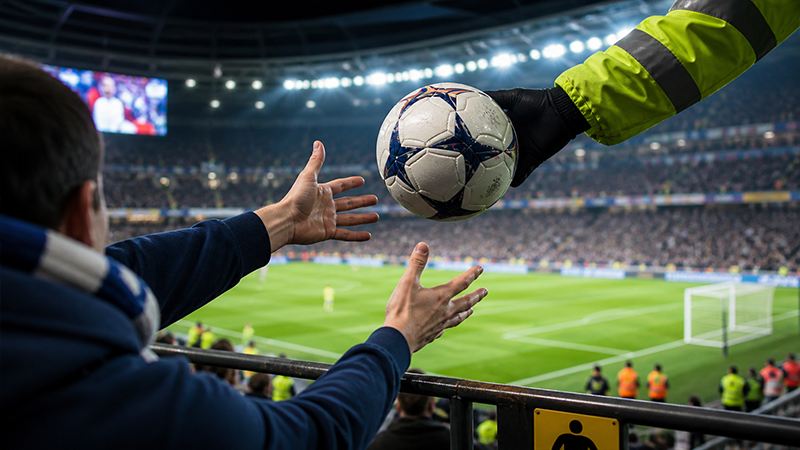
The roar of the crowd, the smell of the turf, and the sudden, heart-pounding moment a ball sails over the boundary and into the stands—it is the quintessential dream for any sports fan.
You reach out, snag the ball from the air, and for a split second, you feel like you’ve secured the ultimate piece of sports history.
However, in the world of professional football—whether you are at an NFL stadium or a high-stakes soccer match—that dream often ends with a tap on the shoulder from security.
Unlike baseball, where keeping a home run ball is a celebrated tradition, the rules in professional football are much more stringent.
This guide explores the “Stadium Rule,” delving into why professional leagues are so protective of their equipment and what actually happens when a ball enters the stands.
The Legal Reality: Who Actually Owns the Ball?
When you enter a professional sports venue, you are entering a space governed by specific terms and conditions.
One of the most fundamental of these is property ownership. In the vast majority of professional soccer (association football) and NFL games, fans are not permitted to keep the ball.
The balls used during the game are legally considered the property of the league or the stadium. When a ball enters the seating area, it does not magically become the property of the person who catches it.
Instead, security personnel and stadium staff are trained to ensure these items are returned to the field of play or the designated ball boys.
Why the NFL Is So Strict: Tech, Tracking, and Tradition
In the NFL, the process of retrieving balls is highly organized. Stadium staff are strategically placed to retrieve any ball that enters the stands immediately. While many fans assume this is purely about the cost of the football, the reality is much more high-tech.
The RFID Revolution
Since 2017, the NFL has revolutionized how it tracks game data. A significant number of official game balls now contain RFID (Radio Frequency Identification) chips. These chips are sophisticated pieces of technology used to track:
- The speed of the ball during a pass or kick.
- The exact location and trajectory of the ball on the field.
Because these balls provide valuable data to the league for “Next Gen Stats” and coaching analysis, they are considered valuable technology assets rather than just leather equipment. This high-tech integration makes the league even more protective of its inventory.
Game Continuity and Approval
Beyond the technology, there is the matter of the “flow” of the game. Professional football requires a high level of consistency. The referee must approve any change in match balls to ensure they meet the specific standards required for play.
If fans were allowed to keep every ball that went out of bounds, the logistics of constantly approving new, “unvetted” balls would disrupt the continuity of the game.
The Soccer Perspective: Sponsorship and Scarcity
In the world of association football (soccer), the culture of returning the ball is deeply ingrained. If a ball is kicked into the stands, the standard procedure is for fans to either throw the ball back onto the pitch or hand it over to the nearest steward.
The Cost of Excellence
While a standard football might not seem like a massive expense to a multi-billion-dollar league, professional-grade soccer balls are surprisingly expensive. Furthermore, these leagues often operate with limited, sponsored stock.
Sports brands like Adidas or Nike provide a specific number of balls for a match or a season as part of a sponsorship deal. Because the stock is not infinite, teams must account for their equipment throughout the 90 minutes of play.
Maintaining the Match Tempo
Soccer is a game of momentum. For the match to proceed without unnecessary delays, balls must be returned to the field as quickly as possible. This is seen as a standard courtesy and a requirement for maintaining the continuity of the match.
The Five Pillars: Why You Can’t Take It Home
To understand the “Stadium Rule” fully, we can break it down into five primary reasons provided by league insiders and stadium protocols:
- Costs & Sponsorship: High-end match balls are specialized equipment with limited availability through sponsorship deals.
- Game Continuity: Constant ball replacement requires referee oversight, which can slow down the game.
- Safety & Security: Stadiums enforce the rule that fans cannot keep items that do not belong to them to maintain order.
- Valuable Technology: In the NFL, the inclusion of tracking chips makes each ball a piece of proprietary league data-gathering equipment.
- Professional Standards: Returning the ball is considered an act of sportsmanship and a standard part of the fan experience in these specific sports.
Are There Any Exceptions?
While the general rule is “return the ball,” there are rare instances where a fan might walk away with a souvenir.
- Player Gifts: On occasion, a player may intentionally hand or throw a ball to a fan as a specific gift. In these cases, security will often allow the fan to keep it because the “owner” (the player acting as a representative of the team) has gifted the property.
- Lower-Level Matches: The rules are typically much more relaxed in non-professional or lower-level matches. In these settings, the balls lack tracking chips, and the sponsorship constraints are less rigid, occasionally allowing for the “finders keepers” rule to apply.
Comparison with Other Sports
It is worth noting that this policy differs significantly from Major League Baseball (MLB). In baseball, the cost of the ball is lower, and the tradition of fans keeping fouls and home runs is a core part of the sport’s marketing and fan engagement.
In contrast, the NBA follows a similar “return it” policy to the NFL and soccer, primarily due to the limited number of game-ready balls and the need for consistency in the ball’s “feel” (texture and air pressure) as approved by officials.
Conclusion: The Etiquette of the Stands
While it might be disappointing to hand back a ball you just caught, it is an essential part of being a fan in the NFL or professional soccer.
By returning the ball, you are helping maintain the continuity of the game, respecting the high-tech equipment involved, and following the standard courtesy expected of all spectators.
The next time a ball comes your way, enjoy the catch, take a quick photo if you can, and then prepare to hand it back to the stewards. You might not get to keep the leather, but you get to keep the memory of the play.