For groundskeepers, coaches, and sports facility managers, the difference between a mediocre pitch and a professional-grade field lies in the geometric precision of its boundaries.
A field that isn’t perfectly square doesn’t just look unprofessional; it can impact the fairness of play, affecting everything from corner kicks to tactical positioning.
While modern technology offers GPS-guided marking, you can achieve the same elite-level accuracy using a centuries-old mathematical principle: the Pythagorean theorem.
This guide provides a comprehensive, step-by-step deep dive into how to square up a football field using the 3-4-5 triangle method, ensuring your corners are true 90-degree angles every single time.
The Geometry of the Pitch: Why Squaring Matters
Before diving into the measurements, it is essential to understand the “why.” A standard football field is a rectangle, and by definition, every corner must be a perfect right angle.
If your corners are off by even a few degrees, the error compounds over the length of the touchline, leading to a field that is “skewed” or “parallelogram-shaped.”
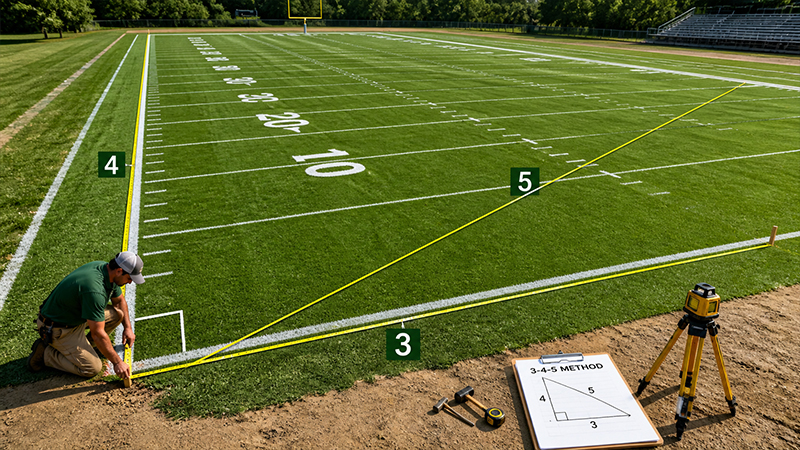
The most reliable manual way to prevent this is by using the 3-4-5 triangle method. This method utilizes the Pythagorean theorem ($a^2 + b^2 = c^2$) to create a perfect right-angled triangle.
By establishing these triangles at your corners, you ensure that your goal lines and touchlines are perfectly perpendicular.
Essential Tools for Professional Field Marking
To achieve professional results, you need more than just a bucket of paint. Precision requires specific tools to ensure your measurements remain consistent across the 100+ yards of a standard field.
- High-Visibility String Lines: These are your “guides.” Use a heavy-duty string that won’t stretch or sag easily.
- Sturdy Pegs or Stakes: These will be driven into the ground to anchor your corners and mid-points.
- Long-Distance Measuring Tapes: You will need tapes that can reach at least 100 to 150 feet to handle the larger ratios required for accuracy.
- A Hammer or Mallet: For securing stakes into firm soil.
- A “Square” Mindset: Patience is the most important tool. “Measure twice, mark once” is the groundskeeper’s mantra.
Establishing Your Baseline
Every accurate field starts with a single, straight line. This is known as your baseline.
- Select Your First Boundary: Decide whether you want to start with a touchline (sideline) or a goal line. Most professionals prefer starting with a touchline if the field must align with existing stadium structures or bleachers.
- Layout the String: Drive a stake into the ground at the first corner. Run your string line the full length of the field to the second corner stake.
- Tension is Key: Use tight string lines between poles for straight boundaries. If the string has any slack, your baseline will bow, and every subsequent measurement will be inaccurate.
Applying the 3-4-5 Method
Once your baseline (Side A) is established, you need to create a perpendicular line (Side B) to form your first corner.
The Standard Ratio
At your first corner stake, measure exactly 3 units (such as 30 feet or 3 meters) down your established baseline and mark that point. This represents the first leg of your triangle.
The Perpendicular Mark
Next, extend a second string line from the same corner stake in the direction where your next boundary will be. Measure 4 units (40 feet or 4 meters) along this new line and make a temporary mark.
Finding the 90-Degree Angle
To ensure this corner is square, measure the diagonal distance (the hypotenuse) between the 30-foot mark on your baseline and the 40-foot mark on your new line.
For the corner to be a true right angle, this diagonal distance must be exactly 50 feet (or 5 meters).
If the measurement is more or less than 50 feet, you must adjust the second string line (the one with the 40-foot mark) until the diagonal hits the 50-foot mark exactly. This creates a perfect 3-4-5 triangle, locking in a 90-degree corner.
Scaling Up for Maximum Accuracy
While a 30-40-50 foot triangle works for small areas, a football field is massive. On such a large scale, even a tiny error in a small triangle can result in a significant deviation at the far end of the field.
To counteract this, you should use larger multiples of the 3-4-5 ratio. The larger the triangle, the more accurate your line will be over a long distance. Common professional multiples include:
- 60-80-100 (Feet or Meters)
- 90-120-150 (Feet or Meters)
By using the 90-120-150 ratio, you are significantly reducing the margin of error, allowing you to adjust the string lines for a truly professional rectangle.
Completing the Rectangle and Double-Checking
After successfully squaring the first corner, you must repeat the process. It is recommended to apply the 3-4-5 method on at least the first two corners.
In theory, if your lengths are correct and your first two corners are square, the remaining two corners should naturally align.
However, “theory” and “reality” often differ in the field. Therefore, checking all four corners is highly recommended to ensure no cumulative errors have crept in.
The Ultimate Test: The Cross-Diagonal Verification
Before you spray a single drop of paint, there is one final verification step that proves your field is perfectly square. This is the Cross-Diagonal Check.
- Once all four corners are marked, take your measuring tape and measure the distance from Corner A to Corner C (top-left to bottom-right).
- Then, measure the distance from Corner B to Corner D (top-right to bottom-left).
- The Result: After marking all corners, these two diagonal lines of the entire rectangle must be equal in length.
If the diagonals are equal, your field is perfectly square. If one diagonal is longer than the other, your field is a parallelogram and requires adjustment before the final marking.
Pro Tips for Maintenance and Marking
- Drive Permanent Stakes: If you manage the same field year-round, consider driving small “carpets” or permanent markers into the ground at the corners so you don’t have to re-square the field every season.
- Weather Awareness: Be mindful of the wind. Strong winds can blow your string lines, creating a curve. Always mark on a calm day if possible.
- String Quality: Always use high-tension, non-stretch string. Braided nylon is often a better choice than twisted twine, which can unravel and stretch under tension.
Conclusion
Squaring a football field is an exercise in patience and geometric precision.
By using the established 3-4-5 method—and scaling it up to 90-120-150 for accuracy—you can ensure that your pitch meets professional standards without the need for expensive laser levels.
Start with a solid baseline, verify your corners with the Pythagorean theorem, and always finish with a cross-diagonal check to guarantee a perfect field of play.