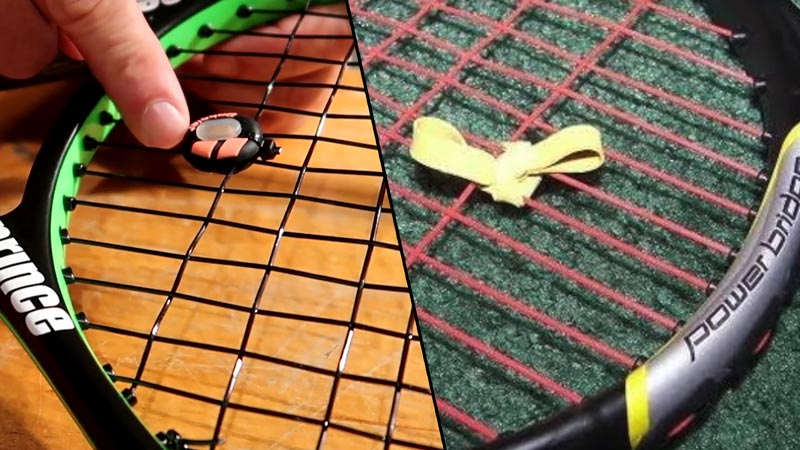
For decades, a subtle but fierce debate has echoed across the professional tour and local club courts alike.
It isn’t about string tension or frame stiffness, but about a small piece of material sitting at the base of the string bed. On one side, you have the sleek, branded commercial dampeners found in every pro shop.
On the other hand, the humble rubber band—a DIY solution favored by some of the greatest legends in the sport’s history.
Choosing between these two isn’t a matter of finding a “better” tool, but rather about identifying the specific feedback you want from your racket.
This comprehensive analysis will break down the physics, the history, and the technical nuances of racket dampening to help you decide which path aligns with your game.
The Fundamental Truth: Sound vs. Shock
Before diving into the hardware, we must address the most common misconception in the tennis world: the belief that dampeners prevent injuries like tennis elbow.
The technical reality is that neither a rubber band nor a premium commercial dampener significantly reduces the shock translated through the frame to a player’s arm. Instead, these tools are designed to filter out the high-frequency “ping” noise created by the strings upon impact.
While this change in sound dramatically alters the perceived feel of the ball, the actual physical vibration of the racket remains largely unchanged.
The Case for the Rubber Band: A Legacy of Precision
The rubber band is perhaps the most iconic “secret” in tennis gear. While it looks like a budget-friendly improvisation, it is a calculated choice for many high-level competitors.
1. The Agassi and Sharapova Influence
The rubber band gained global recognition through Andre Agassi, who famously used a thick #64 rubber band to mute his Head Radical rackets.
This trend continued through players like Maria Sharapova and remains a staple on the modern tour with athletes like Flavio Cobolli and Karolina Pliskova.
For many, the rubber band isn’t just about utility; it’s about a specific acoustic signature. Because a rubber band can be tied to wrap around multiple strings, it absorbs more of the “string buzz,” resulting in a highly muted, soft “thud” that many players find more satisfying than the click of a standard dampener.
2. Security and Reliability
One of the primary frustrations with traditional commercial dampeners is their tendency to “pop out” and fly across the court during a heavy hit or a miss-hit near the frame. A rubber band, tied securely in a knot, is virtually impossible to lose during a point.
This security is particularly vital for players with specific racket preparation habits. For example, Italian pro Flavio Cobolli has stated in interviews that he prefers the rubber band because his finger placement during his racket prep would frequently knock a standard dampener out of place. The tied band stays fixed regardless of how he handles the racket before a strike.
3. Unrivaled Economics
From a cost-benefit perspective, the rubber band is the undisputed winner. A giant pack of #64 rubber bands—the industry standard for tennis—can often be purchased for under $5, bringing the cost per dampener down to approximately one to three cents.
In contrast, name-brand commercial options typically retail between $2 and $6 each. For high school coaches or frequent players who often lose equipment, the rubber band is the most sustainable option.
The Case for Traditional Dampeners: Aesthetics and Ball Feedback
Commercial dampeners are not merely marketing gimmicks; they offer distinct advantages in terms of ease of use and sensory feedback.
1. A Firmer, More Responsive Feel
While rubber bands offer a heavily muted experience, many players find they “kill” too much of the string’s feedback. Traditional dampeners usually sit between only the two middle main strings.
This allows for a firmer feel that preserves more of the ball’s natural feedback while still eliminating the annoying high-pitched ringing sound.
2. Variety and Customization
Commercial dampeners come in an endless array of shapes, sizes, and densities. From the classic Pete Sampras “O” ring to “worm” style dampeners that stretch across several strings, players can fine-tune their racket’s sound with far more variety than a standard rubber band allows.
For many, the aesthetic appeal of matching a dampener to their racket’s color scheme or brand is a valid part of the sport’s enjoyment.
A Technical Comparison: Weight and Physics
For the competitive player, the choice between these two options can have a measurable impact on racket physics, specifically swing weight and balance.
| Feature | Rubber Band (#64) | Commercial Dampener |
|---|---|---|
| Average Weight | ~0.5 grams | 1.4g to 5.0 grams |
| Sound Profile | Muted, soft “thud” | Crisp, firmer feedback |
| Security | Tied-on; won’t fly off | Prone to popping out |
| Swing Weight Impact | Negligible | Can increase by up to 5 points |
A 5-gram dampener—on the heavier side of the commercial spectrum—can actually shift the balance of a racket slightly and increase the swing weight.
Players who are sensitive to the “plow-through” of their frame may prefer the ultra-light 0.5-gram rubber band to maintain their racket’s original specifications.
The Positioning Advantage
One unique benefit of the tied rubber band is the ability to “slide” it. While most dampeners are fixed between strings, a tied band can be moved up or down the two middle mains.
Sliding the band closer to the throat of the racket or higher toward the first cross string allows a player to micro-adjust the amount of dampening on the fly to find their “perfect balance” of feel.
Risks and Maintenance: The “Explosion” Factor
Despite their advantages, rubber bands require more frequent maintenance than their silicone counterparts.
- Dry Rot and Snapping: Because they are made of organic rubber, bands are susceptible to dry rot and environmental wear. Over time, they stretch out and eventually snap. In rare instances, a dry-rotted rubber band can “explode” mid-point, potentially sending a piece of rubber toward a player’s eye. To mitigate this, it is recommended to tie on a fresh band with every new string job or even at the start of every match.
- Latex Allergies: For players with a latex sensitivity, standard rubber bands can pose a health risk. These players should opt for latex-free rubber bands (often found in office supply stores) or stick to silicone-based commercial dampeners.
Finding Your Identity: How to Choose?
If you are currently playing with a racket that has a loud, distracting “ping” upon impact, it is time to experiment. There is no objective “best” in this category—only what feels right to you.
Choose a Rubber Band if:
- You want the most muted, “dead” sound possible from your strings.
- You are a heavy hitter tired of your dampener flying off the racket.
- You want to minimize the impact of the dampener on your racket’s swing weight.
- You enjoy the “retro” look or want to emulate Agassi and Cobolli.
Choose a Commercial Dampener if:
- You prefer a firmer feel with a bit more feedback from the ball.
- You value aesthetics and want a professional, branded look.
- You want an easy “plug-and-play” solution without tying knots.
- You have a latex allergy and want a safe, silicone-based product.
The “No Dampener” Alternative
It is also worth noting that many players, including professionals like Jannik Sinner or those using natural gut strings, often choose to use no dampener at all.
Stringing at lower tensions can sometimes make the “ping” less offensive, and some players actually prefer the raw, unmuted sound as it provides the most direct feedback of where the ball hit the string bed.
Frequently Asked Questions
Does a rubber band actually work?
Yes. A tied rubber band (specifically the #64 size) is highly effective at eliminating the high-frequency vibration noise of tennis strings.
Where should I place my dampener?
According to the rules of tennis, dampeners must be placed outside the pattern of crossed strings. Typically, they are placed below the lowest cross string and between the two central main strings.
What is the best rubber band to use?
The most common choice for tennis rackets is the #64 rubber band. Some players even suggest using the thick bands found on heads of broccoli for a heavier, more durable feel.
Can I use two dampeners at once?
You can, but it is rarely beneficial. Adding multiple dampeners or combining a “worm” with a standard dampener mostly adds unnecessary weight to the head of the racket without providing significantly better sound reduction.
Final Thoughts
In the pursuit of the perfect tennis game, every detail matters. Whether you opt for the three-cent rubber band or a premium six-dollar dampener, remember that you are fine-tuning the racket to your ears and your sense of touch.
Neither will fix a bad backhand, but the right choice will give you the confidence that every hit sounds and feels exactly as it should.
Experiment with both, find your preferred “thud,” and focus on what truly matters: the next point.