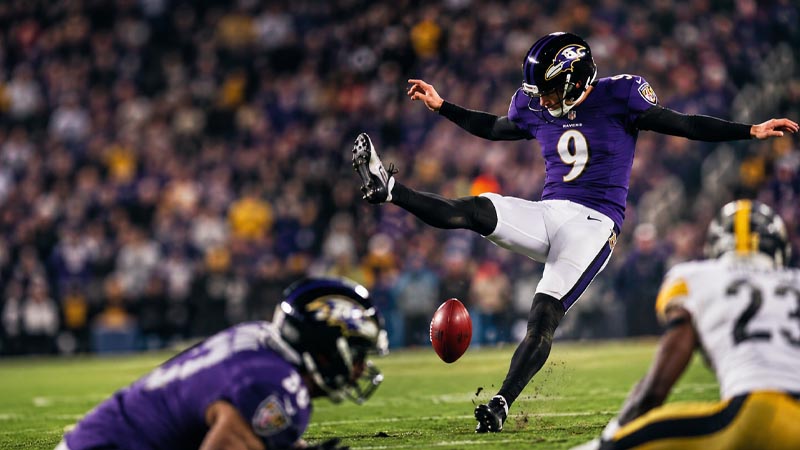
If you watch modern professional football religiously, you will witness jaw-dropping catches, 60-yard field goals, and intricate trick plays.
Yet, there is one legal maneuver that most fans have never seen executed live: the dropkick.
When casual observers first learn about the dropkick, the primary reaction is one of absolute disbelief. Is it actually allowed? Can a team pull it off in a high-stakes game today?
The short answer is a definitive yes. Dropkicks remain 100% legal in the NFL today.
However, bridging the gap between legal theory and modern practical application reveals a fascinating rabbit hole of football history, equipment evolution, and strict rule enforcement.
This breakdown explores why the dropkick remains in the official rulebook, why teams completely abandoned it, and the last player brave enough to pull it off.
What Exactly Is an NFL Dropkick?
According to the official NFL Rulebook (Rule 3, Section 8), a dropkick is explicitly defined as:
“A kick by a kicker who drops the ball and kicks it as, or immediately after, it touches the ground.”
Unlike a placekick—where a holder pins a stationary ball cleanly against the turf—or a punt, where the kicker strikes the ball out of the air before it lands, a dropkick requires precise timing on a short bounce.
Under current league regulations, it is still an officially recognized method to:
- Score a traditional field goal (worth 3 points)
- Convert a point-after-touchdown (PAT / extra point, worth 1 point)
- Execute certain free kicks (such as kickoffs)
Why You Virtually Never See It in the Modern Game
If the rulebook allows it, why do coaches break into blank stares if a special teams coordinator suggests a dropkick? The disappearance of the play comes down to two major structural shifts in football.
1. The Evolution of the Football’s Shape
In the primordial eras of gridiron football, the ball was much rounder and bore a heavy resemblance to a rugby ball. Because of its plump shape, dropping it nose-first onto the turf resulted in a predictable, straight bounce upward.
Over the decades, the NFL aerodynamicized the ball to favor the forward pass. Modern professional footballs are sharply pointed at both ends.
Dropping a modern leather football onto hard turf causes a wildly erratic, unpredictable bounce. Attempting a dropkick today introduces an unacceptable level of risk for coaches whose jobs depend on microscopic margins of error.
2. Modern Efficiency and Accuracy
Special teams operations are heavily optimized. A standard placekick executed with a specialized holder and long-snapper offers near-surgical precision and speed.
Introducing a bounce into the kicking operation adds an entirely unnecessary variable. Simply put, there is no logical competitive advantage to risking a dropkick when standard mechanics are overwhelmingly superior.
Key Legal Guidelines and Guardrails
Coaches cannot simply improvise a dropkick without following strict regulatory boundaries. The NFL maintains tight specifications on how and where the play can occur:
Behind the Line of Scrimmage: For standard scrimmage plays like field goals and extra points, the dropkick must happen completely from behind the line of scrimmage.
The “Immediate” Execution Rule: The kicker cannot bounce the ball, catch it, juggle it, or wait for it to rise high into the air. It must be struck as or immediately after it touches the grass.
The strictness of this timing was highlighted during a 2019 preseason practice and kickoff variation test. Baltimore Ravens star kicker Justin
Tucker attempted a creative kickoff where he dropped the ball and kicked it after a noticeable delay. The league quickly flagged and clarified that execution as illegal under the strict parameters of the rule.
Historical Context: The Last Time It Happened
Because the mechanics are so treacherous, the dropkick has long been a historical artifact. The last player to successfully convert a dropkick in a regular-season NFL game was legendary quarterback Doug Flutie.
Playing for the New England Patriots during the 2005 regular-season finale on January 1, 2006, the 43-year-old Flutie trotted onto the field in the fourth quarter against the Miami Dolphins.
Following a touchdown pass to wide receiver Tim Dwight, head coach Bill Belichick—a noted football historian—let Flutie attempt a dropkick for the extra point.
Flutie took a shotgun snap, retreated, dropped the ball cleanly to the turf, and struck it off the short hop straight through the center of the uprights.
It marked the first successful NFL dropkick since December 21, 1941, when Ray “Scooter” McLean converted one for the Chicago Bears in the NFL Championship Game.
Frequently Asked Questions
Can a team try a dropkick on a two-point conversion?
Yes. Because a dropkick is a legal method of scoring from scrimmage behind the line, a team could theoretically utilize it during a try attempt or standard offensive play, though no team has risked doing so in decades.
Is the dropkick used in other sports?
Yes. While it is extinct in American professional football, the dropkick remains a core element of rugby union and rugby league, where players routinely use drop goals during open play and kickoffs.
Will we ever see another dropkick in the NFL?
While highly unlikely due to the precision of modern placekicking, it remains permanently embedded in the rulebook. It waits silently for a blowout game, a playful head coach, and a bold player willing to write their name next to Doug Flutie in the history books.