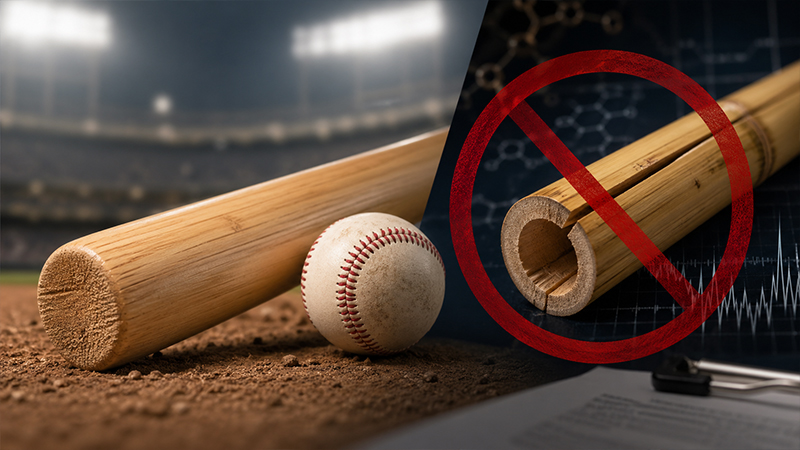
In the world of professional baseball, the equipment used by athletes is scrutinized down to the millimeter and the molecular level.
While fans are accustomed to the iconic “crack” of a maple or ash bat, a relatively modern contender—bamboo—has become a staple in cages and amateur dugouts across the globe. However, if you look at the racks in a Major League dugout, you will notice a glaring absence.
This leads to a critical question for players and enthusiasts alike: Are bamboo bats legal in MLB?
The short answer is a definitive no. Despite their incredible durability and rising popularity in the training world, bamboo bats are strictly prohibited from game use in Major League Baseball (MLB) and its affiliated Minor Leagues (MiLB),.
In this comprehensive guide, we will break down the regulatory, biological, and structural reasons why bamboo remains on the sidelines of professional play.
The Core Ruling: Why MLB Says “No” to Bamboo
According to professional regulations, bamboo bats do not meet the equipment standards required for official game use.
The primary reason for this ineligibility boils down to a fundamental rule regarding the physical composition of the bat.
The “Single Piece of Wood” Mandate
The MLB rulebook contains strict language regarding the construction of hitting implements. Specifically, MLB rules mandate that every bat must be crafted from a single, solid piece of wood.
This requirement is the cornerstone of professional hitting standards and is designed to ensure a consistent performance profile across the league.
Because of how bamboo bats must be manufactured, they fail this “single piece” test immediately. Unlike a traditional bat that is turned from a solid “billet” (a cylindrical block of wood), bamboo bats are constructed by compressing multiple bamboo strips together.
This multi-part assembly makes them, by definition, a composite or laminated product rather than a single solid unit.
The Biological Barrier: Grass vs. Wood
Even if a manufacturer found a way to carve a bat from a single massive stalk of bamboo, it would still run into a significant regulatory hurdle: the definition of “wood.”
Bamboo’s Scientific Classification
Technically and biologically, bamboo is a grass, not a tree-based wood. This distinction is more than just a botanical trivia point; it is a legal disqualifier in professional baseball.
Because MLB regulations specify that bats must be made of tree-based wood, the use of a “grass” implement violates the requirement for solid wood construction.
The Material Difference (External Context)
Trees (dicots) grow in a way that creates a dense, ringed structure that can be harvested in large, solid blocks. Grasses (monocots like bamboo) are hollow and have a vastly different cellular arrangement.
To make something the size of a baseball bat out of bamboo, you cannot simply “turn” it on a lathe from a single plant; you must harvest the “culms” (stalks), slice them, and then reassemble them using industrial adhesives.
Construction and Composition: The Lamination Problem
The manufacturing process that makes bamboo bats so resilient is the very thing that excludes them from the “Big Leagues.”
Lamination and Composites
Because bamboo stalks are naturally hollow, the only way to create a solid bat is through lamination. Manufacturers take dozens of individual strips of bamboo, treat them, and then use high-pressure compression and strong glues to fuse them into a solid “blank.”
From a regulatory standpoint, MLB classifies these as laminated or composite bats. The league has historically been wary of composites because they can be engineered to have a “trampoline effect” that exceeds the performance of natural wood, potentially giving hitters an unfair advantage and putting pitchers at risk from high-velocity exit speeds.
The Amateur Exception: When is Bamboo Legal?
While the doors of the MLB and MiLB are closed to bamboo, the material has found a massive market elsewhere.
Amateur Organized Play
In many lower-level or amateur leagues, bamboo is a popular and legal choice. However, even in these settings, there are rules to follow.
Most organized amateur leagues require bamboo bats to have a BBCOR (Batted Ball Coefficient of Restitution) certification. This stamp ensures that the bat performs similarly to a traditional wood bat and does not provide an artificial power boost.
Practice and Training Scenarios
One of the primary reasons players invest in bamboo is for batting practice. Because bamboo is incredibly difficult to break compared to ash or maple, it is an ideal tool for “saving” expensive game-day wood during long sessions in the cage.
Many professional players use bamboo for training, even though they cannot bring it into the batter’s box during a game.
Key Differences
| Feature | Traditional Wood (Maple/Ash) | Bamboo Bats |
|---|---|---|
| MLB Legal? | Yes | No |
| Material | Tree-based Wood | Grass |
| Structure | Single, solid piece | Compressed/Laminated strips |
| Durability | Prone to splintering/breaking | Highly durable |
| Certification | N/A (Standard) | Requires BBCOR for amateur play |
Conclusion: Tradition Over Technology
Major League Baseball remains one of the most traditional organizations in professional sports.
The refusal to allow bamboo bats is a commitment to the “integrity of the game,” ensuring that the statistics and performance of modern players can be reasonably compared to those of the past.
As long as the MLB maintains the requirement for a single piece of tree-based wood, bamboo will remain a high-tech training tool rather than a professional game-day weapon.
For the amateur player, however, bamboo offers a durable, cost-effective, and BBCOR-certified alternative that can withstand the rigors of a long season.