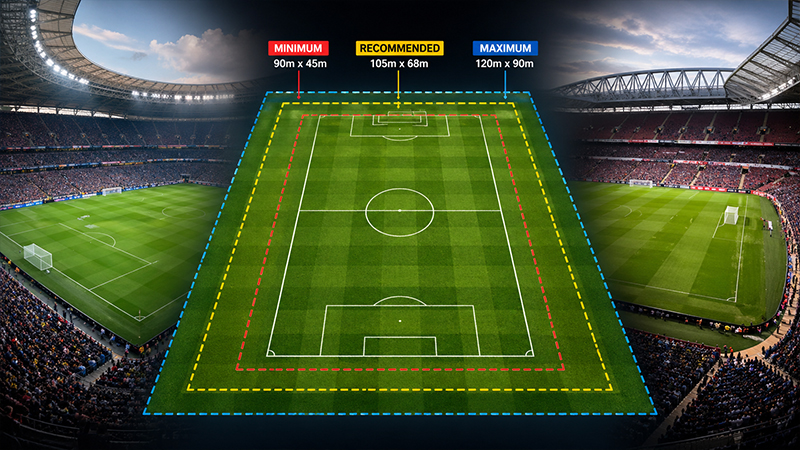
For many casual fans watching a match on television, every professional football pitch looks identical. The lush green grass, the white lines, and the iconic penalty boxes create an image of absolute uniformity.
However, if you were to step onto the turf at different stadiums around the world—or even within the same league—you would find that football pitches are not all the same size.
While sports like basketball or tennis rely on rigid, non-negotiable dimensions for their playing surfaces, football allows for a surprising amount of flexibility.
International regulations govern this variation, but it is also shaped by history, architecture, and even tactical strategy.
In this comprehensive guide, we will break down the official rules, the “constants” of the game, and why your favorite team’s home ground might be giving them a secret advantage.
The Rule Makers: Understanding IFAB Regulations
To understand why pitch sizes vary, we must first look at the governing bodies. The International Football Association Board (IFAB) sets the “Laws of the Game,” which dictate the permissible ranges for pitch dimensions.
For standard senior football, the regulations are remarkably broad:
- Length (Touchline): Minimum 100 yards (90m) to Maximum 130 yards (120m).
- Width (Goal Line): Minimum 50 yards (45m) to Maximum 100 yards (90m).
This means that, legally, a football pitch could technically be a perfect square (100×100 yards), though such a layout is never seen in professional play.
These wide ranges allow clubs at various levels of the pyramid to maintain pitches that fit their local infrastructure while remaining within the sport’s laws.
International Standards: FIFA’s Tighter Restrictions
While IFAB provides the broad foundation, FIFA applies much stricter regulations for high-stakes international matches. When national teams compete, the margin for variation shrinks significantly to ensure a fair and consistent environment for global competition.
For international matches, FIFA dictates the following dimensions:
- Length: 110–120 yards (approx. 100–110m).
- Width: 70–80 yards (approx. 64–75m).
By narrowing the permissible size, FIFA ensures that players transitioning from domestic leagues to the international stage don’t face a radical change in the physical demands of the game.
The Premier League “Gold Standard.”
In the world’s most-watched domestic league, the English Premier League, there is a strong push toward consistency, even if total uniformity isn’t always possible.
Most top-level clubs aim for what is considered the professional “gold standard” for pitch dimensions: 115 yards by 74 yards.
While this size is the preferred standard for many elite clubs to maintain league-wide consistency, it is not strictly enforced for all grounds.
This lack of strict enforcement is what leads to the subtle but significant differences that commentators often mention during a broadcast.
The “Constants”: What Never Changes?
While the outer boundaries of the pitch (the touchlines and goal lines) can shift, the internal markings of a football field are absolute.
This is vital for the integrity of the game; a striker needs to know exactly where the goal is, and a goalkeeper must have a consistent sense of their “box.”
Regardless of the total field size, the following dimensions remain constant:
- The Goals: The height and width of the goalposts never change.
- The Penalty Area: Commonly known as the “18-yard box,” these dimensions are fixed.
- The Penalty Spot: The distance from the goal line to the penalty spot remains the same across all professional pitches.
This consistency ensures that the technical aspects of scoring and defending remain a test of skill rather than a reaction to a changing environment.
Why Do Pitch Sizes Vary?
If most clubs prefer a standard size, why do we still see variation? There are two primary drivers: physical constraints and tactical intention.
Historic Stadiums and Space Constraints
Many of Europe’s most famous stadiums were built over a century ago in the heart of cramped, urban environments.
Unlike modern “bowl” stadiums built on the outskirts of cities with ample space, historic grounds are often boxed in by roads, housing, or railway lines.
For these clubs, expanding the pitch to the maximum allowed width might be physically impossible without tearing down a grandstand.
Tactical Home Field Advantage
Home teams are permitted to adjust their pitch size within the regulated IFAB ranges to complement their specific style of play.
- Narrow Pitches: A team that relies on a strong, compact defense may prefer a narrower pitch to make it harder for opponents to use wide attackers or “stretch” the play.
- Wide Pitches: Conversely, a team with high-speed wingers and a focus on expansive, attacking football will benefit from a wider pitch that provides more room to maneuver.
Case Studies: Premier League Variations
The Premier League provides excellent examples of how these variations manifest in the real world. Despite the move toward the 115×74 yard standard, differences remain noticeable.
For instance, Molineux, the home of Wolverhampton Wanderers, has historically been known for having a noticeably smaller playing surface compared to the league’s larger pitches.
When a team moves from a large, expansive pitch to the tighter confines of Molineux, it can impact their passing rhythm and the total area of the field they are required to cover.
How Pitch Size Affects the Game
The dimensions of a pitch are not just trivia—they have a direct impact on the physical and mental demands placed on players.
- Physical Exhaustion: On a maximum-sized pitch, players must cover significantly more ground over 90 minutes. This can lead to late-game fatigue, favoring teams with high fitness levels or deep benches.
- Passing Lanes: A wider pitch creates larger gaps between defenders, making “through balls” more effective. On a narrow pitch, those lanes vanish, favoring a more physical, “route one” style of play.
- Set Pieces: On a smaller pitch, a long throw-in or a deep free kick becomes a much more dangerous weapon, as the ball is physically closer to the goal more often.
Conclusion
While the game of football is played under a universal set of laws, the “canvas” upon which the players perform is far from uniform.
From the broad allowances of the IFAB Laws of the Game to the tighter requirements of FIFA international matches, pitch dimensions remain a variable factor in professional sports.
The next time you watch a match, remember that the size of the field is a silent participant in the game’s strategy.
Whether it is the result of a stadium’s historic architecture or a manager’s tactical cunning, the variation in pitch size is one of the many quirks that make football the most dynamic sport in the world.