Yannick Noah is a globally recognized icon celebrated for his unprecedented success as a professional tennis champion and a multi-platinum recording artist.
He achieved legendary status by winning the 1983 French Open, remaining the last Frenchman to claim a home Grand Slam singles title.
Beyond his athletic prowess, which saw him reach world No. 3 in singles and No. 1 in doubles, Noah transitioned into a dominant force in the music industry with Diamond-certified albums.
His enduring fame stems from this rare duality, his leadership as a championship-winning team captain, and his charismatic influence as a beloved multicultural public figure.
The Historic Tennis Career of Yannick Noah
Yannick Noah’s rise to prominence began on the clay courts, where his physical dominance and aggressive playstyle revolutionized the game during the 1980s.
Standing at 6 feet 4 inches, his imposing presence and incredible wingspan made him one of the most intimidating serve-and-volley players of the Open Era.
Over a nearly two-decade career, he amassed 23 singles titles and 16 doubles titles, proving himself to be a versatile threat in every format of the sport.
| Career Milestone | Achievement Details |
|---|---|
| Singles Career Record | 482–211 (69.6% win rate) |
| Doubles Career Record | 213–109 (66.1% win rate) |
| Highest Singles Ranking | World No. 3 (July 1986) |
| Highest Doubles Ranking | World No. 1 (August 1986) |
| Major Singles Title | 1983 French Open Champion |
| Major Doubles Title | 1984 French Open Champion |
| Hall of Fame Induction | International Tennis Hall of Fame (2005) |
Why Was the 1983 French Open So Significant?
The 1983 French Open final remains a defining moment in sports history, not just for Noah, but for the nation of France. By defeating Mats Wilander in straight sets at Roland Garros, Noah ended a 37-year drought for French men in Grand Slam singles tennis.
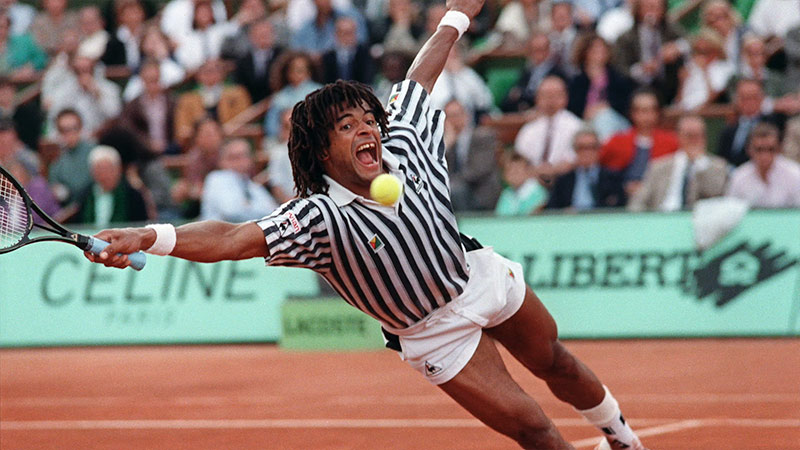
This victory catapulted him to immediate superstardom, as he captivated the home crowd with his athletic diving shots and expressive courtside energy.
Breaking Barriers in Professional Tennis
Noah’s triumph carried immense cultural weight, as he became only the second Black man to win a major singles tennis title. He followed in the footsteps of his mentor, Arthur Ashe, who had discovered him as a child in Cameroon.
This victory solidified his position as a pioneer for diversity in a sport that had historically lacked representation from the African diaspora.
The Technical Mastery of a Champion
His success was built on a heavy kick-serve and a massive topspin forehand that dictated play from the baseline before he would charge the net.
His leaping ability was particularly legendary, leading many analysts to cite his overhead smash as one of the best in the history of the sport. This combination of raw power and finesse allowed him to overcome the most disciplined opponents of his generation.
Ending the Legend of Ivan Lendl
One of the most impressive feats of Noah’s career occurred in 1982 during the Palm Springs final. At the time, Ivan Lendl was on a historic 44-match winning streak, appearing invincible to the rest of the tour.
Noah’s victory in that match proved he was a “giant slayer” capable of stopping any player on his best day, a reputation that followed him throughout his professional journey.
Transitioning from the Court to the Music Charts
While many athletes struggle with retirement, Noah seamlessly pivoted into a second career that rivaled his first in terms of commercial success.
Immediately following his retirement from the ATP tour in 1991, he launched a music career that focused on an upbeat blend of pop and reggae.
His transition was so successful that he eventually became one of France’s most popular entertainers, frequently selling out the 80,000-seat Stade de France.
Diamond-Certified Success and Major Hits
Noah’s musical output was not merely a vanity project; it was a commercial juggernaut. His self-titled album, released in 2000, earned a Diamond certification in France and reached Platinum status in Belgium.
This era of his life produced massive chart-topping hits such as “Saga Africa” and “Aux Arbres Citoyens,” which became anthems across the French-speaking world.
Cultural Influence and Musical Style
His music often reflects his multicultural identity, drawing on his biracial heritage to create sounds that are both rhythmic and socially conscious.
Fans were drawn to the same infectious joy he displayed on the tennis court, which translated perfectly into his high-energy live performances.
By blending African rhythms with European pop sensibilities, he created a unique sonic brand that appealed to a massive, diverse audience.
A Masterclass in Leadership: The Captaincy Years
Yannick Noah’s fame is further cemented by his extraordinary transition from player to coach.
He is widely regarded as one of the most successful international team captains in modern tennis history, possessing a unique ability to inspire his players to achieve upset victories.
His leadership style prioritized team unity and psychological resilience, allowing him to lead French national teams to multiple global titles.
- Davis Cup Dominance: Noah guided the French men’s team to three landmark Davis Cup titles in 1991, 1996, and 2017.
- The 1991 Upset: He famously led a French squad to victory over a heavily favored United States team that featured legends like Pete Sampras and Andre Agassi.
- Billie Jean King Cup Success: In 1997, he demonstrated his coaching versatility by leading the French women’s national team to a historic title.
- Laver Cup Leadership: His reputation for excellence led to his appointment as the official Captain for Team Europe.
Exploring the Athletic Pedigree of the Noah Family
The Noah name is synonymous with elite athleticism across three distinct generations, creating a sporting dynasty that spans soccer, tennis, and basketball.
This family legacy has kept the Noah name in the public eye for decades, as each generation has reached the pinnacle of their respective sports.
The Roots of Success: Zacharie Noah
The athletic foundation of the family began with Yannick’s father, Zacharie Noah. Zacharie was a prominent Cameroonian professional footballer who played at the highest levels in France.
His discipline and physical gifts provided the blueprint for Yannick’s own journey into professional sports.
The NBA Connection: Joakim Noah
The legacy continued with Yannick’s son, Joakim Noah, who inherited his father’s 6-foot-4 frame and surpassed it, standing at 6 feet 11 inches. Joakim became a superstar in his own right as an All-Star center for the Chicago Bulls.
He was twice named an NBA All-Star and earned the prestigious NBA Defensive Player of the Year award, solidifying the family’s status as one of the greatest athletic bloodlines in history.
What is Yannick Noah’s Height and Athletic Profile?
Noah’s physical attributes were a significant factor in his celebrity and his success on the court. His height and build provided a natural advantage that he utilized through rigorous training and a high-energy playing style.
Even after his playing days, his athletic presence remained a key part of his public image.
- Official Height: 6’4″ (1.93 meters).
- Playing Weight: Approximately 180 lbs (82 kg).
- Wingspan Advantage: His height gave him incredible coverage at the net, making it nearly impossible for opponents to pass him.
- Inherited Size: His elite athletic frame was passed to his son, Joakim, who used his inherited size to dominate the NBA.
Philanthropy and Social Impact through Fête le Mur
Beyond sports and entertainment, Noah is famous for his extensive philanthropic work. Alongside his mother, Marie-Claire Noah, he founded the charity Fête le Mur, a sprawling organization designed to support underprivileged children.
The foundation uses tennis as a vehicle for social change, providing education, social support, and athletic training to children in dozens of urban locations across France.
This commitment to social advocacy has ensured that his legacy extends far beyond the trophies he won or the records he sold.
Frequently Asked Questions About Yannick Noah
What is Yannick Noah’s ethnicity?
Yannick Noah is of mixed ethnic background, often referred to as biracial. He was born to a Cameroonian father, Zacharie Noah, and a French mother, Marie-Claire Noah.
He spent a significant portion of his childhood in Cameroon before moving to France to pursue his tennis career, and his multicultural identity remains a core element of his public persona and musical influence.
How many Grand Slam titles did Yannick Noah win?
Noah won two Grand Slam titles during his career at Roland Garros. He captured the singles title in 1983 by defeating Mats Wilander and followed it up with a doubles title in 1984 alongside his partner Henri Leconte.
Is Yannick Noah still involved in tennis?
Yes, Noah remains a highly influential figure in the sport. Most recently, he has served as a captain for various high-profile teams, including the French Davis Cup team and Team Europe in the Laver Cup.
His insights and leadership continue to be sought after by modern players and national organizations.
What kind of music does Yannick Noah perform?
Yannick Noah is best known for his pop-reggae style. His music is characterized by uplifting lyrics, rhythmic beats, and a focus on positive social messages.
His ability to fill massive stadiums like the Stade de France demonstrates the enduring popularity of his musical catalog.
Conclusion: An Enduring Global Icon
Yannick Noah’s fame is the result of a rare combination of elite athletic achievement, musical brilliance, and genuine charisma.
Whether he was ending a decades-long championship drought for France, leading national teams to international glory, or performing in front of tens of thousands of fans, Noah has consistently operated at the highest level of excellence.
His transition from a world No. 3 tennis champion to a Diamond-certified recording artist remains one of the most successful “second acts” in cultural history.
Today, his legacy lives on through his music, his family’s continued athletic success, and his unwavering commitment to using his platform for social good through the Fête le Mur foundation.