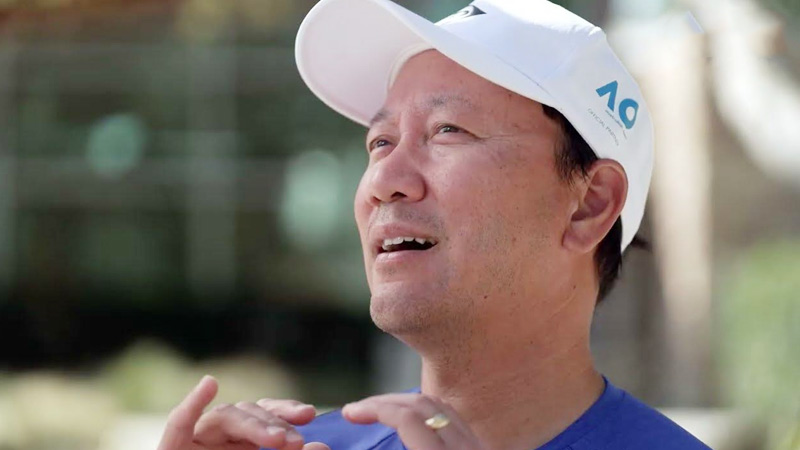
Michael Chang captured 34 ATP Tour-level singles titles throughout his illustrious 16-year career.
While widely celebrated for his historic 1989 French Open victory—making him the youngest male Grand Slam champion at age 17—his trophy cabinet extends far beyond that single major.
Chang secured 7 ATP Masters 1000 titles, 5 ATP 500 series championships, and 19 ATP 250 trophies.
Additionally, he contributed to two significant team championships for the United States, including the 1990 Davis Cup. This impressive tally reflects his status as one of tennis’s most consistent and tenacious baseline competitors.
A Comprehensive Breakdown of Michael Chang’s 34 Titles
Michael Chang’s professional journey was defined by a relentless work ethic and an ability to triumph across diverse global conditions.
His 34 career tournament championships are categorized by the ATP’s competitive tiers, illustrating his capability to win at the highest levels of the sport against legendary contemporaries like Pete Sampras and Andre Agassi.
| Tournament Category | Titles Won | Key Performance Highlights |
|---|---|---|
| Grand Slam Majors | 1 | 1989 French Open Champion |
| ATP Masters 1000 | 7 | 3 titles at Indian Wells; 2 at Cincinnati |
| ATP 500 Series | 5 | Includes three consecutive China Open wins |
| ATP 250 Series | 19 | Victories in Hong Kong, Los Angeles, and Atlanta |
| Team Championships | 2 | 1990 Davis Cup and 1993 Hopman Cup |
How Many Major Titles Did Michael Chang Win?
While Chang was a perennial threat at every Grand Slam he entered, his ultimate success at the major level is defined by one historic victory and several agonizingly close finishes.
He reached a total of four Grand Slam singles finals during his career, showcasing a consistency that kept him near the top of the rankings for over a decade.
The Historic 1989 French Open Triumph
The centerpiece of Chang’s career occurred at Roland Garros in 1989. At just 17 years and 109 days old, he defeated Stefan Edberg in a grueling five-set final.
This victory etched his name into the record books as the youngest male player in history to win a Grand Slam singles major, a record that remains standing today.
His path to the title involved overcoming immense physical and psychological hurdles, proving his championship mettle at an incredibly young age.
Grand Slam Runner-Up Finishes
Beyond his victory in Paris, Chang reached three additional Grand Slam finals where he finished as the runner-up. In 1995, he returned to the French Open final but fell to Thomas Muster.
The following year, 1996, proved to be one of his most consistent at the majors, as he reached the finals of both the Australian Open and the US Open.
In those matches, he was defeated by Boris Becker and Pete Sampras, respectively, illustrating the high level of competition he faced during the “golden era” of American tennis.
Mastery of the ATP Masters 1000 Series
The ATP Masters 1000 events represent the most prestigious tier of tournament tennis outside of the Grand Slams.
Chang’s ability to secure seven of these titles is a testament to his elite status and his ability to defeat top-ranked opponents in week-long, high-intensity brackets.
Dominance at Indian Wells and Cincinnati
Chang found particular success at specific venues that suited his movement and tactical precision. He won the Indian Wells Masters three times, with victories in 1992, 1996, and 1997.
His success in the desert was mirrored by his performance in the Midwest, where he captured two titles at the Cincinnati Masters in 1993 and 1994.
These recurring victories at the same prestigious sites highlight his ability to master specific court conditions and maintain peak performance year after year.
Victory in Miami and Canada
In addition to his multiple titles in California and Ohio, Chang expanded his resume with wins at other major North American stops. He captured the Miami Masters in 1992, an event often referred to as the “fifth major” due to its prestige and draw size.
Earlier in his career, in 1990, he secured the Canada Masters title in Toronto, further establishing his dominance on the hard court summer circuit.
These seven Masters titles collectively represent a significant portion of his 34 career wins and provided the ranking points necessary to propel him to a career-high of World No. 2.
Michael Chang’s Surface Efficiency and Performance Data
One of the most revealing aspects of Chang’s statistical legacy is the disparity between his most famous win and his most successful playing surface.
While the red clay of Paris provided his greatest milestone, his grinding, counter-punching style was mathematically most effective on faster surfaces where his speed and conditioning could wear down opponents.
| Playing Surface | Career Titles Won | Statistical Distribution |
|---|---|---|
| Hard Courts | 22 | 64.7% of total titles |
| Carpet (Indoor) | 8 | 23.5% of total titles |
| Clay Courts | 4 | 11.8% of total titles |
| Grass Courts | 0 | 0% of total titles |
This data clarifies a common misconception about Chang’s career. Although he was a Master of the clay in 1989, his primary success came on hard courts, where he won 22 of his 34 titles.
His speed and defensive baseline skills allowed him to neutralize power hitters on faster courts, making him a versatile threat across the global tour.
What Was Michael Chang’s Biggest Win?
While the victory over Edberg in the 1989 final secured the trophy, many analysts and fans consider a different match from that same tournament to be the defining moment of his career.
His Fourth Round upset of the World No. 1 is widely regarded as his most significant and legendary performance.
Psychological Warfare Against Ivan Lendl
Facing top-seeded and reigning champion Ivan Lendl, a teenage Chang found himself down two sets and suffering from severe, agonizing leg cramps.
To compensate for his lack of mobility, he employed unprecedented tactical shifts, including hitting slow, high “moonballs” to disrupt Lendl’s rhythm.
Most famously, he delivered a shocking underhand serve that mentally rattled Lendl, and even stood directly at the service line to receive a second serve on match point.
The Impact of the Lendl Upset
This 4-6, 4-6, 6-3, 6-3, 6-3 comeback victory is more than just a statistical win; it is a piece of tennis folklore. The match demonstrated Chang’s psychological and physical defiance, proving that he could win through sheer willpower when his body was failing.
This upset provided the momentum and belief necessary for him to continue through the draw and eventually claim the historic title.
A Chronological Timeline of ATP Tournament Victories
Spanning from 1988 to 2000, Chang’s 34 titles were spread across thirteen seasons. This timeline showcases his longevity and his ability to win titles in both the early and late stages of his professional life.
- 1988 (1 title): San Francisco
- 1989 (2 titles): French Open, London Indoor
- 1990 (1 title): Toronto (Canada Masters)
- 1991 (1 title): Birmingham
- 1992 (3 titles): San Francisco, Indian Wells Masters, Miami Masters
- 1993 (5 titles): Jakarta, Osaka, Cincinnati Masters, Kuala Lumpur, Beijing
- 1994 (6 titles): Jakarta, Philadelphia, Hong Kong, Atlanta, Cincinnati Masters, Beijing
- 1995 (4 titles): Hong Kong, Atlanta, Tokyo Indoor, Beijing
- 1996 (3 titles): Indian Wells Masters, Washington D.C., Los Angeles
- 1997 (5 titles): Memphis, Indian Wells Masters, Hong Kong, Orlando, Washington D.C.
- 1998 (2 titles): Boston, Shanghai
- 2000 (1 title): Los Angeles (His 34th and final career title)
Professional Team Achievements and Davis Cup Success
Michael Chang’s impact on the sport extended to team formats, where he was a vital asset for the United States.
His ability to perform under pressure made him a key selection for international competitions, where he added two more major championships to his resume.
The 1990 Davis Cup Victory
In 1990, Chang was a core member of the winning United States Davis Cup team. Representing one’s country in the Davis Cup is considered one of the highest honors in tennis, and Chang’s contributions were essential in securing the trophy for the U.S. that year.
The 1993 Hopman Cup Title
Chang also found success in the Hopman Cup, an international mixed-team competition. In 1993, he helped lead the United States to another team title, further demonstrating his versatility and his value as a team player beyond individual singles competition.
Frequently Asked Questions About Michael Chang’s Career
Has Michael Chang ever been ranked number one?
No, Michael Chang never reached the World No. 1 ranking during his career. His peak position was World No. 2, which he achieved on September 9, 1996. He held this position for 11 weeks during an era dominated by his countryman, Pete Sampras.
What was the breakdown of his finals appearances?
Over his 16-year career, Chang reached a total of 58 singles finals. He was highly efficient in these pressure situations, winning 34 of those matches (a 58.6% win rate) and finishing as the runner-up in 24 instances.
Which region of the world saw his most consistent success?
While he won titles globally, Chang was particularly dominant in Asia. He won the China Open in Beijing three consecutive times from 1993 to 1995 and captured multiple titles in locations like Hong Kong, Jakarta, and Tokyo.
The Lasting Statistical Legacy of an American Icon
Michael Chang retired with a legacy defined by “firsts” and “youngests.” His 34 ATP titles place him among the elite players of his generation, but it is the nature of those wins—the grit shown against Lendl, the record-breaking age in Paris, and the consistent excellence on hard courts—that truly defines his career.
He remained a top-tier competitor for over a decade, reaching his final professional milestone in 2000. For students of the game, Chang remains the ultimate example of how speed, mental toughness, and tactical intelligence can overcome size and power on the world stage.