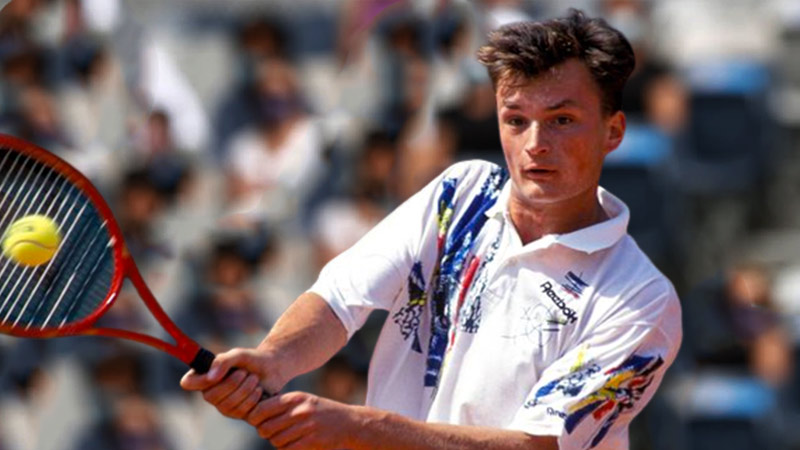
Alexander Volkov is famous in tennis for being the foundational architect of modern Russian success, a 1993 US Open semifinalist, and the elite coach who guided Marat Safin to the world No. 1 ranking.
His “giant-killer” reputation was cemented in 1990 when he stunned world No. 1 Stefan Edberg in straight sets at the US Open.
Beyond individual titles in Milan, Auckland, and Moscow, Volkov is celebrated for his incredible resilience, successfully switching from right-handed to left-handed play after a severe injury. His legacy endures through his mentorship and pivotal Davis Cup leadership.
What Are Alexander Volkov’s Greatest Career Achievements?
Alexander Volkov’s career was defined by his ability to rise to the occasion on the biggest stages of the professional tour.
He was not merely a participant in the golden era of 1990s tennis; he was a disruptor who consistently challenged the dominance of established world leaders.
His achievements provided the necessary proof to a burgeoning Russian tennis community that they could compete with and defeat the very best in the world.
The Historic 1990 US Open Upset
The tennis world was sent into a state of shock during the first round of the 1990 US Open when Volkov faced the top-seeded Stefan Edberg. Edberg, the reigning world No. 1, was expected to cruise through the early rounds, but Volkov had other plans.
In a clinical display of power and precision, Volkov dismantled the top seed in straight sets, finishing with a scoreline of 6–3, 7–6, 6–2.
This victory was statistically significant, as Volkov became the first player since 1971 to defeat the top-seeded man in the opening round of the US Open.
This match single-handedly established his reputation as a “giant-killer” and remains one of the most cited upsets in the history of the tournament.
Reaching the 1993 US Open Semifinals
While the 1990 upset was a flash of brilliance, his 1993 run at Flushing Meadows proved his sustained elite level. Volkov navigated a difficult draw, culminating in a dominant performance against Thomas Muster to reach his first and only Grand Slam semifinal.
Although he eventually fell to the legendary Pete Sampras—who would go on to win the title—Volkov’s presence in the final four of a major tournament was a landmark moment for Russian sports.
This achievement propelled him to his career-high singles ranking of world No. 14 in August 1993, a testament to his consistency among the world’s elite.
Success on the ATP Tour: Three Major Titles
Volkov’s talent translated into three prestigious ATP singles titles across different surfaces, showcasing his versatility as a competitor. His first title came in 1991 in Milan, where he defeated Cristiano Caratti on carpet.
He followed this with a hard-court victory in Auckland in 1993, defeating MaliVai Washington in a gritty three-set battle. Perhaps his most emotional victory occurred in 1994 at the Kremlin Cup in Moscow.
Defeating Chuck Adams in the final, Volkov claimed a title on home soil, further cementing his status as a national hero and the premier face of Russian tennis during that era.
How Did Alexander Volkov Overcome a Career-Threatening Injury?
The narrative of Alexander Volkov is inseparable from his journey of physical resilience. Many athletes define their careers by their statistics, but Volkov’s career was defined by his refusal to let a catastrophic accident dictate his future in the sport.
His transition from a right-handed prospect to a left-handed professional is often cited as one of the most remarkable adaptations in modern athletic history.
The Accident and the Hand Switch
At the age of 15, a period when most professional prospects are honing their primary skills, Volkov suffered a severe accident that resulted in a broken right shoulder. The injury was so debilitating that his future as a right-handed player was effectively over.
Rather than abandoning the sport, Volkov made the radical decision to switch his playing hand. This required a complete rewiring of his muscle memory and tactical approach, essentially forcing him to relearn the mechanics of the game from scratch as a southpaw.
Mastering the Left-Handed Serve
The pivot to left-handed play eventually became Volkov’s greatest tactical advantage. He spent years meticulously mastering a powerful left-handed serve that featured unique angles and spins, which proved exceptionally difficult for even the best returners on the tour to read.
By the time he turned professional in 1988, his “new” left hand was a weapon that allowed him to compete at the highest levels.
This adaptation was so successful that he finished six consecutive seasons in the world Top 50 between 1990 and 1995, a feat that highlighted his incredible durability and technical mastery.
Alexander Volkov’s Career Statistics and Milestones
To understand the depth of Volkov’s impact, one must look at the data that defined his decade-long tenure on the ATP Tour.
His statistical profile reflects a player who was not only capable of high peaks but also maintained a high standard of play across hundreds of matches.
| Milestone Metric | Official Statistic / Detail |
|---|---|
| Career-High Ranking | World No. 14 (August 1993/1994) |
| Overall Win-Loss Record | 303 Wins – 255 Losses (54.3% win rate) |
| Total Career Titles | 3 Singles Titles (Reached 11 Finals) |
| Top 10 Victories | 17 Career Wins over Top 10 Opponents |
| Career Prize Money | $3,362,840 |
| Service Games Won | 76% (Based on ATP Tour metrics) |
| Aces Served | 1,956 career aces |
| Grand Slam Consistency | Reached 4th Round or better at all majors except Roland Garros |
Why Is Alexander Volkov Considered the Architect of Russian Tennis?
Volkov is frequently referred to as the “architect” or “foundational pillar” of Russian tennis because he built the infrastructure for success that subsequent generations enjoyed.
Before the era of multiple Russian Grand Slam champions, Volkov was the one setting the precedents and providing the leadership necessary to transform a national program into a global powerhouse.
Leading the National Davis Cup Team
Volkov’s commitment to his country was most evident in his Davis Cup performances. Alongside Yevgeny Kafelnikov, he was instrumental in leading Russia to its first two Davis Cup Finals in 1994 and 1995.
These runs were cultural milestones in Russia, demonstrating that the nation could compete as a collective unit against the established tennis powers of the West.
His leadership during these campaigns established a tradition of excellence in team competition that continues to define Russian tennis to this day.
Mentoring Marat Safin to World No. 1
Perhaps Volkov’s greatest contribution to the sport came after his retirement in 1998. Transitioning into an elite coaching role, he took a young and mercurial Marat Safin under his wing.
Volkov’s technical knowledge and experience at the highest levels were vital in refining Safin’s immense talent.
This partnership reached its zenith at the 2000 US Open, where Safin defeated Pete Sampras in a dominant final to claim the championship and eventually reach the world No. 1 ranking.
By guiding Safin to the pinnacle of the sport, Volkov proved he could transmit his “architectural” vision to the next generation, ensuring a lasting legacy.
Iconic Rivalries and Historical Tennis Moments
Volkov’s career is punctuated by moments that are etched into the broader history of the sport. He was often the common denominator in matches that marked the end of eras or served as turning points for other legends.
These moments highlight his role as a bridge between the classic era of tennis and the modern, high-powered game.
Ending the Career of Björn Borg
In 1993, the legendary Björn Borg attempted a brief and highly publicized comeback to the professional tour.
At the Kremlin Cup in Moscow, Volkov was drawn as Borg’s opponent in the first round. In a competitive match that went to a third-set tiebreak, Volkov emerged victorious with a 4–6, 6–3, 7–6 win.
This match would officially become the final professional singles appearance of Borg’s historic career. While it was a difficult moment for Borg fans, it was a significant win for Volkov, showing his ability to maintain composure against a sporting icon on home soil.
The 1991 Wimbledon Heartbreak Against Michael Stich
One of the most famous matches of Volkov’s career was a 1991 Wimbledon fourth-round encounter against Michael Stich.
Volkov was serving for the match in the fifth set when a legendary, lucky net-cord shot by Stich flipped the momentum. Stich went on to win that match and eventually the entire Wimbledon championship.
Despite the loss, the match became a part of Wimbledon lore, and Volkov’s performance against the eventual champion solidified his status as one of the most dangerous and skilled grass-court players of his time.
Frequently Asked Questions About Alexander Volkov
What was Alexander Volkov’s highest ranking?
Alexander Volkov reached a career-high singles ranking of world No. 14, achieving this mark in August 1993 and maintaining a strong presence in the top tier of the sport for several years.
Who did Alexander Volkov coach?
Most notably, Volkov coached Marat Safin. Under Volkov’s guidance, Safin won the 2000 US Open and became the world No. 1. Volkov also served as a national team captain for Russia.
What is Alexander Volkov’s most famous win?
His most famous victory was his 1990 US Open first-round upset of world No. 1 Stefan Edberg, where he won in straight sets. He is also remembered for being the final professional opponent of Björn Borg.
How did Alexander Volkov die?
Alexander Volkov passed away in 2019 at the age of 52. He is remembered as a permanent legacy and a foundational pillar of Russian men’s tennis.
The Enduring Impact of a Tennis Pioneer
The story of Alexander Volkov is one of profound transformation and unwavering dedication. From the moment he chose to play with his “wrong” hand to the day he watched his pupil, Marat Safin, lift a Grand Slam trophy, Volkov remained a man of quiet but immense influence.
He did not just play matches; he built a roadmap for an entire nation to follow. His 17 victories over Top 10 opponents and his three ATP titles are significant, but they are only a fraction of the total picture.
Volkov’s life serves as a reminder that the path to greatness is rarely linear. It requires the resilience to adapt to physical limitations and the vision to see the potential in others.
Today, every Russian player who steps onto a major court owes a debt of gratitude to the man who first proved that the top of the rankings was a destination within their reach. Alexander Volkov was, and remains, the architect of Russian tennis glory.