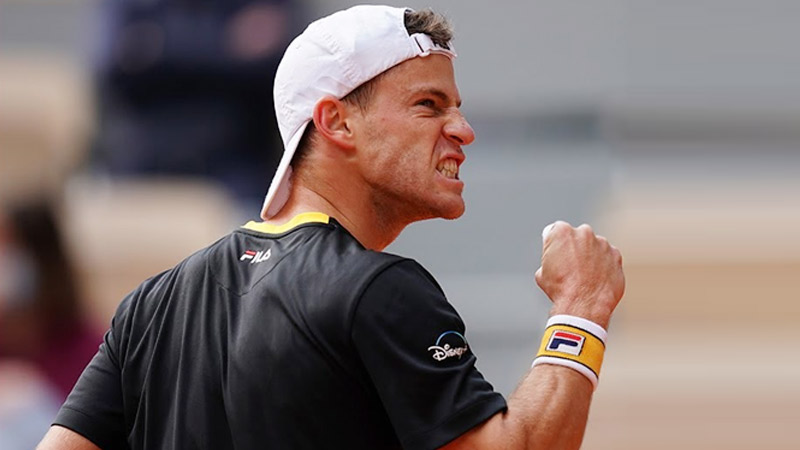
Diego Schwartzman was an elite, world-class professional tennis player who defied physical norms to reach a career-high ranking of world No. 8 in 2020.
Standing just 5’7″, the Argentine star, nicknamed “El Peque,” built a 15-year career defined by relentless grit and a legendary return game.
He proved that height is not a barrier to excellence, capturing four ATP titles and recording 13 wins over top-10 opponents, including Rafael Nadal.
Before retiring in February 2025, Schwartzman cemented his status as one of the tour’s most respected competitors, earning over €12.5 million in prize money.
Key Career Milestones of Diego Schwartzman
To understand how high “El Peque” climbed, one must look at the sheer consistency of his results across all surfaces and major tournaments.
Despite the era of big-serving giants, Schwartzman remained a mainstay in the deep rounds of the world’s most prestigious events.
| Achievement / Metric | Detail |
|---|---|
| Highest Singles Ranking | World No. 8 (October 2020) |
| ATP Singles Titles | 4 (Istanbul, Rio, Los Cabos, Buenos Aires) |
| Best Grand Slam Result | Semifinals (Roland Garros 2020) |
| Total Career Prize Money | €12.5 Million |
| Top 10 Wins | 13 Career Victories |
| Unique Stat | Shortest man in the Top 10 since 1981 |
Breakthrough into the Global Top 10
The year 2020 served as the pinnacle of Schwartzman’s professional journey. By breaking into the global Top 10, he shattered a decades-old ceiling for shorter players in professional tennis.
This achievement was not merely a flash in the pan; it was the result of a decade of grinding through the Challenger circuit and slowly ascending the ATP rankings.
His qualification for the year-end ATP Finals in London that same season served as a definitive stamp of approval, placing him among the elite eight players on the planet.
Consistency at the Grand Slam Level
While many players specialize in a single surface, Schwartzman’s game was surprisingly adaptable. His best Major result was reaching the semifinals at Roland Garros in 2020, but his prowess extended beyond the clay.
He reached the quarterfinals of the US Open twice, in 2017 and 2019, showing that his elite movement and return game could neutralize big hitters on fast hard courts.
Additionally, his two appearances in the round of 16 at the Australian Open further highlighted his status as a threat at every stop on the calendar.
How Did Diego Schwartzman Overcome His Height Disadvantage?
Because his stature limited his maximum serve speed—which usually averaged between 100–105 mph—Schwartzman was forced to master every other technical facet of the game to remain competitive.
He turned what many considered a weakness into a tactical identity centered on speed and precision.
The Goldmine of an Elite Return Game
Schwartzman is widely considered one of the greatest returners in the history of the sport. Statistically, he was a dominant force, routinely leading the ATP Tour in categories such as second-serve return points won and break points converted.
Between 2017 and his retirement, he was consistently ranked in the top three for almost all return-related statistics.
In 2019, he even secured the number one spot as the tour’s best returner, a feat that allowed him to compete with legendary defenders like Rafael Nadal and Novak Djokovic.
Leveraging Acceleration and a Low Center of Gravity
Physics played a significant role in Schwartzman’s success on the court. While taller players may have a longer reach, shorter players often possess a lower center of gravity, which facilitates superior acceleration and agility.
A useful comparison is that of a small sports car versus a large, powerful truck; the sports car is often faster on a twisty racetrack because it can change directions with much higher efficiency.
This allowed Schwartzman to reach balls earlier than his opponents expected, turning defensive scrambles into offensive opportunities.
Exceptional Peripheral Vision and Tactical Reading
Beyond physical speed, Schwartzman possessed an elite ability to read his opponents’ intentions. This was largely attributed to his excellent peripheral vision, which was particularly noticeable during net exchanges and when tracking overheads.
By processing visual cues faster than most, he could anticipate the direction of a shot and begin his movement before the ball had even left the opponent’s racket.
This “no weakness” approach made him a nightmare for the mid-tier of the ATP Tour, who found it nearly impossible to hit through him.
Why Was Diego Schwartzman Called the “Giant Slayer”?
The nickname “Giant Slayer” was not just a reference to his height; it was earned through his remarkable record against the most decorated players in tennis history.
Throughout his career, he racked up 13 victories over Top-10 opponents, proving he could trade punches with anyone.
The Iconic Victory Over Rafael Nadal in Rome
Perhaps the most famous moment of Schwartzman’s career occurred during the 2020 Italian Open in Rome. Facing the “King of Clay,” Rafael Nadal, Schwartzman delivered a masterclass in baseline aggression.
He shocked the world by defeating Nadal in straight sets, a feat very few players have ever accomplished on a clay court.
This match demonstrated that when his timing and speed were perfectly synchronized, even the greatest clay-courter in history could not find a way past his defenses.
Dominating the Baseline Against Elite Power Hitters
Schwartzman’s list of victims includes a “who’s who” of modern tennis stars. He held career wins over Marin Cilic, Dominic Thiem, and Alexander Zverev.
These players are known for their massive serves and heavy groundstrokes, yet Schwartzman’s ability to take the ball early and hit high-quality targets relentlessly allowed him to neutralize their power.
He was not merely a “retriever” who waited for errors; he was an aggressive player who could create insane angles, especially from his backhand wing, to dictate the flow of the rally.
The Strategic Foundation of the Red Clay Courts
The development of a player like Schwartzman is often tied to the surface they were raised on. Experts suggest that his specific brand of tennis—characterized by point construction and dependable ball striking—is a product of the slow clay courts common in Argentina.
- Generating Self-Paced Power: Playing on clay requires athletes to generate their own “pop” on the ball repeatedly. This years-long process gave Schwartzman the ability to hit heavy shots that translated effectively to faster surfaces.
- Defensive Mastery: The slow nature of clay encourages longer rallies, which honed his unmatched stamina and mental toughness.
- Precision and Angles: On clay, hitting through an opponent is difficult, forcing a player to develop a high-target-hitting mentality similar to legends like David Ferrer.
- Physical Conditioning: The grueling nature of best-of-five-set matches on clay prepared him for the physical demands of Grand Slam tennis.
The Final Set: Retirement at the 2025 Argentina Open
The conclusion of Schwartzman’s career in early 2025 marked a poignant moment for the sport. Choosing to say goodbye at his home tournament in Buenos Aires allowed him to celebrate a legacy that went far beyond the win-loss column.
Closing the Chapter in Buenos Aires
Retiring at the Argentina Open was a fitting end for a player who wore his national pride on his sleeve. Throughout his 15 years on the tour, he remained a symbol of Argentine resilience.
His final tournament was an emotional affair, attended by fans who had watched him grow from a promising youngster into a global Top 10 star.
His retirement leaves a void on the tour for a player who competes with that specific brand of “Peque” energy—fearless, tireless, and technically flawless.
A Lasting Blueprint for Smaller Players
Schwartzman’s career serves as a masterclass for any aspiring tennis player who does not fit the typical physical prototype of the modern game.
He proved that by focusing on specialized areas—such as the return game, peripheral vision, and baseline stamina—a “short” player can not only compete but dominate.
He was often compared to Nikolay Davydenko for his clean ball striking and high-speed baseline play, providing a blueprint for how to use timing and positioning to negate an opponent’s physical reach.
Frequently Asked Questions About Diego Schwartzman
When did Diego Schwartzman retire?
He officially retired from professional tennis in February 2025 at the Argentina Open, his home tournament in Buenos Aires.
What was his highest ATP ranking?
Schwartzman reached a career-high of world No. 8 in October 2020.
How many ATP titles did he win?
He captured four ATP Tour singles titles during his 15-year career.
Who was his most famous win against?
His straight-sets victory over Rafael Nadal on clay in Rome is widely considered his most significant career win.
Is height a major disadvantage in modern tennis?
While height helps with serve speed and reach, Schwartzman proved that elite return stats, superior acceleration, and mental toughness can bridge the gap.
Conclusion: Why Diego Schwartzman Matters
Diego Schwartzman was much more than just a successful tennis player; he was a living testament to the power of tactical intelligence and work ethic.
By finishing his career with 13 top-10 wins and over €12.5 million in prize money, he proved that greatness is not measured in inches. His ability to stand toe-to-toe with the giants of the game and emerge victorious earned him a permanent place in tennis history.
As the sport continues to trend toward taller and more powerful athletes, the legacy of “El Peque” will remain a vital reminder that precision, speed, and a “giant-slaying” heart can still conquer the world stage.
For any fan of the underdog, Schwartzman wasn’t just good—he was an inspiration.