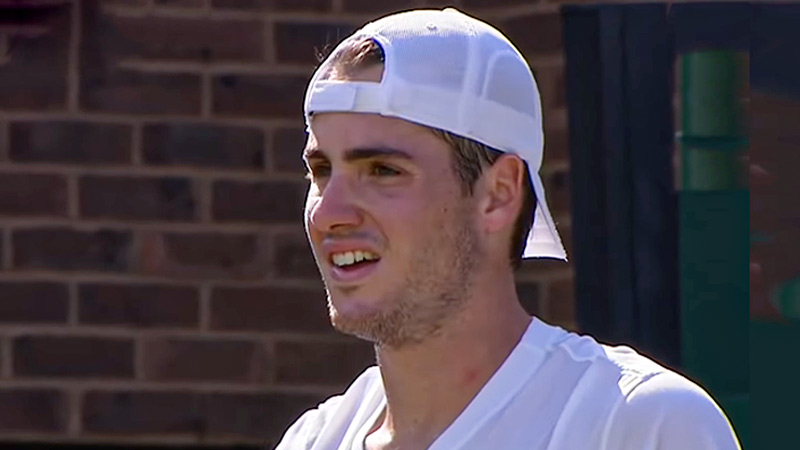
John Isner officially retired from professional tennis in August 2023, following his final matches at the US Open. After an illustrious 17-year career, the 6-foot-10 American stepped away at age 38 to prioritize family life in Dallas, Texas, with his wife and four children.
Today, Isner remains a prominent figure in the tennis world as a high-level analyst, commentator, and co-host of the popular Nothing Major podcast.
He leaves behind a historic legacy, including the all-time ace record, the fastest official serve, and victory in the longest professional match ever played.
The Defining Moment: Breaking Down the Longest Match in Tennis History
John Isner’s name is permanently etched into the record books for a feat of endurance that may never be repeated in professional sports.
While his career was filled with titles, one specific match at Wimbledon defined his tenacity and forced the entire sport to rethink its scoring structures.
The 11-Hour Marathon Against Nicolas Mahut
At Wimbledon 2010, John Isner and Nicolas Mahut engaged in a grueling battle that lasted 11 hours and 5 minutes.
The match was so physically demanding that it had to be spread over three consecutive days to allow the players to recover enough just to stand on the court.
The final set alone reached a surreal scoreline of 70-68 in favor of Isner, making it the longest match in the history of tennis by a significant margin.
This victory showcased Isner’s incredible mental fortitude and physical stamina, proving that his game was built on much more than just a powerful serve.
How Isner Triggered Global Grand Slam Rule Changes
The fallout from the Isner-Mahut marathon was so significant that it fundamentally altered the rules of the game.
Governing bodies realized that such matches were not only detrimental to the health of the athletes but also created logistical nightmares for tournament scheduling.
Consequently, this monumental match served as the primary trigger for an eventual rule change across all four Grand Slams.
Today, every major tournament implements a final-set tiebreak to ensure that matches cannot continue indefinitely, ensuring that Isner’s 70-68 fifth set will remain an unbreakable piece of tennis history.
Analyzing the All-Time ATP Ace Record and Serving Dominance
If there is one aspect of John Isner’s game that defined his professional identity, it was his serve. Standing at nearly seven feet tall, he used his height to create angles and leverage that were virtually impossible for opponents to read, leading to records that may stand for generations.
Reaching the 14,470 Career Ace Milestone
Throughout his 17 years on the ATP Tour, John Isner became the ultimate “Ace King.” He holds the official record for the most career aces in the history of the sport, finishing his journey with a staggering 14,470 unreturnable serves.
This volume of aces allowed him to hold serve with unprecedented ease, often putting immense pressure on his opponents to be perfect on their own service games.
His ability to hit aces on both first and second serves made him one of the most feared competitors on any surface, particularly during high-pressure moments.
The Mechanics Behind the 157.2 MPH Fastest Serve
Beyond the sheer volume of aces, Isner also possessed raw, explosive power. During a 2016 Davis Cup tie, he clocked the fastest official serve ever recorded by the ATP Tour at 157.2 mph (253 km/h).
This wasn’t just a matter of physical strength; Isner revolutionized how extreme leverage and height are used to generate a downward bounce that often saw the ball jump over the heads of his opponents after hitting the court.
This mechanical advantage allowed him to remain a Top 20 player for ten consecutive seasons.
A Decade of Consistency: American Tennis Leadership
John Isner was more than just a record-breaker; he was the steady anchor of American men’s tennis for nearly two decades. His career can be viewed through several distinct eras of growth and dominance.
| Era | Key Milestones & Career Shifts | Notable Legacy Impact |
|---|---|---|
| 2007 – 2009 | Turned pro after a historic NCAA career at the University of Georgia; upset Andy Roddick at the 2009 US Open. | Established himself as a dangerous giant capable of taking down elite players early in his career. |
| 2010 – 2017 | Won first ATP titles; played the 11-hour Wimbledon marathon; consistently ranked in the Top 20. | Revolutionized the use of height and leverage to generate unreturnable bounce on serves. |
| 2018 – 2022 | Won Miami Masters; reached Wimbledon semifinals; broke the all-time ace record in 2022. | Proved that big-serving players could adapt and dominate even late into their 30s. |
| 2023 | Hit his 500th career tiebreak milestone; retired at the US Open against Michael Mmoh. | Left the sport holding the two most unbreakable serving records in tennis history. |
What is John Isner Doing Now? Life After the ATP Tour
Since walking away from competitive singles and doubles at the 2023 US Open, Isner has not distanced himself from the sports world. Instead, he has successfully transitioned into a multi-faceted career in media and alternative competitive sports.
The Success of the Nothing Major Podcast
John Isner has found a second calling as a media personality and content creator. Alongside fellow former American stars Sam Querrey, Steve Johnson, and Jack Sock, he co-hosts the Nothing Major podcast.
The show has become a favorite among fans for its “unfiltered” and humorous take on the modern game.
On the podcast, Isner provides expert breakdowns of current stars like Jannik Sinner and Carlos Alcaraz, offering the kind of deep tactical insight that only a former World No. 8 can provide.
Transitioning into Professional Pickleball and Media Analysis
Beyond his work as a commentator and analyst for major networks, Isner has stayed physically active by picking up competitive Pickleball.
This transition mirrors a growing trend among former tennis professionals who find that their skills translate well to the smaller court.
Additionally, he remains a passionate advocate for improving professional tennis structures, often using his platform to discuss how the tour can better support its players.
Despite these professional endeavors, his primary focus remains his family in Dallas, Texas, where he spends time with his wife and four children.
The Global Influence of the Isner Service Motion
John Isner’s impact is not limited to his own statistics; it is visible in the technique of the current generation of world-class players. His serve has become a blueprint for success in the modern, power-driven era of tennis.
Direct Inspiration for World No. 1 Jannik Sinner
Perhaps the most surprising testament to Isner’s legacy is his influence on the current World No. 1, Jannik Sinner.
It was revealed by tour stars Madison Keys and Jessica Pegula that Sinner heavily modified his service motion by taking direct inspiration from Isner’s historic mechanics.
Sinner’s evolution into a dominant force on the ATP Tour is partly credited to these mechanical adjustments, proving that Isner’s technical approach to the serve is being studied and replicated by the elite of the game.
Proving Career Longevity for Big Servers
Before Isner, many analysts believed that players of his stature (6’10”) would struggle with long-term health and mobility as they aged.
Isner shattered this stereotype by remaining a Top 20 American player for ten consecutive seasons and winning his biggest title, the Miami Open, at age 32.
He proved that with the right serve-centric game style and physical conditioning, a player can remain elite well into their late 30s, paving the way for other tall players to have extended careers on the tour.
Frequently Asked Questions About John Isner’s Career
When did John Isner retire?
John Isner retired in August 2023 after playing his final matches at the US Open in both singles and doubles.
Why did John Isner stop playing tennis?
At age 38, he chose to step away from the grueling travel schedule of the ATP Tour to focus on his family life with his wife and four children in Dallas.
What is John Isner’s all-time ace record?
He holds the record for the most career aces in ATP history with 14,470.
Who did John Isner play in the longest match ever?
He defeated Nicolas Mahut at Wimbledon 2010 in a match that lasted 11 hours and 5 minutes, ending 70-68 in the fifth set.
How many titles did John Isner win?
He captured 16 career singles titles, including the 2018 Miami Open Masters 1000.
What is the “Nothing Major” podcast?
It is a popular tennis podcast co-hosted by Isner, Sam Querrey, Steve Johnson, and Jack Sock that provides expert analysis and humor.
Conclusion: A Legacy That Stands Tall
John Isner’s departure from professional tennis marked the end of an era for American sports. He wasn’t just a “big server”; he was a pioneer who changed the rules of the game at Wimbledon, a model of consistency who anchored American tennis for a decade, and a technical innovator whose serve continues to inspire the world’s best players.
While he has traded the grand stages of the ATP for the microphone and family life in Dallas, his records—especially his 14,470 aces and the 11-hour marathon—stand as monuments to a legendary 17-year journey.
As the next generation of American stars rises, they do so in the shadow of the giant who proved that with the right serve, you can rewrite history.