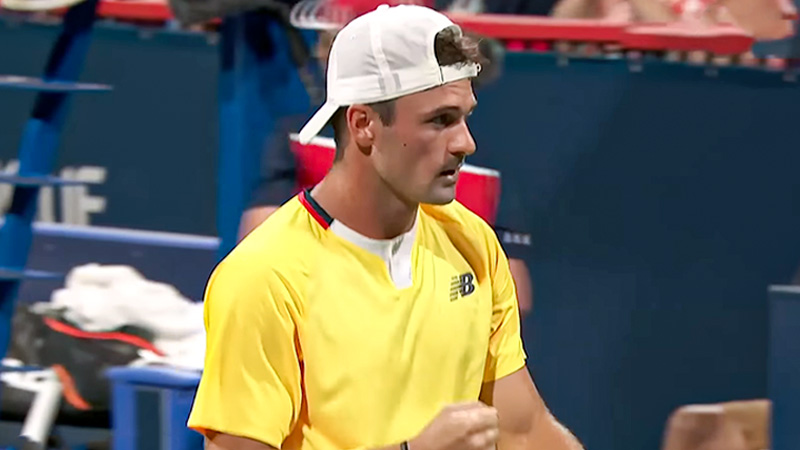
In modern professional tennis, success requires more than raw power or strong baseline play—it demands athleticism, versatility, and tactical intelligence. So, how good is Tommy Paul?
He has established himself as one of the ATP Tour’s top players, highlighted by a career-high singles ranking of World No. 8 and consistent appearances inside the top 20.
Paul’s game is built on explosive movement, precise shot-making, and impressive adaptability across different surfaces and conditions. He can control baseline rallies, counter powerful opponents, and move forward to finish points at the net.
This all-court versatility, combined with his speed and competitive consistency, makes Tommy Paul a formidable opponent at the highest level of men’s tennis.
Physical Foundation: Elite Footwork and Court Coverage
At the heart of Tommy Paul’s success is an athletic foundation that sets the tempo for his entire tactical system.
Superior movement in professional tennis encompasses split-step precision, lateral recovery, directional change, and deceleration mechanics that allow a player to hit with balance even under severe defensive pressure.
Speed and Court Coverage on the ATP Tour
Paul is widely recognized for possessing some of the best court coverage and speed on the ATP Tour. His footwork allows him to shrink the court for opponents, forcing them to play extra balls and hit into narrower target zones.
By covering ground efficiently, he reduces the operational time available to opponents, transforming potentially point-ending winners into manageable baseline returns.
Defensive to Offensive Transitions
Elite movement serves a dual purpose in Paul’s strategic execution:
- Pace Absorption: His ability to track down deep, heavy groundstrokes enables him to reset point dynamics using neutral trajectory and precise placement.
- Immediate Counter-Attacking: Rather than remaining passive when pushed behind the baseline, his speed allows him to take early ball recognition and transition instantly from defense to baseline control.
This dynamic court coverage creates mental pressure on opponents. Knowing that standard point-ending shots will likely be retrieved forces adversaries to push their margins, often inducing unforced errors during extended rallies.
Technical Variety: Deft Touch and Tactical Balance
While elite movement creates opportunity, technical versatility is what converts defense into victory.
Modern baseline tennis can often devolve into repetitive, rhythm-based exchanges, but Paul avoids predictability through a rich, multi-layered shot selection.
Forehand Power Paired with Finesse
A cornerstone of Paul’s offensive toolkit is his forehand, which combines explosive power with subtle touch. On neutral balls, his forehand generates heavy pace and sharp angles that push opponents outside the singles court.
Simultaneously, he exhibits exceptional feel for drop shots and delicate touch play, catching defenders off guard when they expect a hard baseline drive.
Net Play and the Backhand Slice
To break the baseline rhythm of his opponents, Paul employs two critical technical elements:
- Effective Net Play: Paul transitions forward smoothly, utilizing sharp instincts and clean volleying mechanics to close out points at the net. His forward movement is an intentional strategy to capitalize on court position gained through heavy groundstrokes.
- Reliable Backhand Slice: His backhand slice acts as a key tactical variation. By changing the spin, height, and tempo of the ball, the slice disrupts the rhythm of modern topspin baseline players, forcing them to generate their own pace from lower strike zones.
This complete shot-making arsenal ensures that Paul is never reliant on a single pattern of play, allowing him to adapt mid-match against diverse opponent styles.
All-Surface Mastery: Hard, Clay, and Grass
A defining benchmark of an elite tennis player is the ability to adapt core mechanics to varying surface characteristics. Different surfaces alter ball bounce, court friction, and sliding mechanics, requiring structural adjustments in point construction.
Paul has developed into a genuine all-surface threat, crafting competitive strategies optimized for hard courts, clay, and grass alike.
Multi-Surface Adaptability
- Hard Courts: On hard surfaces, his blend of explosive movement, rapid court coverage, and baseline firepower translates into high win rates during high-tempo rallies.
- Clay Courts: On clay, his elite footwork, balance, and patience allow him to slide into shots effectively, construct extended rallies, and utilize his touch play to exploit the slower court speed.
- Grass Courts: On grass, his quick reaction times, low-trajectory slice, and effective net play make him a highly dangerous competitor on fast, low-bouncing surfaces.
Championship Success Across Conditions
Paul’s multi-surface capability is proven by his tournament achievements across different conditions. He has captured multiple ATP singles titles, highlighted by prestigious victories on grass at the Queen’s Club Championships, alongside hard-court title triumphs in Dallas and Stockholm.
Winning ATP titles across distinct surface environments demonstrates that his success is rooted in structural adaptability rather than situational surface preferences.
Major Milestones: Grand Slams and Olympic Glory
Sustained excellence on the professional tour is validated by deep runs at the sport’s most prestigious events.
Paul’s career milestones demonstrate his ability to perform under peak pressure against the highest tier of competition.
Grand Slam Breakthrough: Australian Open Semifinals
A major highlight in Paul’s career came at the 2023 Australian Open, where he produced a standout performance to reach the semifinals.
Competing across demanding rounds of best-of-five-set tennis, his physical endurance, strategic discipline, and tactical versatility were showcased on a global stage.
Reaching the final four of a Grand Slam tournament confirmed his status as a legitimate contender at the highest tier of the sport.
Olympic Podium Success: Paris 2024 Bronze
Paul’s international achievements extend to representing his country on the Olympic stage. At the 2024 Paris Olympic Games, he captured a bronze medal in men’s doubles alongside partner Taylor Fritz.
This podium finish highlighted not only his individual skill set but also his high-level doubles competencies—specifically return accuracy, hand speed at the net, and team coordination—adding prestigious Olympic hardware to his career resume.
Tactical Breakdown: Matching Up Against Tour Archetypes
To fully evaluate how good Tommy Paul is, it helps to examine how his game interacts with the primary player archetypes on the ATP Tour:
- Against Power Servers & Aggressive Hitters: Paul’s court speed and fast-twitch return mechanics allow him to neutralize big serves. By returning balls deep into neutral zones, he extends rallies and forces power hitters into longer exchanges where his movement yields tactical advantages.
- Against Baseline Counter-Punchers: Against patient baseline defenders, Paul leverages his forehand power and deft touch. His ability to shorten points with effective net play or drop shots prevents rallies from grinding down his physical reserves.
- Against Net Attackers: His reliable backhand slice and passing shot precision allow him to dip balls low at the feet of approaching volleyers, forcing uncomfortable defensive responses.
Conclusion & Strategic Summary
Tommy Paul stands out as one of the most complete and versatile competitors in modern men’s tennis. His game is built on a foundation of world-class speed and footwork, elevated by technical variety and an ability to construct points effectively across hard, clay, and grass courts.
With a career-high ranking of world No. 8, multiple ATP titles across varied conditions, a Grand Slam semifinal appearance, and an Olympic bronze medal to his name, Paul has proven that his all-court methodology succeeds at the pinnacle of the sport.
As he continues to refine his game and maintain his physical edge, he remains a dangerous contender capable of deep runs at every major tournament on the calendar.